

If you can trust United States’ President Donald Trump on one thing, it would be his ability to start trade wars through tariff hikes. Acting under the motivation to reduce trade deficits with his country’s trading partners, Trump announced 30% tariffs on solar panels from China in January 2018, in his first term. This happened after the failure of the 100-day trade talks plan between both countries.
In April, Beijing retaliated with 15% duties on steel pipes, wine, nuts, and fruits imported from the United States. China also slapped a 24% tax on U.S. pork and seven other products. The tit-for-tat tariff hikes went at least four more rounds.
Less than two weeks after taking the oath of office for his second term, Trump hit again with sweeping tariffs targeting imports from Chinese manufacturers. After several rounds of tit-for-tat in the new tariff war, the United States and China declared a 90-day truce. The temporary ceasefire—of some sort—saw the rolling back of most of the duties.
What The 90-day Tariff Pause Means For Global Trade
After days of intense tariff wars between the United States and China, both countries agreed to a temporary 90-day truce. Also, the U.S. rolled back its tariff hikes on goods from Chinese manufacturers from 145% to 30%, while Beijing wound down from 125% to 10%. The 90-day pause will elapse in July.
While the U.S. temporarily dropped its reciprocal tariff hikes, the baseline 10% levies on goods from all countries coming into the United States will remain. This means importers and consumers will still pay slightly more for overseas goods.
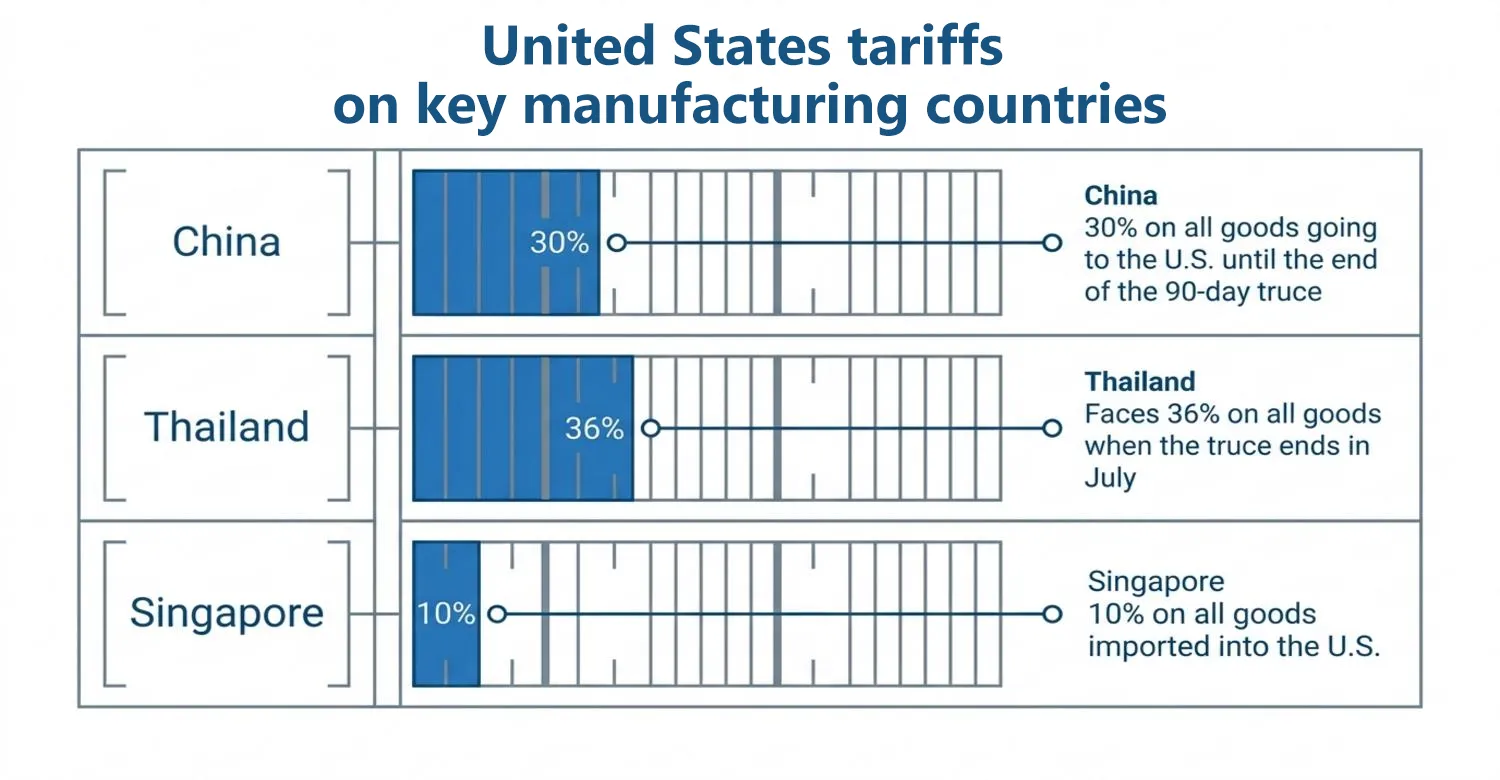
United States tariffs on key manufacturing countries
| Country | Tariff |
|---|---|
| Mexico/ Canada | 25% on goods not covered under the USMCA trade pact* 10% on energy and potash |
| China | 30% on all goods going to the U.S. until the end of the 90-day truce (or breakdown of negotiations) |
| Thailand | Faces 36% on all goods when the truce ends in July |
| Singapore | 10% on all goods imported into the U.S. |
*Agriculture and food, electrical equipment, electronic manufacturing, clothing and footwear, chemicals, machinery and equipment, and medical devices and pharmaceuticals are all covered by the USMCA and enjoy a 0% tariff.
U.S. manufacturers that rely on Chinese technology companies can temporarily heave a sigh of relief. The truce also paves the way for talks between delegates of both countries. However, there is no guarantee that President Trump will not unilaterally announce new levies before the 90-day truce expires.
The Soaring Manufacturing Costs vs Tariff Hikes Dilemma
According to President Trump, the goal of tariff hikes is to force manufacturers to localize their operations in the United States. The President believes that it is the only way to create jobs for the teeming American population.
Consequently, U.S. manufacturers must choose one of two options. They either localize their operations and deal with the high domestic labor and rental costs or work with Chinese technology companies and Southeast Asian suppliers and pay higher levies.
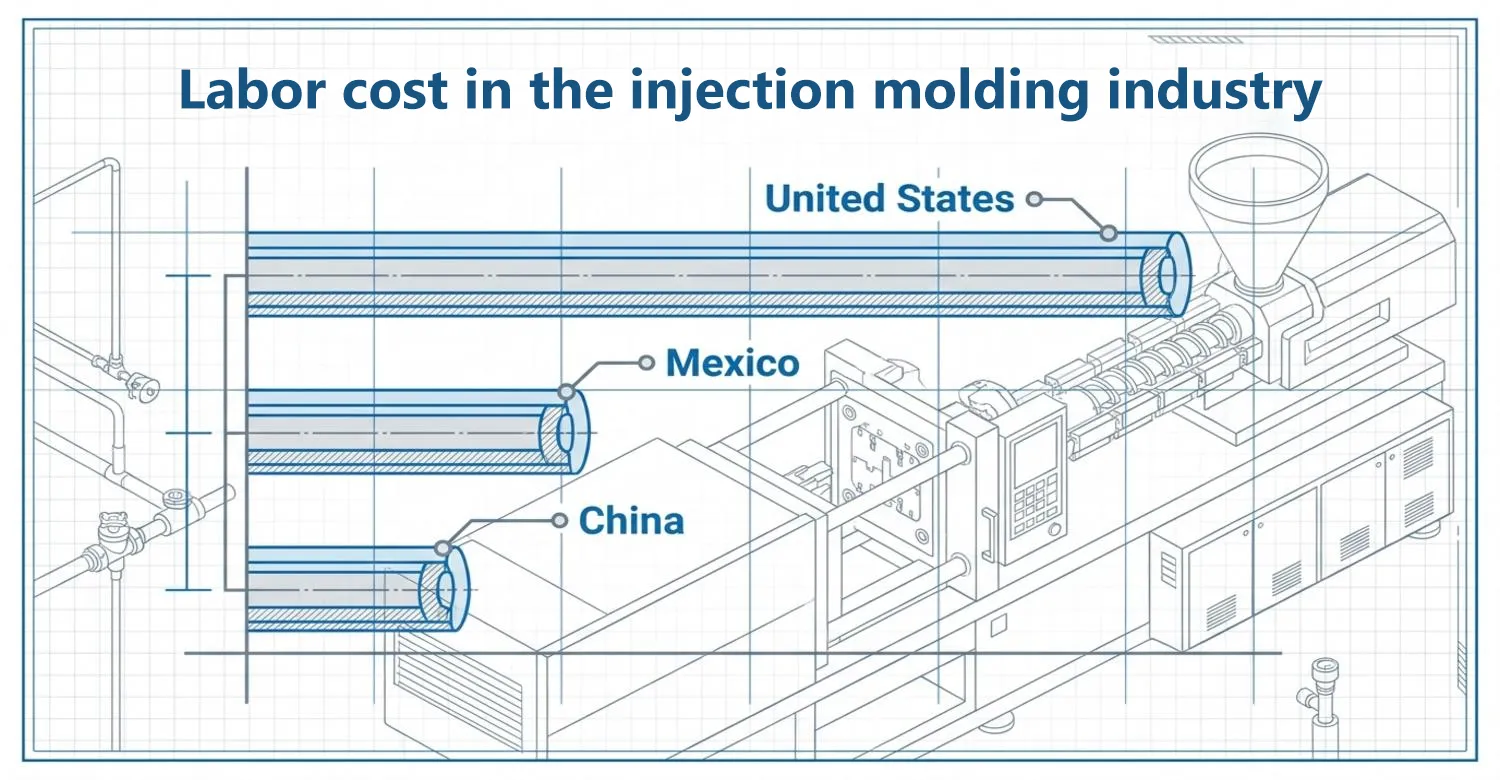
Labor cost in the injection molding industry
| Country | Hourly wage ($) |
|---|---|
| China | 4 to 6 |
| United States | 20 to 30 |
| Mexico | 5 for unskilled Up to 9 for skilled |
| Thailand | 5 |
| Singapore | 15 with an average of 20 |
United States manufacturers that rely solely on Chinese technology companies based in China will save a huge cost on labor. However, all those gains may be lost to higher tariffs. Thus, the price of their products may still not be competitive enough to thrive in the U.S. market.
Beyond the tariff hikes, the Chinese government has imposed export licensing requirements on certain rare earth elements critical for modern technology, including electric cars. These controls target specific heavy rare earths (e.g., dysprosium, terbium) and require end-user declarations to prevent military use. While access is prioritized for compliant civilian applications, non-Chinese companies may obtain resources if their end-use aligns with China’s national security criteria.A lot of U.S. manufacturers continue to struggle with finding the balance between labor costs and tariffs. However, the solution to this dilemma lies in investing or partnering with Chinese-funded overseas factories—and here’s why.
How Chinese-Funded Overseas Factories Balance Costs And Risks
The launch of the Made in China 2025 (MC2025) plan back in 2015 and the supporting policies that followed focused on upgrading Chinese technology to global competitiveness. Import substitution, indigenous innovation, and stronger manufacturing capability are some of the policy objectives.
China hopes to start manufacturing 70% of its basic materials and components domestically by 2025. Additionally, it hopes to cut its production cycles, operating costs, and product defects by half within the same period. These benefits extend to Chinese-funded overseas factories—which is good news for U.S. manufacturers. Chinese-funded overseas companies balance costs and risks through the following initiatives:
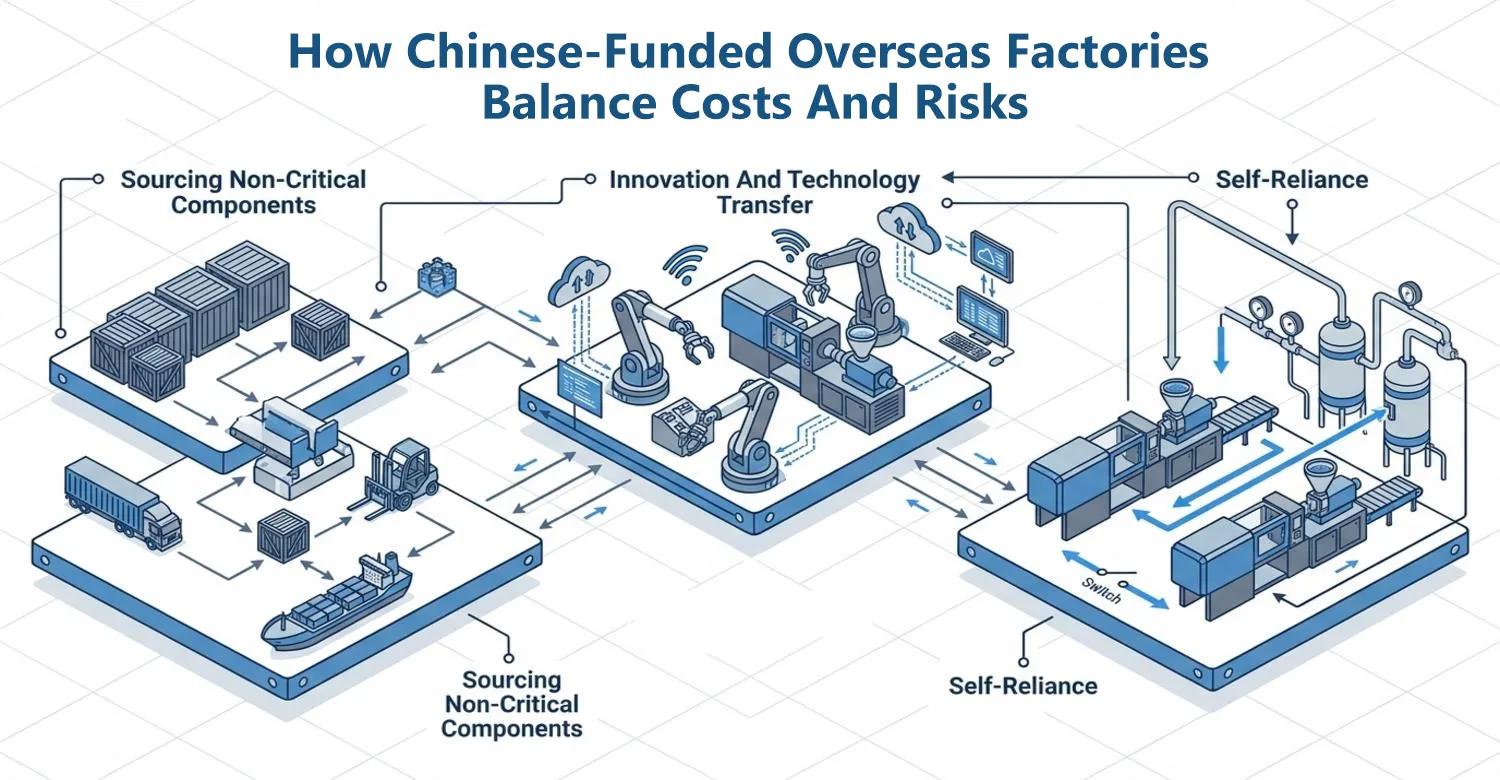
1. Locally Sourcing Non-Critical Components
Moving manufacturing operations overseas often incurs higher labor and operational costs. Overseas factories with Chinese backing strike a balance in costs by sourcing non-critical components from their local markets rather than shipping them from overseas. By sourcing components locally, these companies save transportation costs and adapt to the local economy. This cost-cutting strategy helps in the making of products with competitive pricing.
2. Innovation And Technology Transfer
Part of the success of Chinese manufacturers abroad is their ability to innovate around the local conditions and technologies of their host countries. They do this by collaborating with local partners in research and/or development and employing local professionals to create a collaborative and efficient ecosystem.
3. Acclimating To The Host Country’s Regulatory Environment
One of the ways overseas factories with Chinese backing avoid the risk of policy changes is by first understanding the regulatory environment of their host nation and blending in. In most cases, they may engage with labor unions, government officials, local stakeholders, and community leaders to build trust and mutual respect.
4. Harmonizing Global Integration And Self-Reliance
While striving to source non-critical materials locally, Chinese technology companies also make plans for supply chain disruptions and geopolitical tensions that may ground their manufacturing operations through production capacity switching scenario planning.
The Pros And Cons Of The Different Manufacturing Regions
United States manufacturers looking to move their production or supply chain overseas to cut labor costs will find North America, China, and Southeast Asia as viable alternatives. However, there are advantages and disadvantages of choosing one region over the other. That leads to a dilemma on how to determine the optimal supply chain choice.
Pros and cons of different manufacturing regions
| Country | Pros | Cons |
|---|---|---|
| United States | Easy to find the right skilled laborNo tariff on productsGovernment subsidiesCloseness to market | Very high labor costsIncreased spending on rental spaces and tax |
| China | Readily available skilled laborAbundant raw materialsLower labor costsGovernment incentives | Prone to tariff hikes and the trade war between the U.S. and China |
| Mexico | Lower labor costsGovernment incentives0% tariff on USMCA goodsAccess to distribution and raw material networks | Goods not covered by USMCA are still prone to tariff war. |
| Singapore | Government incentives More favorable tariff compared to other Southeast Asian countriesRaw materials refining hubs | The 2025 report by the ManpowerGroup Global Talent Shortage Survey shows employers are struggling to find skilled talent.Higher labor costsImport reliant for manufacturing resources |
Labor costs, proximity to raw materials, developed supply chain and distribution networks, and the impact of tariff hikes are important factors that U.S.-based companies must consider when planning to move their production overseas. The optimal supply chain choice must strike a balance across all these key factors.
Looking at the table above, for example, it is obvious that labor cost alone is not a strong enough determinant of an investment destination. The gains from cheaper labor will easily be eroded by raw material and logistics challenges or tariff wars.
Chinese Manufacturers With Overseas Operations As A Game-Changer
Partnering with Chinese manufacturers whose headquarters are in China and branch factories spread across North America and Southeast Asia is a game-changer that allows U.S. manufacturers to enjoy the best of both regions. Some of the benefits that U.S. manufacturers can get from such collaborations include:
- Having access to a skilled workforce with competitive labor costs
- Cost savings on transportation due to proximity to the U.S. market
- Potential tax incentives from the Mexican government, which further lower operational costs
- Manufacturers making products covered by USMCA enjoy a 0% tariff.
- Access to a more diversified global supply chain, which can shield the manufacturer from disruptions in one region
- Lower bottlenecks and trade barriers, considering the strained relationship between the United States and China
- Shields the manufacturer from the incessant trade tensions and trust deficit between the United States and China
- Proximity to raw materials is crucial to modern technologies and can significantly lower production costs
- Easier access to rare earth materials from China, which may not be approved for export to other countries
- Chinese technology companies with branches in North America and Southeast Asia can make it possible for the manufacturer to quickly shift production capacity between countries when production or trade conditions become unfavorable in one region.
How Mexican Bases Cut U.S. Shipping Costs
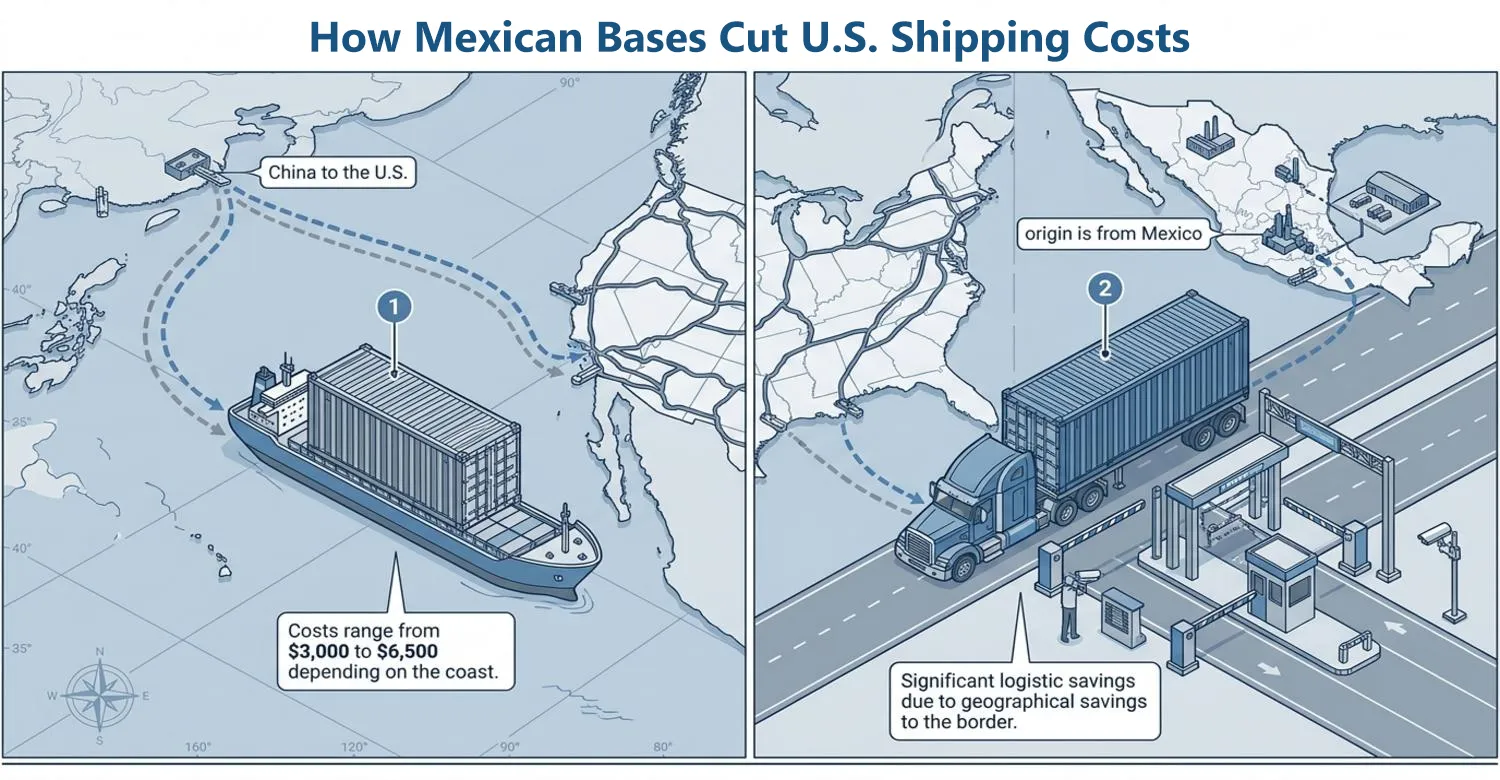
Here’s a snapshot of how subsidiaries of Chinese technology companies located in Mexico, for example, are helping U.S. manufacturers to drive down the logistic costs of moving their products across the United States border compared to producing in China.
The average cost of shipping a fairly sized injection mold in a 40-foot container from China to the U.S. can range from $3,000 to $5,000 for the West Coast or $4,000 to $6,500 for the East Coast—minus the import duty. The same cargo will cost around $500 to $2,500 if the origin is from Mexico. It is important to bear in mind that factors like mold weight, size, complexity, choice of shipping method, and insurance can affect the shipping cost.
How U.S. Companies Can Prepare For The Next Tariff Hikes
July is around the corner. As we get closer to the end of the truce period for the United States’ reciprocal tariffs, U.S. manufacturers should be concerned about what happens next and how it will impact their production capacity and supply chains. Consequently, this is also the best time to start preparing for the next trade war.
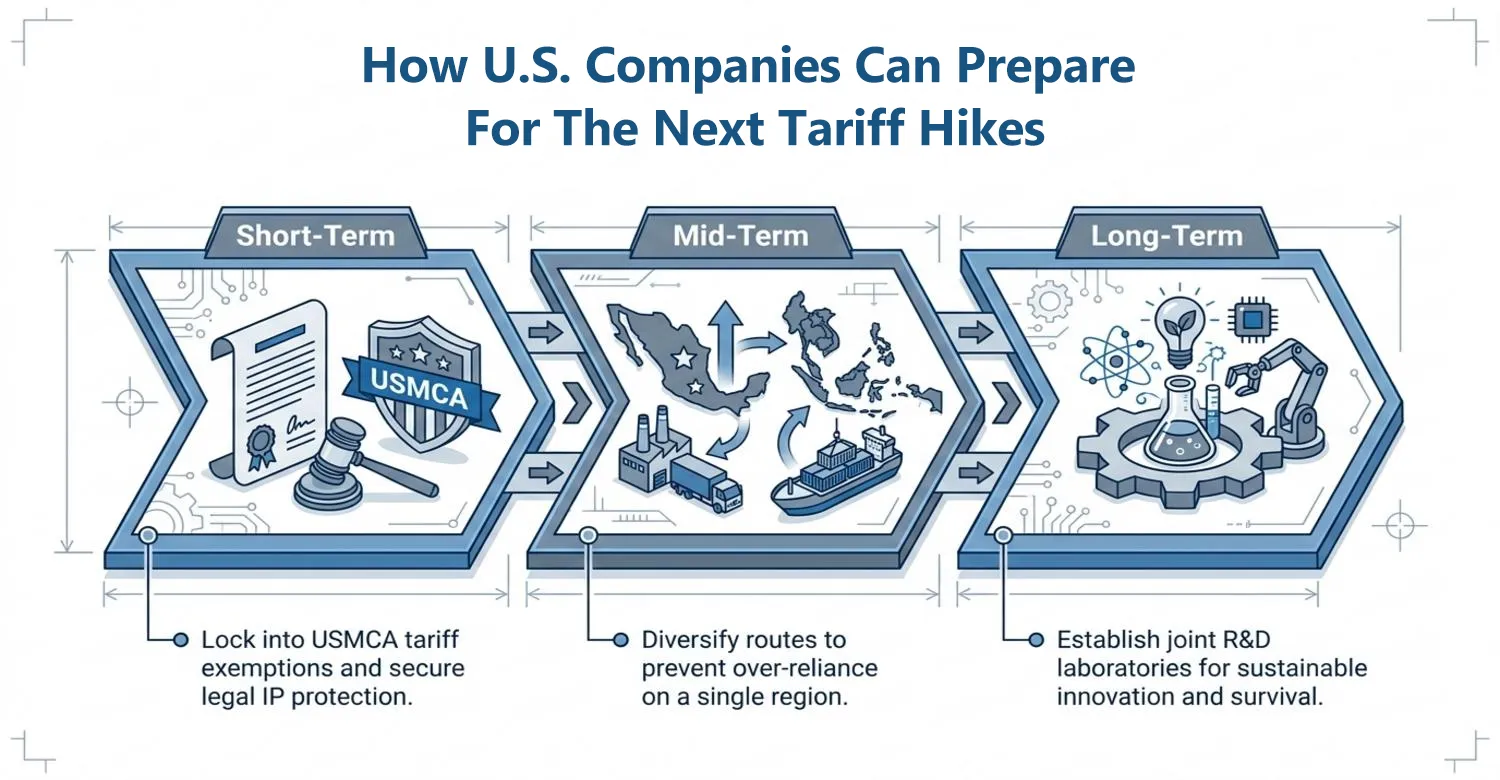
Even if the outcome of the ongoing meetings between the United States and China delegates ends favorably, there is no guarantee that the next U.S. president—whoever that may be—will not go on another tariff charade. There is also no guarantee that the next U.S. president will invalidate any unfavorable policies of the Trump administration. Former president Biden didn’t intervene in some of the sanctions imposed on China and Chinese manufacturers during President Trump’s first term. There are three steps to preparing for the next tariff war, namely short-term, mid-term, and long-term.
Short-Term
U.S. manufacturers in machinery and equipment production should leverage the 90-day tariff truce to sign agreements with Chinese technology companies with bases in Mexico. This strategic partnership will allow them to lock into the USMCA tariff exemptions. The regional trade agreement endorsed by the United States, Mexico, and Canada also proffers legal protection for IPs. This can provide greater security for companies that want full control of their product’s innovations.
Mid-Term
To ensure some sort of insulation from supply chain disruptions, U.S. manufacturers should work with suppliers that provide production capacity switching scenario planning for Mexico and Southeast Asia. In other words, the supplier should not be over-reliant on one country or region such that if there is a disruption to one supply route, they can easily move to another to keep the flow of raw materials and other components crucial to the production process.
Long-Term
While the short- and mid-term goals are more like quick fixes for the current tariff hikes, a more sustainable plan that will ensure the survival of the company involves investing in overseas technology centers owned by Chinese suppliers. Such collaborations can be in the form of establishing a joint research and development laboratory in Mexico, where new innovations and products would be cultivated.
If properly executed, this 3-point plan will help U.S. manufacturers overcome the current tariff war and prepare them for the next—which may be just another administration away. It will also boost investor confidence in the sustainability of the business.






 EN
EN  ES
ES  FR
FR  DE
DE  IT
IT  PT
PT  NL
NL  PL
PL  AR
AR  JA
JA  KO
KO  ZH
ZH