

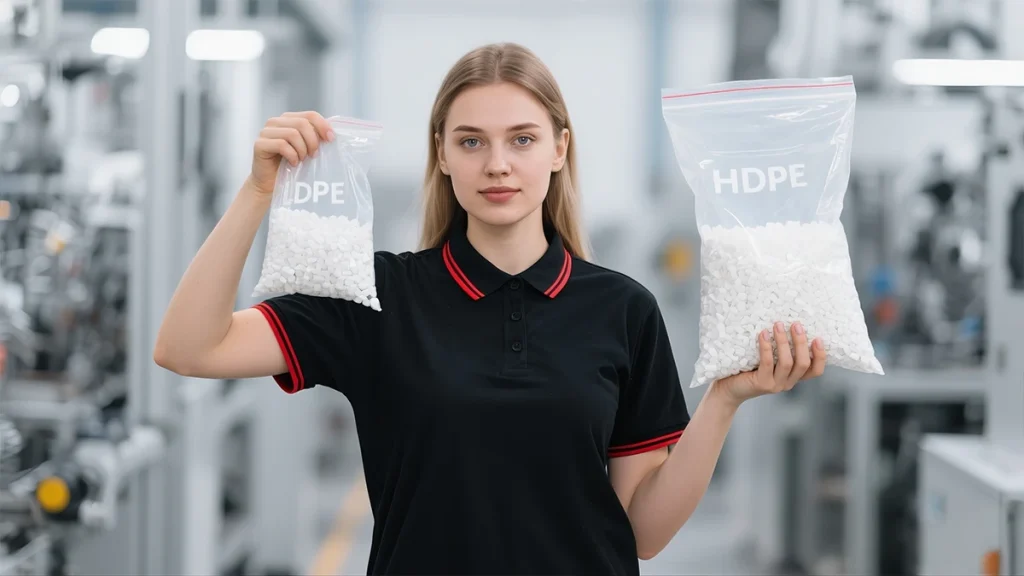
In the field of plastic product development and injection molding, when selecting materials for manufacturing processes, one often encounters the comparison between Low-Density Polyethylene (LDPE) and High-Density Polyethylene (HDPE). Although both belong to the polyethylene family, their performance characteristics differ significantly.
LDPE is a flexible, soft, and impact-resistant polymer. In industrial production, it is well-suited for applications such as plastic bags and squeeze bottles. On the other hand, HDPE offers superior rigidity, tensile strength, and exceptional chemical resistance. It is commonly used to manufacture rigid containers, pipes, and industrial components. Although both materials are lightweight and low-cost, their density and molecular structure differences directly influence processing conditions, mechanical performance, and product life. Engineers, designers, and manufacturers can make informed decisions based on their end-use applications by understanding the practical differences between LDPE and HDPE.
What Is Polyethylene?
Polyethylene is one of the most common thermoplastics used in endless everyday products. While it is highly versatile and durable, it is relatively cheap, hence being valued by manufacturers. It has various grades, but LDPE (Low-Density Polyethylene) and HDPE (High-Density Polyethylene) are the most common. These two have a similar chemical composition but differ in structure and performance.
LDPE, which contains a highly branched molecular structure, is softer, more flexible, and easier to mold. HDPE, conversely, is more linear in structure and, therefore, more substantial, stiffer, and resistant to impact and chemicals.
These structural differences govern the behavior of the two types of materials in molding, design, and actual fields. An individual needs to have a clear understanding of LDPE vs. HDPE to make an informed decision about selecting the right material for a specific manufacturing application.
Property Comparison for LDPE vs HDPE
The most crucial differences between LDPE and HDPE are based on their physical properties. In real-life situations, this difference directly affects the material’s functionality. LDPE has a density of 0.91- 0.93 g/cm³. It is lighter and more flexible. HDPE has a higher density of 0.94–0.97 g/cm³, ensuring greater rigidity. LDPE has a lower tensile strength and a maximum continuous service temperature of around 80°C (though it begins to soften significantly earlier, with a melting point typically around 105-115°C).
In contrast, HDPE has a higher melting point (130–137°C) and can withstand short-term exposure up to 120°C, while its continuous service temperature is typically below 100°C. As for their resistance to impacts, both LDPE and HDPE offer good performance. LDPE is recognized for its excellent toughness and ability to absorb impact, particularly in flexible applications such as films. HDPE also provides good impact resistance, maintaining its strength well at low temperatures, and is generally chosen when higher rigidity is also required. Further, LDPE is more transparent, whilst HDPE is more opaque. However, both are resistant to chemicals, and HDPE has only a slightly higher performance in harsh environments. Such differences are due to their molecular structure and branched chains, which result in the softness and flexibility of LDPE. Linear chains in HDPE translate into increased stiffness and resistance to moisture and gases.
Processing in Injection Molding for LDPE vs HDPE
LDPE and HDPE exhibit distinct differences in injection molding performance, starting with their melting behavior.
LDPE melts at a lower temperature and flows freely into the mold cavities. This no-hassle flow is ideal for creating fluid, flexible items with thin walls, such as lids, seals, and squeeze containers. The lower processing temperature that offers faster cycle times is desirable for high-volume production. However, its softness and lower strength can result in difficulties such as sink marks, warping, or incomplete mold filling if not taken into consideration when designing the shape.
LDPE generally exhibits lower melt viscosity (higher Melt Flow Index, or MFI) under typical injection molding conditions due to its branched structure, which enables good flow in thin-walled molds. HDPE, with its more linear structure, typically has a higher melt viscosity (lower MFI) compared to general-purpose LDPE, which can make filling very thin sections more challenging, though specialized HDPE grades exist for such applications. However, HDPE’s higher crystallinity may lead to greater shrinkage. HDPE is more suitable for rigid components, such as containers, pipes, crates, or structural elements. The HDPE tooling must handle a significantly higher amount of stress, possibly with a slightly longer cycle time, but the reward is a more robust product in terms of resisting deformation. Manufacturers must balance the elements of flexibility, strength, and efficiency in comparing the material manufacturing properties of LDPE and HDPE.
Additives and Enhancements
Manufacturers alter LDPE and HDPE with additives to enhance their functions. For example, adding glass fiber to HDPE is highly effective in terms of rigidity and strength, thereby extending its applications to parts with load-bearing or high-impact functions. Talc enhances the stiffness and heat deflection temperature of HDPE but may reduce the impact strength. To minimize shrinkage and warping, mineral fillers like calcium carbonate or nucleating agents are more effective. These additives enhance the consistency of the part quality and control processes.
Colorants are also crucial in tailoring LDPE and HDPE products. Manufacturers use pigments and masterbatches to meet branding, aesthetic, or functional requirements. In packaging and consumer goods, color and finish must be consistent. Additives enable engineers to modify the base properties of LDPE versus HDPE without altering the entire substance. Designers can fine-tune the performance, durability, and appearance to exact specifications by making the right enhancements.
Applications by Industry
LDPE is more suitable for flexible, soft applications, such as squeeze bottles, plastic bags, and tubing, while HDPE is more substantial and stiffer, therefore suited to milk jugs, containers, and pipes. It all depends on whether flexibility or strength is required.
Packaging Industry
The choice between LDPE and HDPE hinges on the balance between flexibility and stiffness. LDPE has good performance in products like film packaging, flexible caps, and squeeze bottles. Its softness and transparency are ideal for products demanding high flexibility and user-friendly handling.
HDPE, conversely, excels in manufacturing rigid containers such as milk jugs, detergent bottles, and food storage containers. HDPE products reliably retain their shape while offering impact resistance and moisture barrier properties. These characteristics position it as the material of choice for goods requiring impact protection and waterproofing capabilities.
Medical Industry
The medical industry utilizes both LDPE and HDPE frequently. LDPE is widely applicable for IV bags and flexible tubing because of its softness and non-reactive properties. It gives comfort and ease in handling. HDPE is widely used for rigid medication containers and bottles used for medical purposes. It provides for structural integrity, chemical resistance, and a tight seal of pharmaceutical packaging and storage. With these properties, HDPE becomes vital for pharmaceutical packaging and storage.
Construction Industry
LDPE vs HDPE in construction will depend on the need for flexibility or strength. LDPE is also suitable for vapor barriers, sealants, and flexible liners. It is easy to install, and it fits irregular surfaces. HDPE is preferred for rigid applications such as pipes, cables, and tool handles. It has high resistance to pressure, chemicals, and environmental stress, thus a dependable material for long-term use in adverse conditions.
Consumer Goods
Commercial products are essential in both LDPE and HDPE. LDPE is widely used in flexible products, including shopping bags, toys, and soft kitchenware. Its low weight and ductility make it suitable for everyday articles. HDPE is used for more rigid applications such as bins, buckets, crates, and storage containers. It provides strength and durability, and it is desirable for handling and repeated use.
Agriculture Industry
The preference for LDPE and HDPE is the same in the agricultural sector. LDPE is excellent for greenhouse films and irrigation tubing, where flexibility and lightweight handling are essential. HDPE is applied to more structural purposes, such as water tanks, pesticide containers, and fencing. When modified with UV stabilizers, HDPE exhibits excellent resistance to environmental stress cracking and ultraviolet degradation, making it suitable for outdoor applications.
LDPE vs HDPE: Which Should You Choose?
Your product’s requirements will determine the right material. LDPE (low-density polyethylene) is the best in flexibility, softness, transparency, and low production cost. Its pliable texture is perfect for film wraps, squeeze bottles, and soft caps. It is also commonly used in applications where easy molding and light-duty performance are required, such as plastic bags, tubing, and other consumer products.
On the other hand, HDPE (High-density polyethylene) is chosen for products that require rigidity, impact strength, and excellent chemical resistance. Its strength and durability make it more suitable for structural components, storage containers, detergent bottles, and outdoor parts such as piping and tanks. If your design requires preserving form under pressure or withstanding harsh materials, HDPE provides the performance and strength necessary for long service life in both industrial and consumer environments.
Conclusion
LDPE vs. HDPE is not so much a difference in density as it is a matter of flexibility, as opposed to strength, softness versus rigidity, and cost-efficiency versus durability in a given plastic product. Each material offers specific advantages tailored to the requirements of each application, ranging from soft packaging films to rugged structural elements. Understanding these differences is crucial for selecting the most suitable plastic for your design and performance requirements. We simplify the material selection process at FirstMold. From experts who have been in the industry for years, we’ll help you choose the best polyethylene type, whether HDPE, LDPE or another type, depending on your injection molding’s technical and functional needs.




 EN
EN  ES
ES  FR
FR  DE
DE  IT
IT  PT
PT  NL
NL  PL
PL  AR
AR  JA
JA  KO
KO  ZH
ZH