
Home / 5 Axis CNC Machining Service
Precision 5-Axis CNC Machining Services
First Mold’s 5-axis machining service gives you higher part consistency. No matter how complex your part geometry is, 5-axis machining can push surface finish and tolerances to the extreme.
- ±0.005mm ultra-tight tolerances
- Ra 0.1μm Superior Finishes
- 0.5mm Ultra-Thin Walls
Our 5-Axis Machining Solutions
First Mold has been using 5-axis CNC centers for 11 years. Our machining capability balances both speed and precision. By skillfully applying 3+2 positional machining and full 5-axis simultaneous milling, we provide our customers with two main services: precision rapid prototyping and low-volume production.
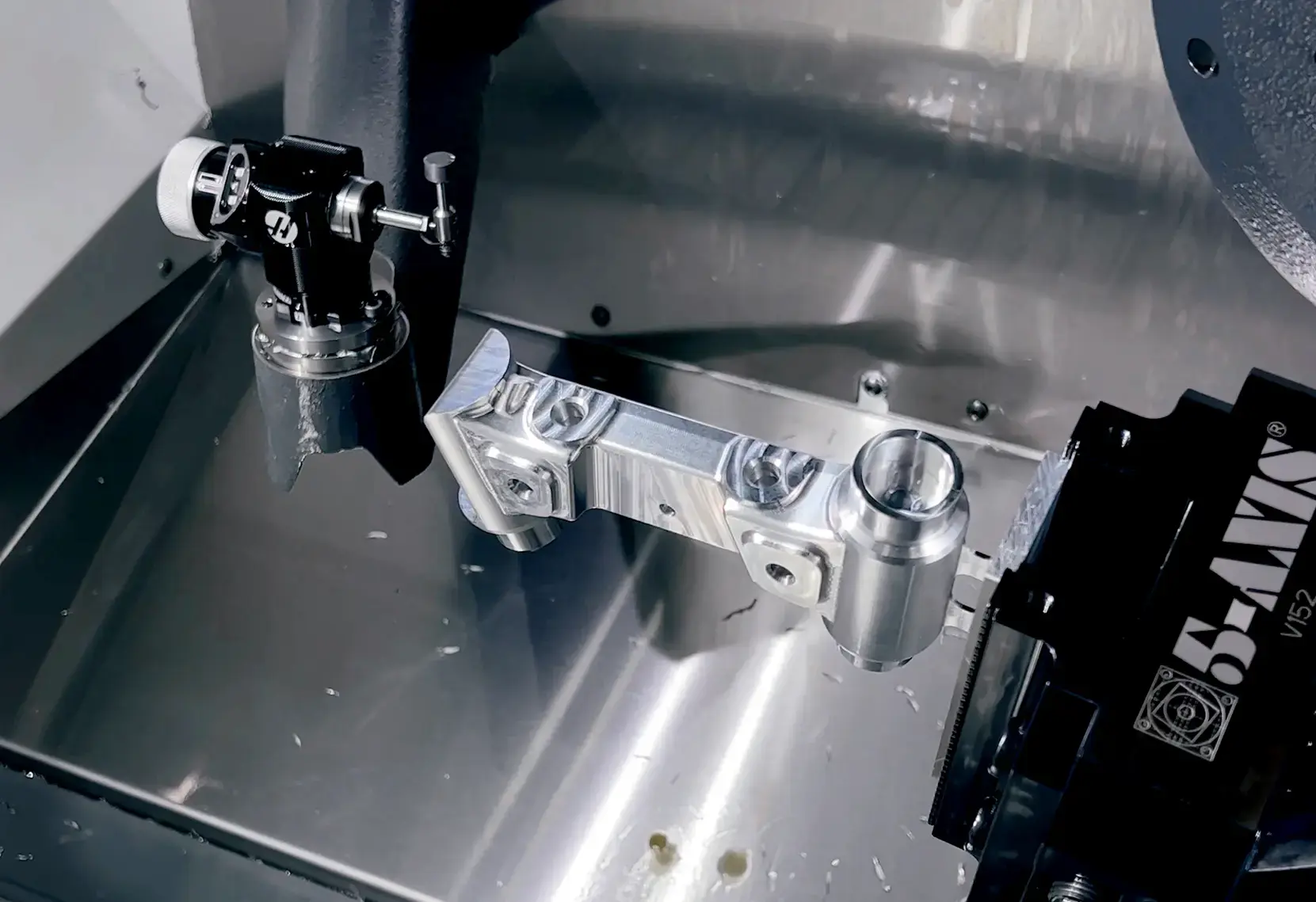
5-axis CNC prototyping is one of our primary means of achieving rapid prototyping. Our fastest machining lead time can be as short as 3 days. Typically, customers entrust us with prototype quantities of up to 50 pieces. 5-axis CNC prototyping is commonly used for functional/assembly testing prototypes, patent application samples, exhibition display parts, and rapid design feasibility verification.
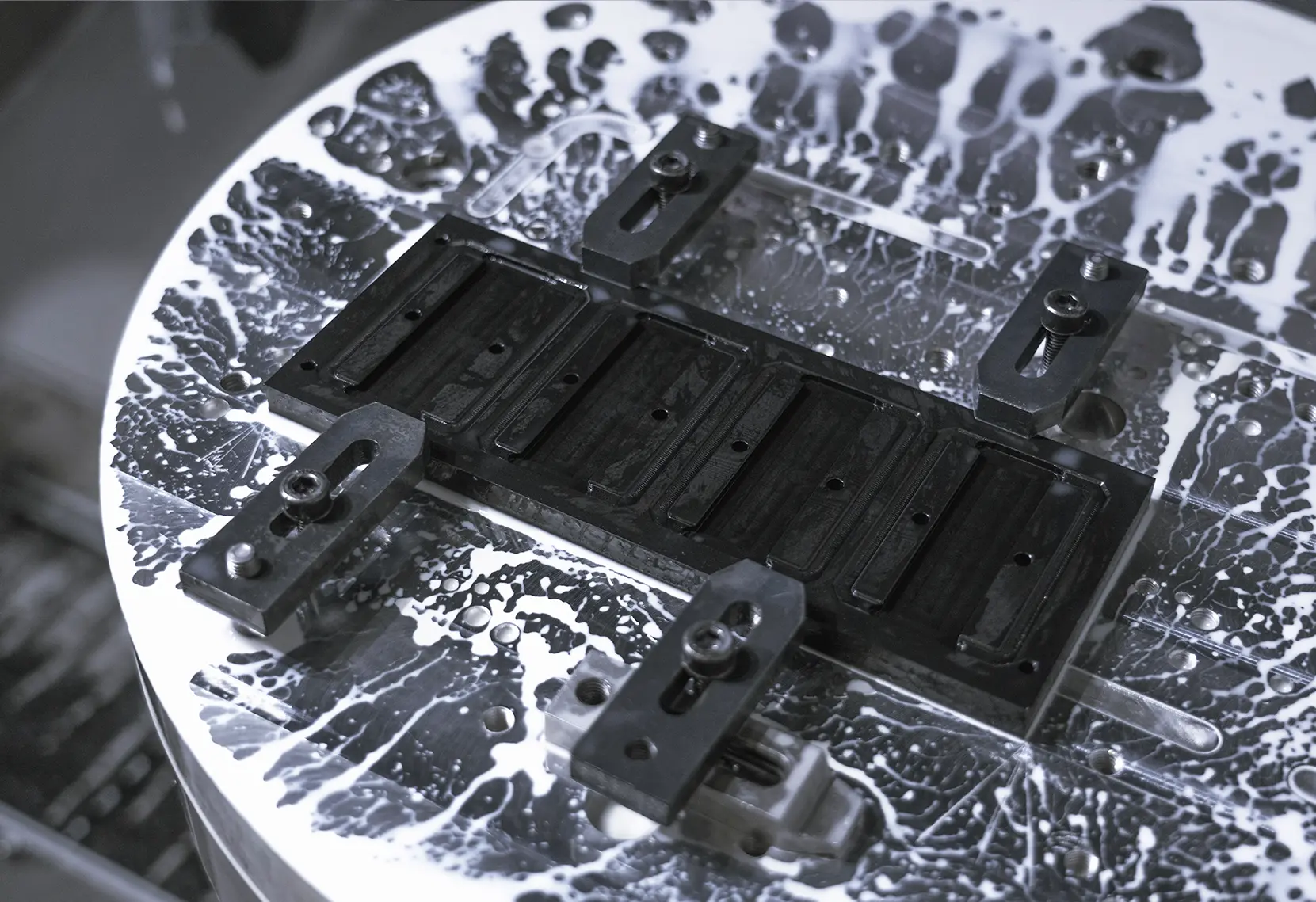
5-axis low-volume production typically stays within 1,000 pieces. Dimensional accuracy for all workpieces can be consistently held to ±0.01 mm (with a limit of ±0.005 mm). This solution is suitable for pre-market small-batch trial production, market validation orders, small OEM supporting orders, equipment spare parts, permanent low-volume supply without the need for mold making, and transitional production projects.
Machining Type | Machining Accuracy | Surface Finish | Parts |
|---|---|---|---|
3+2 Positional Machining | Positioning: ±0.005 mm, Dimensional: ±0.01 mm | Ra 0.8–1.6 μm | Complex housings, medical brackets, fixtures |
5-Axis Simultaneous Milling | Positioning: ±0.003 mm, Dimensional: ±0.005 mm | Ra 0.1–0.8 μm (up to Ra 0.1 μm) | Turbine blades, impellers, medical implants |
5-Axis Comprehensive Machining | Positioning: ±0.005 mm, Dimensional: ±0.01 mm | Ra 0.4–1.6 μm | Precision mold components, robot parts |
Tips: Compare 3-axis and 5-axis CNC machining, and explore more knowledge about multi-axis CNC machining.
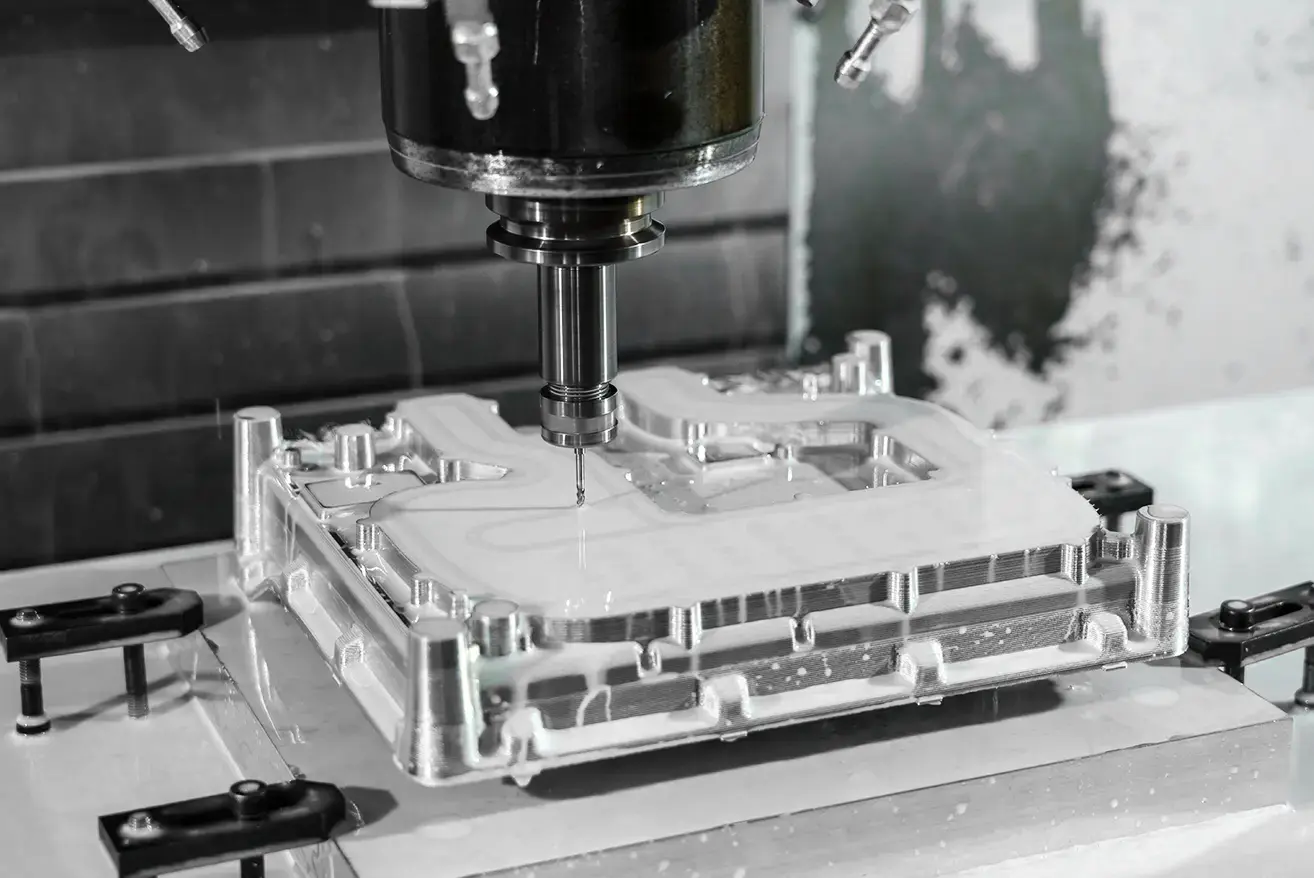
5-Axis Solutions & Case Studies
First Mold’s 5‑axis CNC machining services are trusted by innovators in aerospace, medical and robotics sectors, while we also serve most industries. However, we do not recommend 5‑axis machining for every project. When your workpieces have simple structures and less stringent requirements, our engineers will recommend 3‑axis or 4‑axis milling solutions to reduce costs.

- Ra 0.1μm Mirror Finish
- Flawless Snap-Fit Assembly
- Complex 3D Contours

- IATF 16949 Compliant
- High-Stress Durability
- Large Curved Surfaces

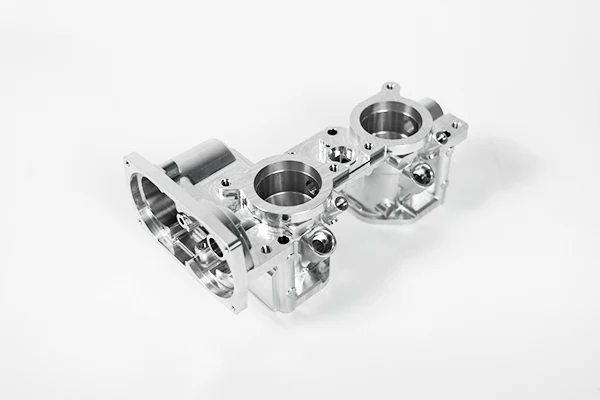
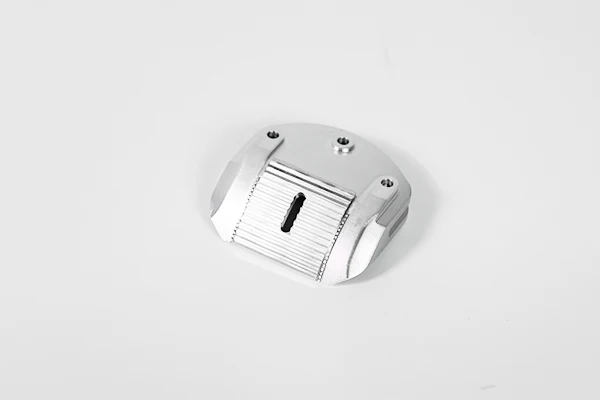
First Mold's 5-Axis Machining Cases & Gallery

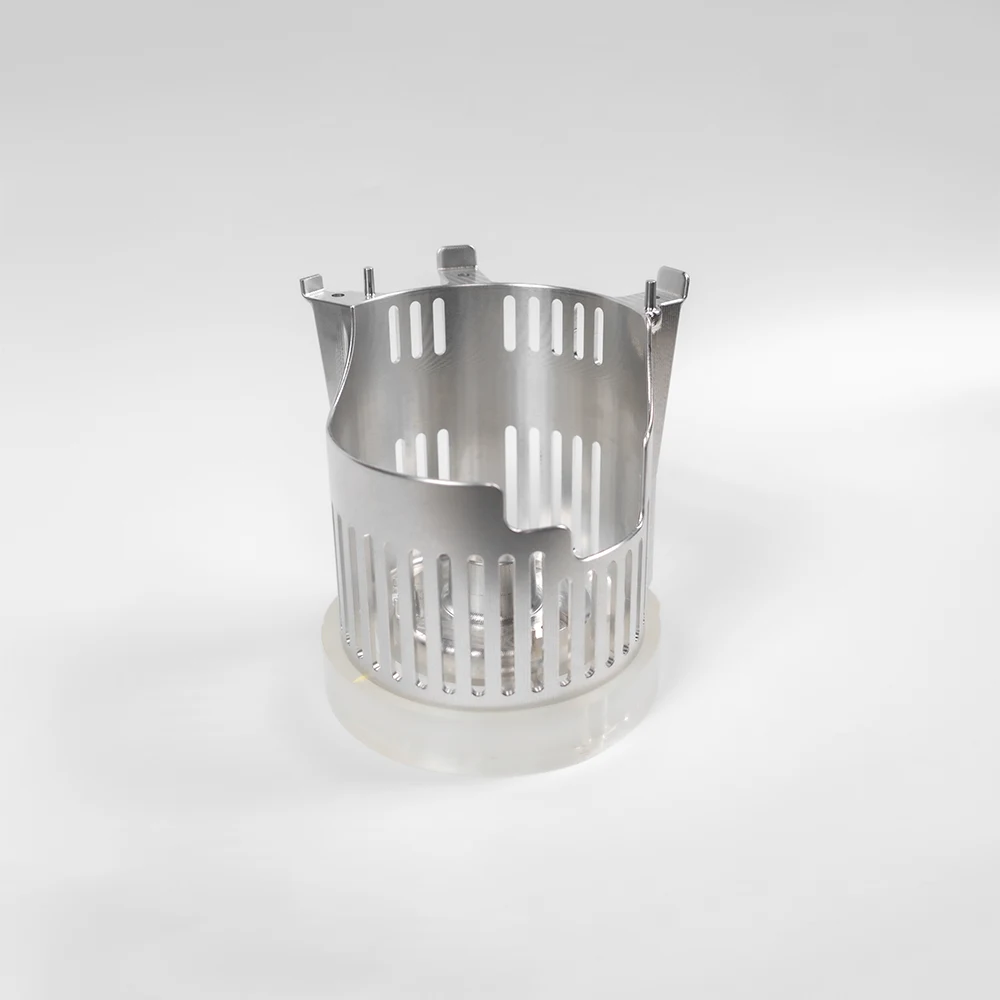
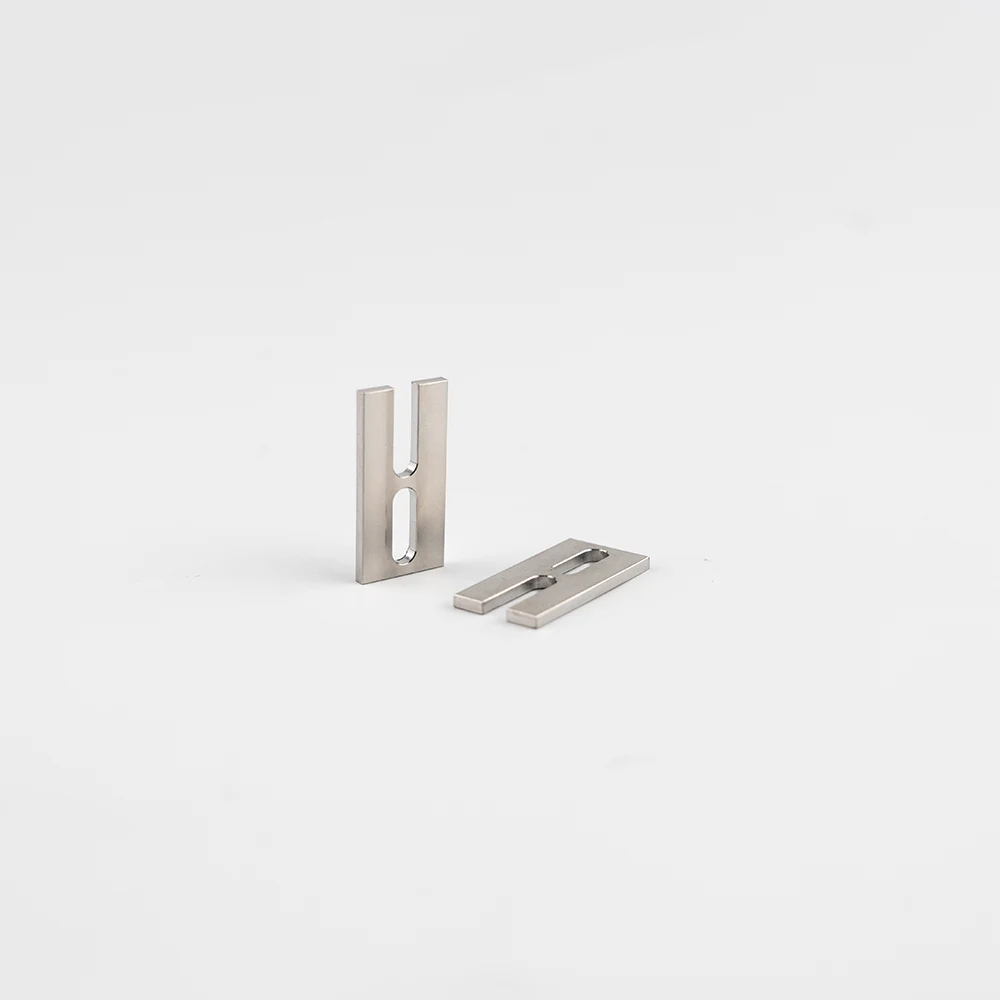
5-Axis Machining Gallery


Supported 5 axis Machining Materials
Our factory uses five-axis CNC machining technology and can process over one hundred types of commonly used subdivided materials.
Aluminum 6061
Ideal for 5-axis complex profiles & high-speed machining.
Aluminum 7075
High-strength aerospace material for 5-axis precision parts.
Stainless Steel 304
Corrosion-resistant for 5-axis structural components.
Stainless Steel 316
Marine-grade for 5-axis complex medical & marine parts.
Titanium Grade 5
Aerospace-grade for 5-axis high-stress parts.
Brass
Smooth finishing for 5-axis precision electrical components.
Copper
Excellent conductivity for 5-axis thermal components.
Inconel
Superalloy for 5-axis high-temperature parts.
ABS
Common plastic for 5-axis prototype machining.
PEEK
High-performance for 5-axis medical implants.
Delrin (POM)
High rigidity for 5-axis precision mechanical parts.
Nylon 6/6
Wear-resistant for 5-axis mechanical gears.
PTFE (Teflon)
Low-friction for 5-axis high-temperature parts.
Acrylic (PMMA)
Clear finishing for 5-axis transparent components.
Why Choose Our 5 Axis Service
Choosing First Mold’s five-axis machining services can resolve the various production issues that have long troubled your parts manufacturing. We possess the standard advantages common to companies in the industry, as well as multiple advantages that others in the industry do not have.
Affordable and practical pricing
Large-scale five-axis machining reduces costs, offering a significant price advantage for the same level of precision.
Strict control over low-waste processing
Mature processes for over a hundred materials, with precise control that greatly reduces the scrap rate.
Reliable delivery for urgent orders
Sufficient production capacity ensures that rush orders are shipped on time without delays.
5 Axis Machining Tolerance Standard
Check First Mold’s recommended tolerance standards. If you do not have specific tolerance requirements for your product, we will proceed with machining based on the standard class.
| Tolerance Type | Tolerance Range | Application | Description |
|---|---|---|---|
| Dimensional Tolerance | ±0.005 mm (±0.0002″) to ±0.1 mm (±0.0039″) | General parts with standard precision | Standard dimensional tolerances, suitable for most general machining tasks. |
| Geometric Tolerance | ±0.01 mm (±0.0004″) to ±0.05 mm (±0.002″) | Complex parts needing precise geometry | Controls the form, orientation, location, and runout of features. |
| Straightness | 0.005 mm (0.0002″) to 0.02 mm (0.0008″) | Components requiring straight edges | Ensures that a surface or axis is perfectly straight. |
| Flatness | 0.005 mm (0.0002″) to 0.03 mm (0.0012″) | Parts needing a flat surface | Ensures the part’s surface does not deviate from the ideal flat plane. |
| Cylindricity | 0.01 mm (0.0004″) to 0.05 mm (0.002″) | Cylindrical parts with strict tolerances | Controls the roundness and straightness of cylindrical surfaces. |
| Concentricity | 0.01 mm (0.0004″) to 0.03 mm (0.0012″) | Parts where concentricity is crucial | Ensures that features (e.g., holes, shafts) are aligned within a common centerline. |
| Perpendicularity | 0.01 mm (0.0004″) to 0.05 mm (0.002″) | Parts needing precise perpendicular surfaces | Ensures that features are exactly perpendicular to each other. |
Our colleagues will contact you promptly to analyze and recommend tolerances for your product based on our experience.
How to start a project with 5-axis services
Submit CAD
Send your STEP/IGES files to kick off a 5-axis project.
DFM Analysis
Receive a 5-axis manufacturability review within 24 hours.
5-Axis Machining
Precision parts machined on advanced 5-axis equipment.
Pre-Shipment Report
Get first-article inspection reports before delivery.
5 Axis Machining FAQ

Do you support 5-axis machining from customer-supplied samples?
Yes. We can perform reverse modeling, measurement, and program creation based on physical samples to achieve precise machining. Please provide the sample and key dimensional information; we will handle the rest.
Can you quote and machine parts with only 2D drawings?
No. If only 2D drawings are provided, we will proactively request 3D model files (e.g., STEP, IGES) from you via email. Without a 3D model, we cannot guarantee machining accuracy or complex surface programming. Please provide the 3D files.
Do you offer volume discounts for long-term 5-axis machining orders?
Yes. Long-term cooperation customers can enjoy tiered or contract-based exclusive discounts. The specific discount depends on order quantity, materials, precision, etc. Please send an inquiry; our project manager will handle one-on-one negotiations.
Can your 5-axis centers process conductive and anti-static modified plastics?
Yes. We have established mature 5-axis processes for such modified plastics, including specialized tools, cutting parameters, and cooling solutions, ensuring dimensional stability, no burrs, and no delamination.
What is the maximum part size your 5-axis machines can handle?
Maximum dimensions: Length 1500mm (59.06″), Width 800mm (31.50″), Height 800mm (31.50″). Parts exceeding these limits may require split machining or outsourcing.
Can you guarantee on-time delivery during peak production seasons?
Yes. We use a combination of multiple 5-axis machines, shift work, capacity reservation for peak seasons, and backup outsourcing resources. For large orders, we recommend advance scheduling. Under normal circumstances, on-time delivery is ensured.
Do you produce food-grade or cleanroom-grade 5-axis parts?
Currently we do not have an on-site food-grade or cleanroom environment. However, we have spare space and equipment, and can temporarily set up such clean or sanitary facilities through negotiation. Specific solutions and costs depend on the required grade and batch quantity.
 EN
EN  ES
ES  FR
FR  DE
DE  IT
IT  PT
PT  NL
NL  PL
PL  AR
AR  JA
JA  KO
KO  ZH
ZH