

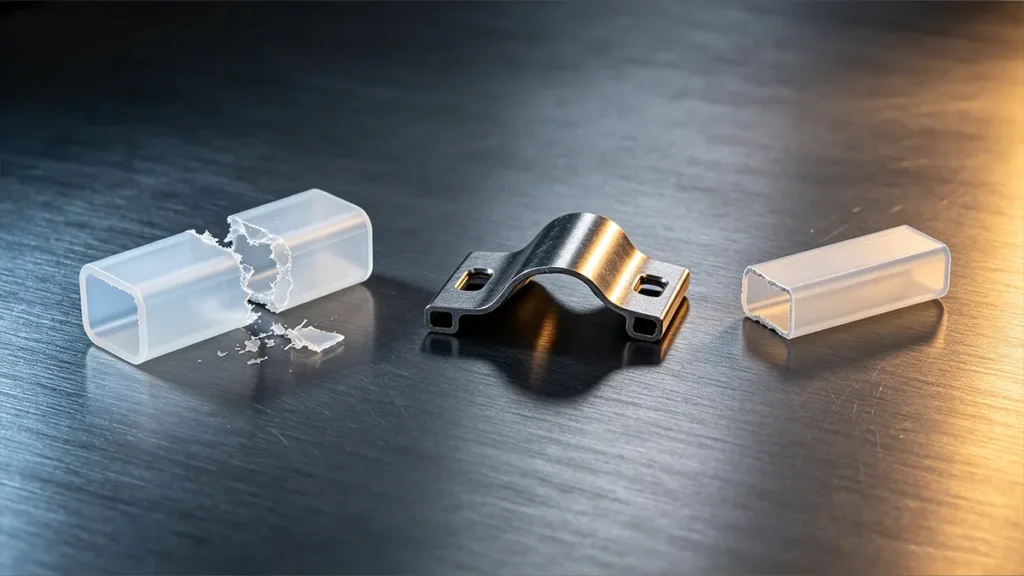
Os engenheiros cometem, sem se aperceberem, erros na conceção do produto ao determinarem e selecionarem a resistência do mesmo. Por vezes, os produtos falham devido a uma falha por cisalhamento, enquanto a maior parte da atenção é dedicada à resistência à tração e ao limite de escoamento. Os diferentes materiais utilizados no desenvolvimento do produto podem falhar devido a um projeto inadequado no que diz respeito às diferentes resistências. Por exemplo, enquanto exceder a resistência ao escoamento pode levar à deformação de uma caixa de plástico, uma inserção roscada pode falhar devido a uma resistência ao cisalhamento insuficiente. Da mesma forma, quando os suportes metálicos atingem a sua resistência à tração, fraturam-se. Estes casos demonstram que materiais diferentes apresentam tipos distintos de resistência, o que deve ser tido em conta na conceção e no desenvolvimento do produto. Mas existe uma diferença clara entre estas três propriedades? Este guia descreve cada propriedade, mostra como cada uma difere das outras e aborda a sua medição e ensaio.
O que são resistência à tração, limite de elasticidade e resistência ao cisalhamento?
É provável que a maioria das pessoas interprete mal estes termos devido à sua estreita relação. De facto, quem não pertence às áreas da física, da mecânica e da engenharia pensa, por vezes, que são a mesma coisa. No entanto, estes termos descrevem mecanismos de falha diferentes. Vamos aprofundar cada um deles.
O que é a resistência à tração?
A resistência à tração é uma das propriedades mecânicas que não podem ser ignoradas nas aplicações industriais. Esta propriedade tem um impacto crucial na segurança e no desempenho dos diversos materiais utilizados no fabrico de diferentes produtos.
Esta propriedade é observável nas atividades do dia-a-dia. Por exemplo, uma grua consegue levantar uma carga pesada utilizando um cabo de aço fino sem que este se parta. Isto deve-se ao facto de o cabo possuir uma resistência à tração muito elevada. Suponha que a carga exceda a resistência à tração do cabo de aço; o cabo irá fraturar-se e partir-se, causando vítimas.
Definição e unidades
A resistência à tração é definida como a tensão máxima que um material consegue suportar antes de se partir ou fraturar. É calculada dividindo a força máxima de tração pela área da secção transversal original de uma amostra. Baseia-se no princípio de que, quando a tensão num material aumenta, as ligações entre os seus átomos são esticadas e acabam por se romper.
Um material adquire elasticidade quando lhe é aplicada uma tensão. Quando a tensão é removida, o material regressa à sua forma original. No entanto, à medida que a tensão continua a ser aplicada, o material entra na região plástica. Nesta região, a estrutura atómica ou molecular interna do material sofre um deslizamento permanente (impulsionado pelo movimento de deslocamentos em metais cristalinos ou pelo desembaraçamento das cadeias moleculares nos polímeros), tornando-se impossível que o material volte à sua forma original [1].
A resistência à tração é medida em megapascais (N/mm²). A tabela seguinte resume as outras unidades relacionadas.
| Unidade | Utilização comum |
|---|---|
| MPa | Mais comum na engenharia e na indústria transformadora |
| Psi | Comum nos Estados Unidos |
| Ksi | Frequentemente utilizado para metais na engenharia dos EUA |
1 MPa ≈ 145 psi
1 Ksi = 6,895 MPa
Fórmula para a resistência à tração
Resistência à tração (S) é dada por:;
S = F / A
Em que F é a força de tração aplicada, em N ou lbf. A é a área da secção transversal original da amostra (mm², m² ou in²).
A resistência à tração máxima atingida por um material durante a aplicação de carga denomina-se resistência à tração máxima (UTS). Assim que a UTS é atingida e ultrapassada, o material começa a apresentar estreitamento. À medida que a carga aumenta, o estreitamento acelera até o material fraturar. A UTS é dada pela fórmula:,
UTS=Fmáximo/A0
Onde Fmáximo é a força máxima suportada antes da ruptura, e A0 é a área transversal original antes da aplicação da carga.
Medição da resistência à tração
É possível medir a resistência à tração realizando ensaios de tração numa máquina de ensaio universal (UTM). A UTM é por vezes designada por máquina de ensaio de tração.
O processo começa com a preparação de uma amostra padrão. No caso dos plásticos, o material é moldado numa amostra em forma de «osso de cão», enquanto que, para os metais, é usinada uma amostra cilíndrica. Antes da usinagem, é medida a área da secção transversal original, A0.
Após a preparação, a amostra é fixada na máquina de ensaio de tração (UTM). A máquina puxa as amostras a uma velocidade controlada. À medida que a máquina continua a puxar a amostra, deve-se registar os dados, que incluem a força e o alongamento correspondente. É possível interpretar o comportamento do material observando a curva tensão-deformação gerada pela máquina. A resistência à tração (S) pode então ser calculada conforme indicado na fórmula acima.
O que é o limite de escoamento?
O limite de escoamento e a resistência à tração são termos relacionados. No caso dos materiais dúcteis, o material atinge o seu limite de escoamento antes de atingir a sua resistência máxima à tração. No entanto, os materiais frágeis fraturam-se normalmente antes de ocorrer qualquer escoamento significativo.
O limite de escoamento é o limiar de tensão em que os materiais passam de um comportamento elástico (deformação reversível) para um comportamento plástico (deformação permanente). É medido em megapascais (MPa).

Tomemos, por exemplo, quando se puxa lentamente ambas as extremidades do clipe de papel. No início, os clipes esticam-se ligeiramente. Quando se deixa de puxar, os clipes voltam à posição original. Quando se continua a puxar com mais força e se liberta a pressão, os clipes não recuperam a sua posição original. Nesta altura, dizemos que o clipe atingiu o seu limite de escoamento. Tecnicamente, diz-se que o clipe, neste estado, sofreu uma deformação permanente sem se partir.
Medições do limite de escoamento
Antes de compreender os métodos de medição do limite de escoamento, é essencial compreender os termos derivados utilizados no seu cálculo. Um desses termos é a tensão (σ). Trata-se da quantidade de força por unidade de área a que um material está sujeito. É dada pela fórmula:,
σ = F/A,
Sendo F a força aplicada e A a área da secção transversal. A tensão máxima ocorre quando uma força máxima é aplicada a uma área de superfície muito estreita.
O segundo termo é a deformação (ε). Trata-se da capacidade do material de se esticar ou comprimir em relação ao seu tamanho original. É dada pela fórmula:,
ε = ΔL/L₀,
Em que ΔL é a variação do comprimento e L₀ é o comprimento inicial.
O módulo de Young (E) indica o grau de rigidez de um material. Um valor elevado de E significa que o material quase não se deforma sob carga, como é o caso do aço em comparação com a borracha. É dado por
E = σ/ε
Um material manterá um comportamento linear na relação tensão-deformação, de acordo com a lei de Hooke, até atingir o ponto de escoamento, o limiar exato em que a tensão aplicada supera de forma permanente as forças interatómicas que mantêm a rede cristalina do material no seu estado elástico [2].
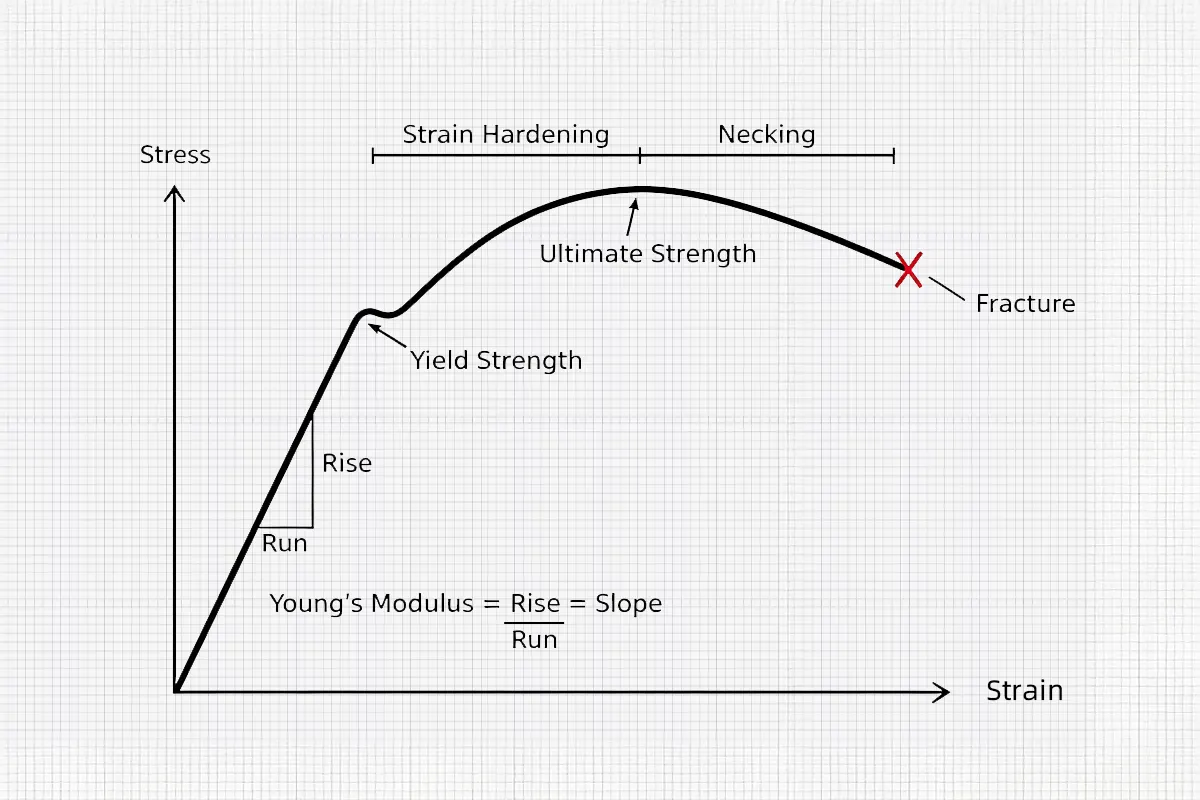
Diz-se que um material é rígido se resistir à deformação. Esses materiais apresentam o módulo de Young mais elevado. No entanto, isso não significa que tenham o limite de escoamento mais elevado. Um bom projeto de engenharia deve equilibrar sempre estas propriedades. Para uma análise mais aprofundada sobre a diferença entre a rigidez, a resistência global e a dureza, consulte o nosso guia completo em [Resistência, rigidez e dureza].
O que é a resistência ao cisalhamento?
Antes de compreender a resistência ao cisalhamento, é importante compreender o que é a força de cisalhamento. A força de cisalhamento descreve a força interna que atua paralelamente a uma superfície, tentando fazer deslizar ou deformar uma parte da superfície em relação a outra.
A resistência ao cisalhamento é a capacidade de um material de resistir a forças que podem fazer com que a sua estrutura interna deslize contra ele. À medida que as forças de cisalhamento são aplicadas, a superfície do material tenderá a deslizar e a deformar-se. A resistência ao cisalhamento é essencial em várias aplicações de engenharia em que os materiais são sujeitos a forças laterais.
A resistência ao cisalhamento desempenha um papel fundamental na conceção e análise de estruturas como vigas, pilares e juntas. Garantir uma resistência ao cisalhamento adequada previne falhas estruturais e aumenta a longevidade das construções.
A resistência ao cisalhamento também se manifesta em situações do quotidiano. Numa ponte de aço, os parafusos que ligam os elementos estruturais estão sujeitos principalmente a cargas de cisalhamento. Se a carga se tornar excessiva, os parafusos podem partir-se, permitindo que as placas ligadas se separem. Esta resistência também é aplicada no corte de parafusos. A força de corte é aplicada na direção oposta. Estas forças opostas fazem com que o material ceda ao longo de um plano, em vez de se esticar. A capacidade do parafuso de resistir a estas duas forças opostas é a resistência ao cisalhamento.
Medição e ensaio da resistência ao cisalhamento
Os ensaios de cisalhamento são frequentemente utilizados na ciência dos materiais, na engenharia e em vários outros setores para avaliar a adequação de um material a aplicações específicas.
No ensaio de cisalhamento, uma amostra de material é colocada entre duas superfícies paralelas e é aplicada uma força até que o material sofra uma falha por cisalhamento. O parâmetro-chave medido é a tensão de cisalhamento, que é calculada dividindo a força aplicada pela área da secção transversal do material. O resultado pode fornecer informações sobre a durabilidade, resistência e desempenho do material em condições reais de tensão.
Quais são os valores típicos da resistência à tração, ao escoamento e ao cisalhamento?
A tabela seguinte resume a resistência à tração, a resistência ao escoamento e a resistência ao cisalhamento de diferentes materiais. Estes valores de referência são rigorosamente obtidos a partir de protocolos normalizados de ensaio à temperatura ambiente (tais como a norma ASTM E8 para metais e a norma ASTM D638 para plásticos) [3].
| Material | Resistência à tração (MPa) | Resistência ao escoamento (MPa) | Resistência ao cisalhamento (MPa) |
|---|---|---|---|
| Alumínio 6061-T6 | 310 | 276 | 207 |
| Alumínio 7075-T6 | 572 | 503 | 331 |
| Aço inoxidável 304 | 515 | 215 | 310 |
| Aço ao carbono A36 | 400–550 | 250 | 250 |
| Latão C360 | 338 | 124 | 207 |
| ABS | 40–50 | 35–45 | 25–35 |
| Policarbonato | 60–70 | 60–65 | 40–50 |
| Nylon 6 | 70–90 | 65–80 | 45–60 |
| PEEK | 90–100 | 90–97 | 55–70 |
Referência
[1] Meyers, M. A., & Chawla, K. K. (2008). Comportamento mecânico dos materiais (2.ª ed.). Cambridge University Press. https://doi.org/10.1017/CBO9780511810947
[2] Pelleg, J. (2012). Propriedades mecânicas dos materiais. Springer. https://doi.org/10.1007/978-94-007-4342-7
[3] ASM International. (1990). Manual da ASM, Volume 2: Propriedades e Seleção: Ligas Não Ferrosas e Materiais para Fins Especiais. ASM International. https://doi.org/10.31399/asm.hb.v02.9781627081627







 PT
PT  EN
EN  ES
ES  FR
FR  DE
DE  IT
IT  NL
NL  PL
PL  AR
AR  JA
JA  KO
KO  ZH
ZH