

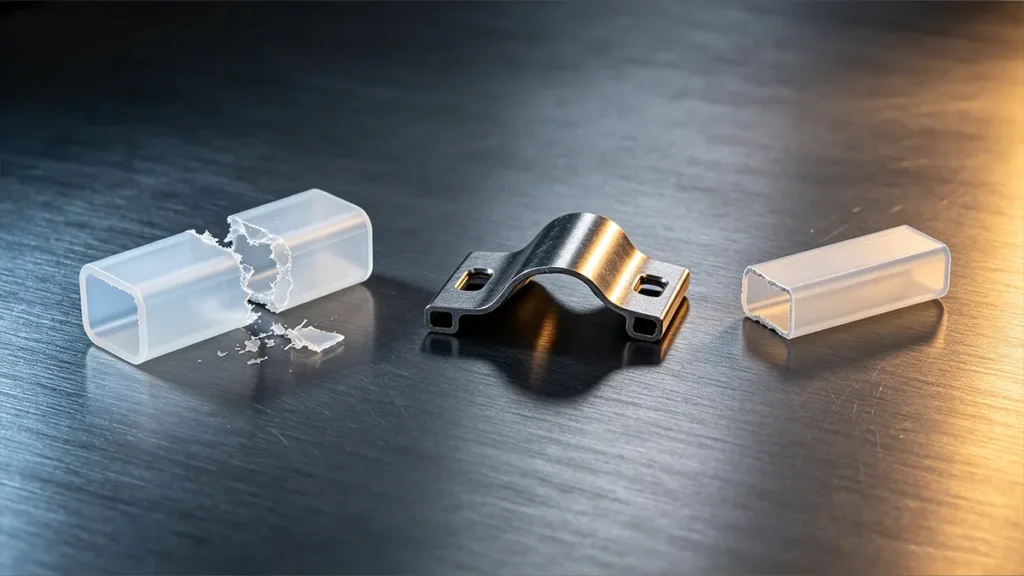
Engineers unknowingly make mistakes in the product design while determining and selecting product strength. Sometimes, products will fail because of shear failure, while most attention is paid to the tensile and yield strength. Different materials in the product development may fail because of insufficient design for different strengths. For instance, while exceeding yield strength can lead to plastic housing deformation, a threaded insert can fail because of insufficient shear strength. Similarly, once metal brackets reach their tensile strength, they fracture. These instances demonstrate that different materials experience different types of strength, which must be considered in the product design and development. But is there a distinct difference among these three properties? This guide describes each property, shows how each differs from the other, and discusses their measurement and testing.
What Are Tensile Strength, Yield Strength, and Shear Strength?
Most people are likely to misinterpret these terms because of their close relationship. In fact, those outside the physics, mechanics, and engineering fields sometimes think they are the same. However, these terms describe different failure mechanisms. Let’s delve into each term.
What is Tensile Strength?
Tensile strength is one of the mechanical properties that are non-negligible in industrial applications. This property has a critical impact on the safety and performance of different materials used in the manufacture of different products.
This property is observable in the day-to-day activities. For instance, a crane can lift a heavy load using a thin steel wire rope without the wire breaking. This is because the wire has very high tensile strength. Suppose the load exceeds the steel rope’s tensile strength; the rope will fracture and break, leading to casualties.
Definition and Units
The tensile strength is defined as the maximum amount of stress that a material can withstand before breaking or fracturing. It is calculated by dividing the maximum tensile force by the original cross-sectional area of a specimen. It works on the principle that when stress is increased in a material, the bonds between its atoms are stretched and eventually broken.
A material gains its elasticity when stress is applied. When the stress is removed, it gets back to its original shape. However, as the stress continues to be applied, the material enters the plastic region. In this region, the material’s internal atomic or molecular structure undergoes permanent slip (driven by dislocation movement in crystalline metals or molecular chain untangling in polymers), and it becomes impossible for the material to revert to its original shape [1].
Tensile strength is measured in Megapascals (N/mm2). The following table summarizes the other related units.
| Unit | Common Use |
|---|---|
| MPa | Most common in engineering and manufacturing |
| Psi | Common in the United States |
| Ksi | Frequently used for metals in U.S. engineering |
1MPa≈145Psi
1Ksi=6.895 MPa
Formula for Tensile Strength
Tensile strength (S) is given by;
S = F / A
Where F is the applied tensile force in N or lbf. A is the original cross-sectional area of the specimen (mm², m², or in²).
The maximum tensile strength achieved by a material during loading is called ultimate tensile strength (UTS). Once UTS is reached and exceeded, a material starts necking. As more loading is added, necking accelerates until the material fractures. UTS is given by,
UTS=Fmax/A0
Where Fmax is the maximum force sustained before failure, and A0 is original cross-sectional area before loading.
Measuring Tensile Strength
You can measure tensile strength by performing tensile tests from Universal Testing Machine (UTM). UTM is sometimes called tensile testing machine.
The process starts by preparing a standard specimen. For plastics, the material is molded into a dog-bone specimen while a cylindrical specimen is machined for metals. Before machining, the original cross sectional area A0 is measured.
After preparation, the specimen is clamped on UTM. The machine is allowed to pull the specimens at controlled speed. As the machine keeps pulling the specimen, you keep recording the data which includes force and corresponding elongation. You can read the material behavior by observing the stress-strain curve generated by the machine. Tensile strength (S) can then be calculated as shown from the formula above.
What is Yield Strength?
Yield strength and tensile strength are related terms. For ductile materials, a material reaches its yield strength before reaching its ultimate tensile strength. However, brittle materials will typically fracture before any significant yielding occurs.
Yield strength is the stress threshold where materials shift from elastic behavior (reversible deformation) to plastic behavior (permanent deformation). It’s measured in megapascals (MPa).

Take, for instance, when you slowly pull both ends of the paper clip. At first, the clips stretch slightly. When you stop pulling, the clips fold back to the original position. When you continue pulling harder and release the force, the clips do not regain their original position. At this point, we say that the clip has gained its yield strength. Technically, the clip in this state is said to have undergone permanent deformation without breaking.
Measurements of Yield Strength
Before understanding ways of measuring yield strength, it is essential to understand the derivative terms of calculating it. One of the terms is stress (σ). This is the amount of force per area a material experiences. It is given by,
σ = F/A,
Where F is the applied force, and A is the cross-sectional area. Maximum stress is experienced where a maximum force is applied to a very narrow surface area.
The second term is strain (ε). It is the ability of the material to stretch or compress compared to its original size. It is given by,
ε = ΔL/L₀,
Where ΔL is the change in length and L₀ is the starting length.
Young’s modulus (E) tells us how stiff a material is. A high E means the material barely deforms under load, like steel compared to rubber. It is given by
E = σ/ε
A material will maintain straight-line behavior of the stress-strain relationship under Hooke’s law until it reaches the yield point, the exact threshold where the applied stress permanently overcomes the interatomic forces holding the material’s crystalline lattice in its elastic state [2].
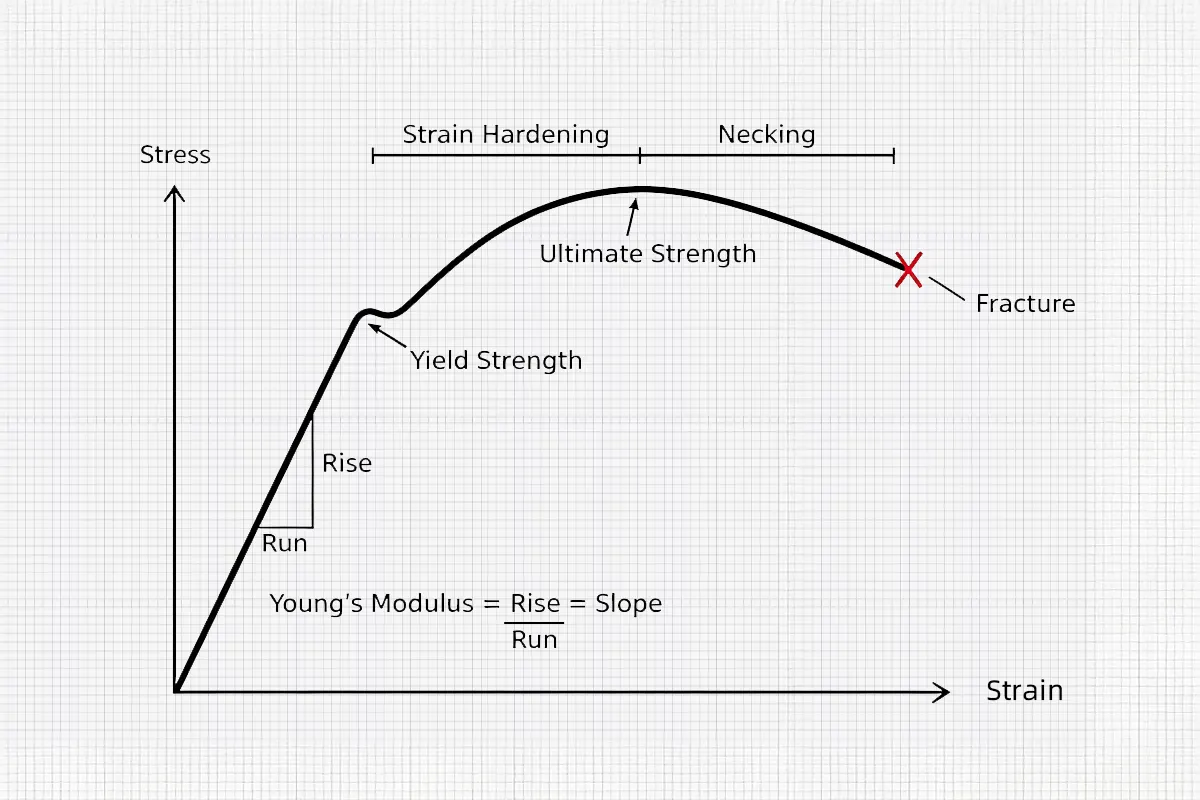
A material is said to be stiff if it resists deformation. Such materials have the highest Young’s modulus. However, it doesn’t mean that they have the highest yield strength. A good engineering design must always balance these properties. For a deeper dive into how stiffness differentiates from overall strength and hardness, refer to our comprehensive guide on [Strength, Stiffness, and Hardness].
What is Shear Strength?
Before understanding shear strength, it is important to understand what shear force is. A shear force describes the internal force that acts parallel to a surface trying to slide or deform one part of a surface relative to another.
Shear strength is a material’s ability to resist forces that can cause the internal structure to slide against it. As the shear forces are applied, the material surface will tend to slide and deform. Shear strength is essential in various engineering applications where materials are subjected to lateral forces.
Shear strength plays a vital role in the design and analysis of structures such as beams, columns, and joints. Ensuring adequate shear strength prevents structural failures and enhances the longevity of constructions.
Shear strength is also exhibited in day-to-day experiences. In a steel bridge, bolts connecting structural members are primarily subjected to shear loads. If the load becomes excessive, the bolts may shear off, allowing the connected plates to separate. This strength is also applied in bolt cutting. The cutting force is applied in the opposite direction. These opposite forces cause the material to fail along a plane rather than stretch. The ability of the bolt to resist these two opposite forces is shear strength.
Measurement and Testing of Shear Strength
Shear tests are commonly used in material science, engineering, and various other industries to assess a material’s suitability for specific applications.
In shear testing, a sample material is placed between two parallel surfaces, and force is applied until the material experiences shear failure. The key parameter measured is the shear stress, which is calculated by dividing the applied force by the material’s cross-sectional area. The result can provide insights into the material’s durability, strength, and performance under real-world stress conditions.
What are Typical Tensile, Yield, and Shear Strength Values?
The following table summarizes the tensile strength, yield strength, and shear strength of different materials. These baseline values are strictly derived from standardized room-temperature testing protocols (such as ASTM E8 for metals and ASTM D638 for plastics) [3].
| Material | Tensile Strength (MPa) | Yield Strength (MPa) | Shear Strength (MPa) |
|---|---|---|---|
| Aluminum 6061-T6 | 310 | 276 | 207 |
| Aluminum 7075-T6 | 572 | 503 | 331 |
| Stainless Steel 304 | 515 | 215 | 310 |
| Carbon Steel A36 | 400–550 | 250 | 250 |
| Brass C360 | 338 | 124 | 207 |
| ABS | 40–50 | 35–45 | 25–35 |
| Polycarbonate | 60–70 | 60–65 | 40–50 |
| Nylon 6 | 70–90 | 65–80 | 45–60 |
| PEEK | 90–100 | 90–97 | 55–70 |
Reference
[1] Meyers, M. A., & Chawla, K. K. (2008). Mechanical Behavior of Materials (2nd ed.). Cambridge University Press. https://doi.org/10.1017/CBO9780511810947
[2] Pelleg, J. (2012). Mechanical Properties of Materials. Springer. https://doi.org/10.1007/978-94-007-4342-7
[3] ASM International. (1990). ASM Handbook, Volume 2: Properties and Selection: Nonferrous Alloys and Special-Purpose Materials. ASM International. https://doi.org/10.31399/asm.hb.v02.9781627081627













 EN
EN  ES
ES  FR
FR  DE
DE  IT
IT  PT
PT  NL
NL  PL
PL  AR
AR  JA
JA  KO
KO  ZH
ZH