

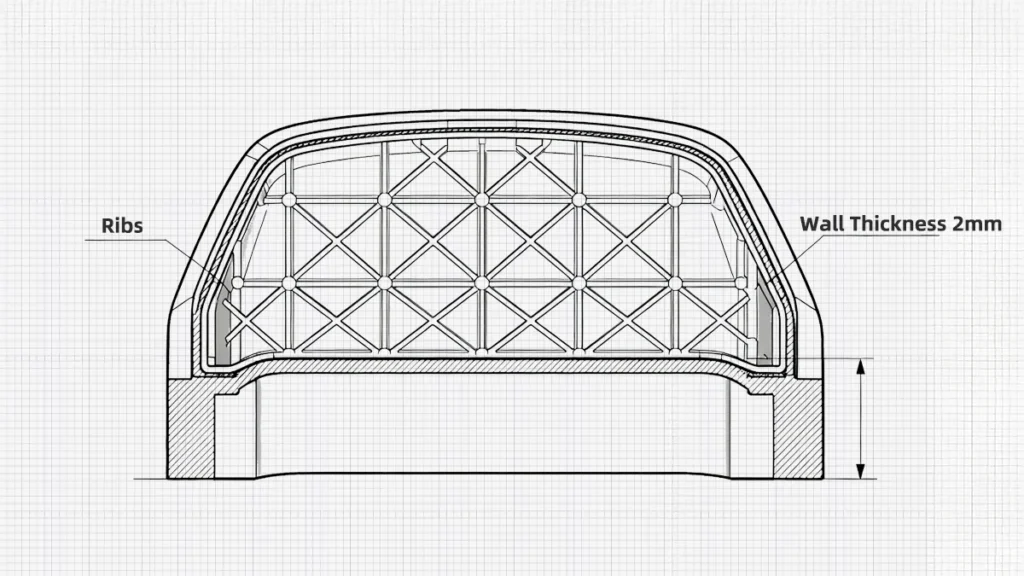
Ribs act as mini columns or beams that provide support to large, thin-walled surfaces. They add rigidity, strength, and improve the load-bearing capacity of walls or flat surfaces without increasing the overall thickness, cycle time, and material cost of the part—if applied properly. Additionally, rib design in injection molding can prevent sink mark and warping. Some of the times when the use of ribs is necessary include:
- Optimal strength is desired in the plastic part while maintaining thin walls
- The part will endure bending, torsion, and pressure
- The plastic part requires additional strength without increasing material use and weight
- The part is large and complex
Manufacturers must be intentional about rib design and placement based on the stresses that the part or product will be subjected to in its application environment. To better appreciate the importance of rib design, it is important to look at the role they play in structural integrity.
How Optimized Rib Design in Injection Molding Impacts Product
The rib design, height, and thickness are critical to the strength and quality of a plastic product or part. They strengthen thin parts without increasing the wall thickness. Manufacturers prefer using ribs to strengthen their parts as opposed to increasing wall thickness.
Thicker walls can increase manufacturing defect risk, such as sink marks and warping, which impact the product’s quality. Also, thicker parts require more materials, which increases the production costs—and part weight. Optimized rib design helps to achieve the following:
1. Enhance Structural Rigidity
Thin walls are prone to deformation from external forces. However, through optimized injection molded rib design, the wall is strengthened to withstand mechanical stress. The added ribs underneath the walls often appear decorative in nature. However, their main purpose is to disperse stress so that it doesn’t concentrate on a spot and lead to structural failure. Proper rib design can improve structural durability.
2. Relevance in Defect Prevention
Plastic materials used in injection molding shrink as they cool, which can lead to warping. The rate of shrinkage will vary depending on the specific material. Polypropylene and polyethylene experience the most shrinkage compared to polycarbonate and polystyrene. Optimized rib design in injection molding provides support and evenly distributes internal shrinkage to maintain the stability of the shape and reduce sink marks and warping.
3. Improve Load-carrying Capacity
The addition of appropriate ribs will increase the compressive resistance of thin walls, thereby increasing the amount of load they can bear without deformation. This is particularly important where a part must withstand bending, compression, or tension. The addition of ribs helps to evenly distribute the pressure throughout the structure, lowering the risk of localized damage.
4. Reduction in Material Costs
A fraction of the material that would have been used to increase the wall thickness can be used to create ribs with the right thickness and height. The ribs make the part more rigid without increasing thickness. Since material costs make up 30 to 70% of the total production costs, reducing material use without affecting the integrity of the part will directly lower the production costs.
5. Extend the Product’s Life
The use of optimized rib design in injection molding will delay the formation or expansion of cracks. They do this by distributing stress, especially in products exposed to dynamic loads. Improved durability is always an integral part of consumer satisfaction.
Essential Rib Design Rules to Avoid Common Failures
Sink marks, warpage, and cracking are some of the most common injection molding rib design defects. Their presence can affect the integrity of the product or make it less aesthetically appealing, ultimately leading to the discarding of an entire batch of product. How do these defects occur?
- Warpage: Happens when there is uneven wall thickness, which leads to differential cooling between the thick and thin sections.
- Sink marks: This occurs when the thin adjacent wall cools faster than the thick rib section, which leads to visible depression on the surface.
- Cracking: The major causes of this defect are excessive thickness at the intersections where ribs join with the main wall or stress concentration at sharp corners.
To avoid failures related to rib design in injection molding, manufacturers must follow a set of rules governing rib thickness, height, fillet design, and draft angle.
Rib Thickness
The rule of thumb is that the thickness of the ribs should be around 50 to 60% of the adjacent wall thickness, and not more. Maintaining this rib-to-wall thickness ratio helps to prevent shrinkage patterns, air bubbles, sink marks, and stress concentration. Manufacturers who use thicker ribs will face cooling difficulties.
Rib Height
The height of the rib should be limited to 2.5 to 3 times the nominal wall thickness. A longer rib design in injection molding is harder to eject and prone to breakage. Also, the excessive thickness can lead to cracking, sink marks, and voids. Manufacturers must optimize rib height by experimenting to find the lowest possible height where the ribs will still be functional.
Rib Spacing
Stacking ribs too close to each other can create problems with cooling and material fluidity, which will not only make the cycle times longer but also create sink risks. As a rule of thumb, the distance separating two ribs should be 2 to 3 times the thickness of the nominal wall. This will allow for even material flow, uniform cooling, and shorten the cycle times.
Rib Base Radii
Making the base of the rib rounded will help to minimize stress concentration in the part. As a rule of thumb, the radius should be kept around 0.25 to 0.5 times the wall thickness of the part to increase strength. Avoid sharp corners, which will add to stress concentration, using chamfers or fillets. Stress concentration can lead to cracking, crazing, or total part failure.
Rib Draft Angle
Making the injection molded rib design too straight will lead to a defect where the part will stick to the mold during ejection, which can cause damage to the part. To avoid this, draft angles of around 0.5 to 1 degree are added on each side of the rib.
Rib Placement
The location of the ribs should be strategic and mostly concentrated on areas where strength is needed or along flat or thin sections. This will not only provide structural support but also improve performance. Choose numerous smaller ribs over fewer larger ones.
Rib Design in Injection Molding Guideline at a Glance
| Rib Thickness | 50% to 60% of nominal wall thickness |
| Rib Height | 2.5 to 3 times the nominal wall thickness |
| Rib Spacing | 2 to 3 times the thickness of the nominal wall |
| Rib Base Radii | 0.25 to 0.5 times the nominal wall thickness |
| Rib Draft Angle | 0.5 to 1 degree on each side |
| Rib Placement | Along flat or thin sections or where strength is needed |
Selecting the Right Material and Process for Rib-Reinforced Parts
The material selection will directly impact rib design in injection molding. For example, when using stiffer materials with high strength, manufacturers may need fewer ribs of smaller heights to achieve the desired structural integrity, compared to when the material in use is less stiff.
Likewise, the thermal conductivity of the material must be considered because of its impact on cooling—and the associated defects if not properly managed. That said, here are the factors that must be considered during material selection.
- Material stiffness and strength: Materials with higher stiffness can let manufacturers create fewer or thinner ribs and achieve the same structural integrity. Consequently, this can lead to lower material usage and weight.
- Thermal conductivity: The thermal conductivity of the material will affect the cooling times. The right injection molding rib design must include adequate spacing in materials with low thermal conductivity to improve cooling.
- Impact resistance: When the part needs to withstand high impact, the selected material should have this property. The use of Acrylonitrile Butadiene Styrene (ABS) and some polycarbonates will help prevent breakage and brittleness.
- Creep resistance: If the part or product will be under sustained load, using high-performance polymers like PTFE, PAI, and PEEK will help maintain the structural integrity and shape of the part over time.
- Environmental impact: During the material selection process, an important factor to consider is the environment where the part or product will be used. If it will be exposed to saltwater UV radiation or extreme temperatures, the selected material should have the properties to withstand these environmental factors.
- Cost: In high-volume productions, it is important to consider the cost of material for profitability and competitiveness. A less expensive alternative that won’t compromise on structural integrity and quality should always be favored.
Process for Rib-Reinforced Parts
Just as the material selection process must be intentional, the process of rib design in injection molding must accommodate the unique properties of the selected material. Considerations that must be made in rib design, based on the selected material, are as follows:
- Melt viscosity: When working with materials with higher melt viscosity, the manufacturer may need specialized equipment to ensure proper filling of thin and complex rib geometries. Alternatively, the manufacturer can experiment with the possibility of using a higher melting temperature without destroying the integrity of the material.
- Fiber-reinforced material: Manufacturers using fiber-reinforced plastics must incorporate special geometries in their rib design to optimize the alignment of the fibers for maximum strength.
- Sink marks: Too thick rib design or using materials with high melt viscosity can lead to depressions called sink marks on the surface opposite the ribs. To avoid this, the rib-to-wall ratio must be properly managed.
- Branding: While this is not a critical production factor, it is still important to consider if the rib design would include special graphics or logos, which will also play a role in material selection.
Using Advanced Technologies to Optimize Rib Performance
The traditional methods of optimizing rib design in injection molding relied on trial and error, which can be both costly and time-consuming. Some of the challenges encountered with traditional rib design are highlighted in the table below.
| Rib design flaws | Impact on part or product |
|---|---|
| Excessive ribbing | It prolongs cycle times, material usage, and heightens the risk of damage during ejection |
| Abrupt transition in thickness | A sudden change from thin to thick sections can lead to poor filling and increase the risk of defects like warping and sink marks |
| Inadequate vents around ribs | Poor vents around ribs will lead to excessive injection pressure that can lead to sink, burn marks, and short shots |
Manufacturers often use advanced technologies to simulate material flow, to overcome rib design flaws. Data from these simulations can be used to predict rib behavior under different circumstances. It also helps in material selection, finding the right designs for efficient heat transfer, improving structural strength, and lowering pressure drops and drag. Below are some of the advanced technologies used for rib performance optimization.
Computational Simulation
The best example of computational simulation for injection molding rib design is the use of computational fluid dynamics (CFD). This powerful engineering tool uses high-performing computing to analyze issues regarding fluid flows (including liquids and gases) under different conditions. It works by applying the laws of mass, momentum, and energy conservation. The simulation of fluid in a virtual environment allows manufacturers to predict performance, visualize the flow patterns, and optimize the part or product design.
Optimization Algorithms
They are used with computational simulation to find optimal rib configuration and shape. Non-dominated Sorting Genetic Algorithm II (NSGA-II) is one of the popular tools used in rib design. Compared to earlier algorithms, NSGA-II is faster and makes use of a non-dominated sorting approach to lower computational complexity.
Additive Manufacturing
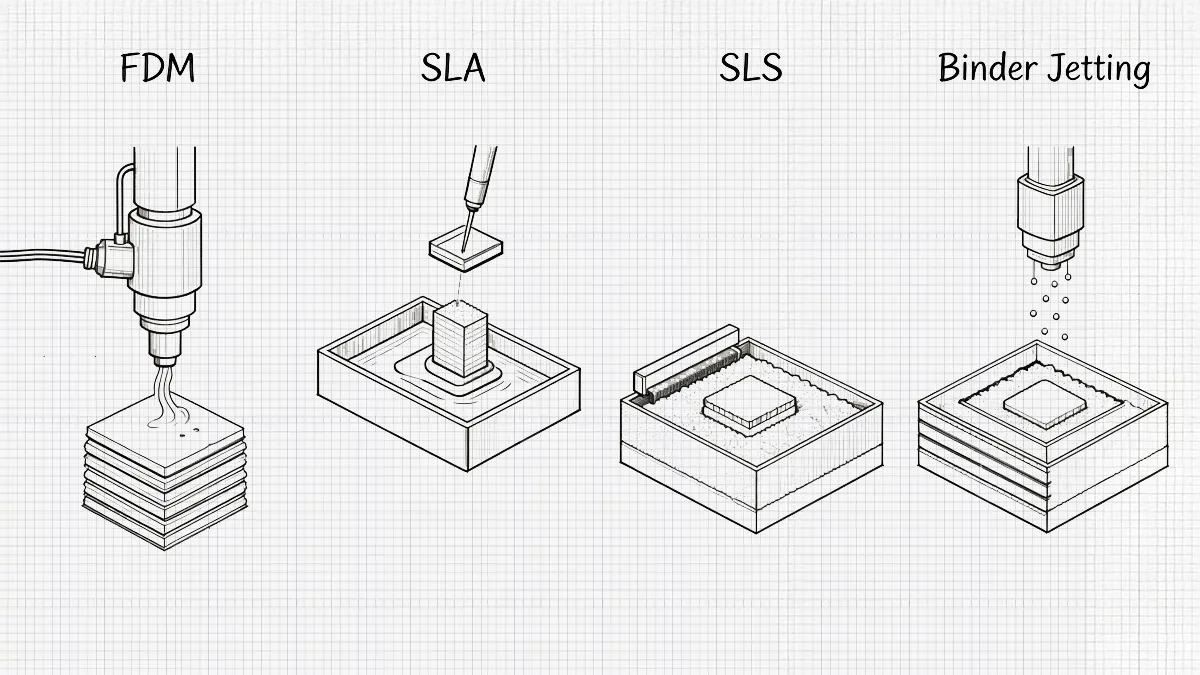
Advanced additive manufacturing techniques, like 3D printing, have enabled manufacturers to create intricate rib structures that were previously impossible with traditional molding methods. For example, 3D-printed conformal cooling molds balance the cooling rate in complex rib designs in injection molding, which can significantly prevent warping and sink marks.
Topology Optimization
This is another computational method based on the Solid Isotropic Material with Penalization Method (SIMP) theory that can be used to directly design and optimize ribs for proper structural reinforcement. It leverages AI algorithms to optimize rib cross-sectional shape and placement to minimize material use without compromising performance goals.
Simulation Software
Autodesk MoldFlow and Ansys Workbench are popular flow simulation software. Manufacturers leverage these tools to assess different rib designs in injection molding to ensure the chosen configuration aligns perfectly with the performance requirements of a specific material. With MoldFlow’s defect thermal map, manufacturers can predict and prevent blemishes like weld lines, warpage, and sink marks.
Metamodeling
Kringing metamodels are used for sensitivity analysis and system optimization. It is used in injection molding rib design to create faster and simplified predictive models from CFD data. This saves time and helps to speed up the optimization process. The use of metamodels helps to lower computational costs by substituting full-scale simulation with a statistically effective replacement model.
Solving Real-World Problems in Critical Applications with Rib Design
CFD and various other optimization techniques have empowered manufacturers to design and optimize ribs for critical applications, like aircraft wing ribs, with greater efficiency and accuracy. The optimization of wing ribs helps to increase lift and reduce drag for a more efficient aircraft operation. Other critical applications of optimized rib design in injection molding include:
1. Improving Heat Transfer
Overheating is one of the challenges faced by electronic devices. For the systems to continue working optimally, manufacturers must find a way to transfer and disperse that heat through the structure effectively. In laptops, for example, ribs are placed within the cooling channels to create airflow turbulence that increases heat transfer from the heat sink.
Manufacturers also leverage technologies to find the right rib shapes for wind turbine blades (e.g., V-shaped, elliptical, etc.) and configurations that will maximize heat removal—especially in environments with high temperature—while also minimizing drops in pressure.
2. Lower Energy Consumption
In automobiles, heavier parts will add to the overall weight of the car, which will lead to higher energy consumption. By optimizing injection-molded rib designs using advanced technologies, manufacturers can create lighter and more efficient parts that will contribute to the automobile’s increased energy efficiency by lowering the overall weight of the vehicle.
3. Restricting Fuel Motion in Aircraft Tanks
Rigorous fuel motion in aircraft tanks is potentially dangerous. The motion can lead to rapid shifts in the center of gravity that can affect the airplane’s stability. It can also lead to fuel starvation during maneuvers or the build-up of static electricity that can lead to an explosion or ignite fire. To prevent this, optimized ribs are added to the internal compartments of aircraft tanks to limit fuel motion and stabilize the fuel’s center of gravity for flight stability.
4. Solar Air heaters
Manufacturers of solar air heaters use ribs to form artificial roughness on absorber plates. This roughness enhances heat transfer for efficient performance of the solar air heater.
It is always important to work with professionals like First Mold, who understand rib design in injection molding guidelines. The right manufacturing partner should have advanced technologies to offer data-driven advice on rib design, height, placement, and material selection based on the expected structural properties and environmental application of the desired product or part.




 EN
EN  ES
ES  FR
FR  DE
DE  IT
IT  PT
PT  NL
NL  PL
PL  AR
AR  JA
JA  KO
KO  ZH
ZH