

Before the discovery of low pressure injection molding (LPIM) in the 1970s, different traditional methods hermetic sealing, potting, and conformal coatings, were used for the encapsulation of electronic components. The major challenge with these techniques is that sometimes the electronic component is not properly sealed or the seals degrade over time, exposing the electronic components to moisture and potential hazards.
There was also the risk of damage during the sealing process from high temperatures or mechanical damage during the application of the sealant. Components like printed circuit boards tend to have uneven surfaces or complex geometry, which makes it harder to achieve uniform sealing. These traditional methods are mostly labor-intensive and time-consuming, which raises the manufacturing costs.
What Is Low Pressure Injection Molding?
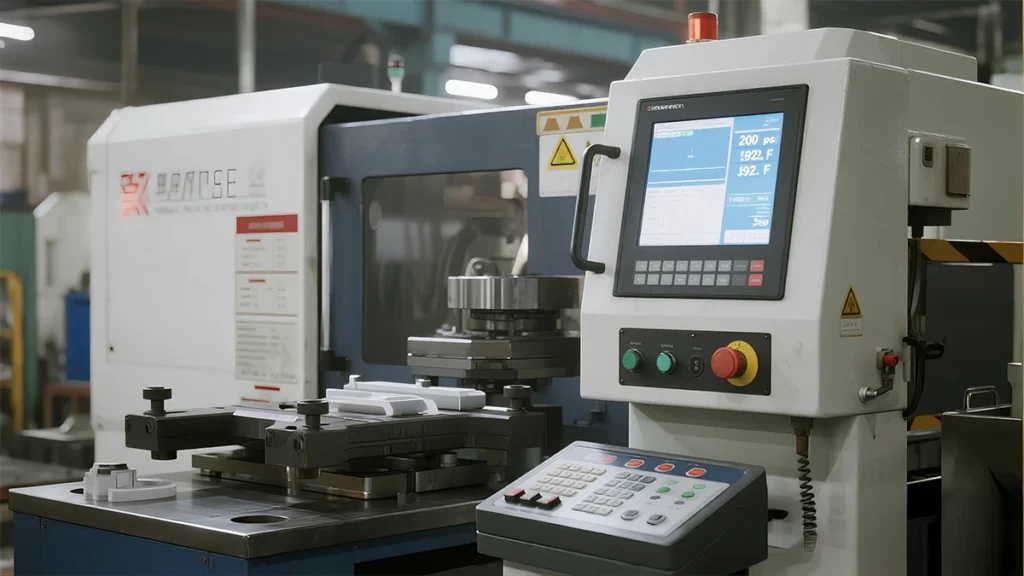
Just as the name suggests, thermoplastic materials are used at low pressure (20 to 580 psi) and temperature (356°F to 428°F) to encapsulate delicate electronic parts. The lower pressure makes it safe for components like connectors and printed circuit boards (PCBs), which high temperatures and pressures can easily damage.
Thermoplastic materials like polycarbonates and polyamides (nylon) are mostly used because of their increased flowability at lower pressures. Here are the different types of materials used in low pressure injection molding and their benefits.
| Thermoplastic Material | Benefit |
|---|---|
| Polyamides (nylon) | Possess good mechanical strength, are resistant to abrasion, highly durable, and easy to process. |
| Polycarbonates | Offer extraordinary strength and clarity. |
| Polyurethanes | Resistant to impact and highly flexible. |
| Polyolefins | Easy to process and more affordable compared to other materials. |
| Silicones | Resistant to temperature and chemicals, highly flexible, and biocompatible. |
| Epoxy resins | Good for electrical insulation with good chemical resistance. |
Different factors will determine the choice of material for your product. The most important factors are the properties you want the product to have and the environment where it would be used. For example, if you are creating a product that would be used in a hospital, medical-grade silicone (ISO 10993 certified) is the best choice because of its high resistance to temperature and chemicals and its biocompatibility.
Steps Involved In Low Pressure Injection Molding
The main idea about this technique is to melt the desired plastic material and mold it around the component. The entire process can be summed up into four main steps. Thus, it is easier to tell that it is a more streamlined process compared to traditional methods like potting with seven to eight steps. The stages involved in low pressure injection molds are as follows:
- Heating the molding material: The first step is heating the desired thermoplastic material.
- Placing the component: The component to be encapsulated is placed in one half of the mold cavity, and the mold is closed.
- Injection of molding material: The liquefied molding material is injected into the cavity at low pressure.
- Cooling: Due to the reduced temperature and pressure, low pressure injection molding cures faster
Technical Comparison Table: LPIM vs Traditional Processes
The LPIM technique of coating materials is simpler and more efficient compared to traditional methods. Unlike the latter, it requires lower human input, which makes scaling without added human errors possible. It achieves perfect concealment without harming delicate materials. Some of the key benefits of using LPIM in the manufacturing industry are highlighted below.
#1. Improved cost efficiency
Low pressure injection molding uses less material to achieve complete encapsulation compared to traditional methods. Also, it operates at lower pressure and temperature, which means lower energy bills. The faster cycle time allows manufacturers to increase their production and fulfil orders faster.
#2. Lower investment in tooling
Due to the lower temperature and pressure requirements for this process, less expensive aluminum molds can be ideal instead of the more expensive steel molds, especially for smaller production runs. This lowers the initial investment and leads time.
#3. Better component protection
LPIM does a better job at protecting components with complex geometries like connectors, sensors, and circuit boards with greater consistency and minimal risk of damage. The sealant gets into areas where traditional methods may struggle to reach.
#4. Better aesthetic and resistance
Low pressure injection molding achieves a cleaner and more polished finish, which consumers will find more attractive compared to traditional methods. Also, manufacturers can customize the properties of their product by altering the material used in the molding.
| Properties | Low Pressure Injection Molding | Potting |
|---|---|---|
| Steps | Fast with 3 to 4 fewer steps | Slower with 7 to 8 steps |
| Curing time | Seconds (5 to 50 secs) | Hours or days |
| Material use | Higher material efficiency. Lowers the amount of material used | Frequent material wastage. Requires a high amount of sealing material |
| Recycling material | Thermoplastics (nylon, PC) are recyclable due to reversible molecular bonding, while thermosets (epoxy) form permanent cross-links and cannot be recycled. | Excess material after curing is not recyclable because the process is a chemical reaction. |
| Environmental impact | More environmentally friendly when using non-PU materials or with VOC capture systems | Risk of toxic fumes or wastes (contains two-part polyurethanes) |
| Cost | More cost-effective over time | Higher costs from labor and material waste |
| Human intervention | Can be automated, which reduces human error | Labor-intensive and requires close human monitoring in the mixing of the materials |
| Weight of part | Lowers the weight of the part because of the thin coating | A heavier coating means an increased weight of the part |
In-depth analysis of three major pain points in manufacturing electronic devices
Electronic devices are delicate. Their efficiency or outright usefulness can be harmed by natural elements like dust, UV, and moisture. Therefore, electronic device manufacturers must figure out a way to protect their products from these natural elements without harming the unit. Finding the balance has been a major challenge in the industry until low pressure injection molding.
Although previous traditional methods offered some level of protection to electronic devices, like printed circuit boards and connectors, they usually faced three key challenges: lack of precision, high damage rate, and high impact on costs and the environment. Manufacturers who relied on traditional methods were often called out by environmental regulators for leaving a messy footprint. So, how did manufacturers overcome the pain points of traditional encapsulation methods using low pressure injection molding?
Pain Point 1: The dilemma of packaging efficiency for precision electronic components
The traditional coating methods would have been easier to use if electronics had just one component. However, a typical PCB has different components with varying geometries, sizes, and orientations—and that is where traditional encapsulation techniques struggle.
With conformal coating and potting, it is hard to achieve the same sealing consistency across the entire board. In other words, you will end up with a product where one area may have a thick layer of sealing material while another area will have a thin layer. This imperfect coating can introduce air gaps or lead to incomplete coverage, thereby leading to incomplete protection of the electronic device.
Pain Point 2: High damage rate of thin-walled parts/inserts
Unlike low pressure injection molding, traditional encapsulation techniques are labor-intensive, which can lead to higher damage to thin-walled parts from human error. For example, since the curing process of some potting compounds involves chemical reactions, they can generate heat that may damage sensitive components or cause failure in solder joints.
Damage to thin-walled parts can occur due to the shrinkage of the potting compound during the curing process. The shrinking can cause stress on the component due to the inflexibility of the potting material. Part of this failure may result from cracking or delamination of the coating material. Cracking can occur due to the disparity in the coefficient of heat-induced expansion between the coating material and the substrate. Once cracks form, the electronic parts become vulnerable to dust and fluid.
Also, traditional sealants are difficult to remove, which makes repairability difficult if there is damage to the part. Therefore, great care must be applied in removing the seals to avoid further damage to the parts.
Pain Point 3: High costs and risks of environmental compliance
The material waste from traditional methods may seem small at first, compared to fabricating an aluminum low pressure injection mold. However, the costs will eventually start adding up when you have to frequently fill in new supply orders. Potting is also labor-intensive, which means more workers on your payroll. Low pressure injection molding makes up for the initial higher tooling costs by allowing manufacturers to run faster cycles, reduce labor, and lower material consumption.
Beyond the economic cost, traditional coating often uses chemicals that may be toxic to the environment. For example, potting makes use of isocyanates. Short-term inhalation of this compound can lead to eye irritation, nose and throat irritation, wheezing, coughing, and gastrointestinal disturbances like nausea.
Low Pressure Injection Molding Technical Implementation Guidelines
For the effective and consistent implementation of low pressure injection molding, manufacturers must follow a set of guidelines. These guidelines cut across material selection, mold design, setting up of the molding machine, and process control. A great deal of thought must go into each of these factors, with the perfect encapsulation of the electronic part or insert at the center.
- Material selection: The material of choice must be compatible with the electronic part, as well as have the right properties (moisture and temperature resistance, and chemical compatibility) for the intended application.
- Mold design: For consistent material flow and to avoid weld lines, the wall must have uniform thickness, and the gate must be of the right size and location. Sharp corners should be avoided to lower stress concentration, which could lead to cracks. Vent should be adequate for proper air release during injection to avoid the formation of air pockets, which would lead to defective products.
- Setting up the molding machine: The molding machine must be set at optimal parameters for low pressure injection molding as recommended by the manufacturer, including temperature, pressure, injection speed, and cooling time.
- Process control: The key molding parameters must be consistently monitored to ensure consistency in part quality. All material specifications, parameters, procedures, and troubleshooting guides should be documented.
Equipment selection table
Low pressure injection molding requires specialized equipment optimized to handle the delicate insert. The temperature control and material delivery systems are critical components that can make or mar the success of the system in encapsulating fragile electronic parts. The table below will guide you in equipment selection.
| Equipment Component | Key Consideration |
|---|---|
| Mold design | Must have precise space for placement of the inserts |
| Tooling material | Aluminum is preferred because of its machinability and lower cost |
| Material selection | The material used must be compatible with low pressure molding |
| Temperature control | The system must maintain the correct temperature, which is crucial for maintaining product integrity. |
| Material delivery | Choose machines with hydraulic systems that meet the specific speed, pressure, and temperature requirements of your process. |
Key points of mold design
When designing a mold, attention must be paid to the core, draft angles, parting line, ejection system, and cooling channels. The mold design strategy begins with the analysis of the insert’s 2D/3D drawing that contains dimensions, geometry, and tolerance. The core design is modeled after the part’s geometry. Other critical considerations in mold design are:
- Draft angles: Prevent sticking of the part to the mold, which could lead to damage during ejection.
- Parting line: The location should be carefully thought out to minimize visibility that may affect the part’s aesthetics and structural integrity.
- Ejection system: The ejector pins should be effective and minimize any potential damage to the molded part
- Cooling system: Must be strategically placed within the mold to properly circulate coolant and prevent sink marks or warping.
- Design for manufacturability: The mold design must be efficient and relatively easy to produce.
Industry application of low pressure injection mold
Injection molding under low pressure has a broad industrial application, including in electronics, automotive, medical devices, and aerospace. When properly done, it provides excellent protection against chemicals, dust, and moisture. Consequently, it helps to extend the lifespan of the sealed component. Below are practical industrial applications of LPIM.
- Electronics industry: Used for coating circuit boards, connectors, and other delicate components to protect them from moisture, physical impact, and dust. It can also form a structural part of the component.
- Automotive industry: It is mostly used for overmolding material to substrate, particularly in the vehicle interior, including door guards and parcel shelf guards.
- Medical devices: Medical devices need to be sterilized frequently using chemicals or heat. The sensitive part of devices is usually encapsulated using low pressure injection molding to ensure they can be sterilized without losing their efficiency.
- Aerospace industry: Low pressure injection molding is used to seal cable connections as a more durable and permanent solution for cable connections.
The shift to low pressure injection molding has helped manufacturers to avoid the pitfalls of traditional encapsulation of electronic parts and made the entire process faster and more sustainable. The benefits of injection molding with low pressure are enormous. By fully understanding the process, manufacturers can make the right choice on the best material to use to achieve the desired result.




 EN
EN  ES
ES  FR
FR  DE
DE  IT
IT  PT
PT  NL
NL  PL
PL  AR
AR  JA
JA  KO
KO  ZH
ZH