

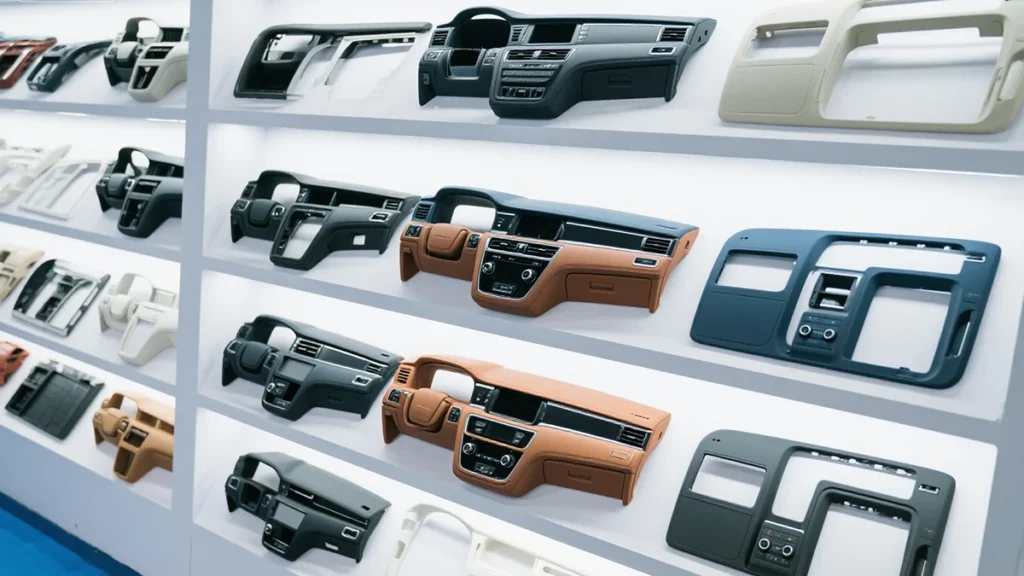
There are five key features that consumers consider in choosing a new vehicle. They are comfort, performance, technology, safety, and costs. Although consumer preference has continued to shift, comfort is one feature that many will never compromise. A 2024 data from MarketingCharts shows that quality was the top reason considered by consumers when making a purchase [1]. Comfort is a major part of car quality. This is why automotive interior manufacturers are coming up with new ideas to improve overall comfort.
Automakers design the cabin of a modern vehicle to be aesthetically pleasing, functional, and comfortable for occupants. It is essential for automakers to be intentional about their interior design because modern cars are becoming more than driving tools. They are now a personalized environment for relaxation and work.
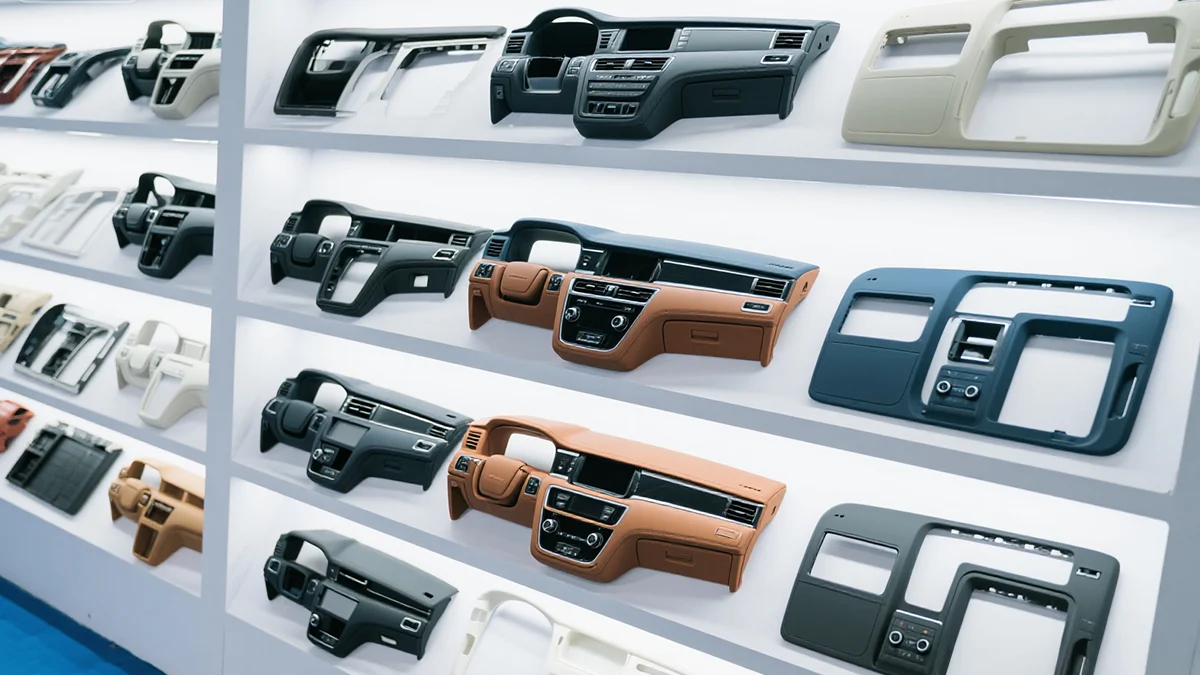
Injection-Moldable Automotive Interior Components
Automotive interior parts can be decorative, functional, or operational. The approach to interior parts manufacturing (from material selection to the molding technique and finishing) will depend on the role they play. For example, when manufacturing decorative parts, the focus is usually on getting accurate polish, texture, and colors.
On the other hand, if the part is expected to be functional or operational, extra effort goes into dimensional accuracy to ensure the part fits perfectly with other components for a smooth operation. Durability is also a major concern for operational parts. Injection molding is usually the primary choice for car interior parts making if:
- The part is not a core load-bearing component. Load-bearing components like seat frames will require metal reinforcement.
- The part has complex structures or textures, like grooves, clips, or custom textures. Injection molding excels at creating complex textures in one shot.
Decorative and Cover Components
The primary aim of the decorative and cover components of automobiles is to improve comfort and aesthetic appeal. Additionally, cover components provide protection for the underlying structure. We highlight below the parts of car interiors that play decorative roles.
| Decorative or Cover Parts | Use | Material and Injection Molding Process |
|---|---|---|
| Panel/dashboard trim | It improves vehicle aesthetics as well as conceals and protects underlying components. | Made of carbon fiber, vinyl, wood, or specific plastic materials like Acrylonitrile Butadiene Styrene (ABS) or Polypropylene (PP). Gas-assisted injection molding, overmolding, or thermoforming. |
| Door interior panel trim | Adds beauty to the door and protects the mechanical and electrical components, like speakers and motors. Includes ergonomic surfaces like armrests. | Usually made with polypropylene using large-scale molds. Hot runner systems with sequential gating controls can be used to remove visible weld lines. |
| Center console panel housing | Serves both aesthetic and functional purposes. It includes the storage compartments and houses various controls and accessories, including the gear stick or selector, multimedia system controls, storage bins, and more. | Commonly produced with engineering-grade thermoplastics like PP, ABS, Polycarbonate (PC), Nylon, and other thermoplastic blends. Automotive interior manufacturers use injection molding for large volume production of center console panel. |
| Floor mat | It enhances the car’s interior aesthetics. Also, they are designed to contain spills and dirt to make cleaning easier. | Injection molding allows the creation of custom-fit mats with complex textures and shapes that precisely fit the contours of the car. |
Other important car interior part that serves decorative or cover purposes include the storage box lid, glove compartment door, speaker grille, and pillar garnish.
Operational and Grip Components
Injection molding is not only used for decorative car interior parts production. Some interior components play operational roles, like the gear shift lever cover and air vent blades. Sometimes, there is an overlap where a part that plays functional roles will be created to blend in with the interior design, therefore also giving it a decorative role.
| Operational and Grip Parts | Use | Material and Injection Molding Process |
|---|---|---|
| Door inner handle housing | The housing contains different mechanisms (including cables and linkage rods) that are used for opening the door (mechanically or electronically) from the inside. | The manufacturing of this interior part is done using high-precision plastic injection molding. This allows for the integration of complex features like mounting points. |
| Gear shift lever cover | It improves grip for an enhanced driving experience, particularly for manual transmission. Additionally, it protects the original knob from sweat, dirt, and wear. | The material selection and injection molding process are often intentionally designed to achieve specific properties, like scratch resistance, oil resistance, and durability. |
| Air vent louvers/blades | They are usually found on the dashboard and the back of the center console. Air vents help in climate control within the vehicle and can be tilted in different directions. | Automotive interior manufacturers use injection molding to create intricate blade designs to optimize airflow dynamics. It is usually more difficult and costlier to achieve this with other manufacturing techniques. |
| Steering wheel switch bezel | It is a plastic trim that houses the control buttons on the steering wheel. It allows drivers to manage different functions without taking their hands off the steering wheel. | Injection molding using ABS, PC, or PC/ABS blend allows for the creation of complex designs with specific surface finishes and integration with other components, e.g., metal inserts. |
Seat adjustment button/knob, window switch panel, instrument panel, and other operational interior parts manufacturing is achieved using precision injection molding. The choice of injection molding is mostly because of the complexity and precision of the parts.
Functional & Auxiliary Components
Functional automobile parts assist other components to operate. A good example is an airbag cover. Auxiliary components, on the other hand, serve the primary purpose of enhancing convenience and comfort. An example of an auxiliary component is a sun visor bracket.
| Operational and Grip Parts | Use | Material and Injection Molding Process |
|---|---|---|
| Cup holder insert | Firmly secures the drinks held in them to prevent spills. It also comes in handy for organizing small items like keys, coins, and phones to keep the interior tidy. | The choice of material often depends on the property that the automotive interior manufacturers desire. Injection molding is used to capture the intricate designs of cup holder inserts. |
| Airbag cover | It protects the hidden airbag module, helping with proper deployment. It also hides the associated wiring and inflation module. | It is often made with plastics or composites. Air bag covers are usually made to match the surrounding material to boost the aesthetic appeal of the interior. |
| Sun visor bracket | It secures the sunshade in a way that allows it to pivot and block windshield or side window glares. This helps to improve visibility by lowering the strain on the eyes. | Car interior parts making, especially the sun visor bracket, relies on injection molding because of its precision in the production of small parts. |
| Trunk interior panel clips | These are small tools used to secure upholstery linings, carpets and various other parts to keep them firmly in place. It also helps to hide wires and bare metal for a clean finish. | The combination of small size and complex designs makes injection molding the perfect technique for producing trunk interior panel clips. |
Steering wheel ornament, window regulator switch panel, and coat hook are the other parts that automotive interior manufacturers usually make with injection molding.
Recommended Chinese Automotive Interior Suppliers
There is a long list of Chinese automotive interior manufacturers who have proven their skills and expertise over the years. The right partner may depend on the material in use and the type of interior part you want to make. Here is a list of the highly recommended car interior manufacturers in China. It is important to mention that this list was arranged in no particular order.
1. Changzhou Huawei Mold Co., Ltd
It was founded in 1992 as a packaging industry and for making home appliances tools. By 1998, the company started building injection molds for the automotive industry. Today, they are one of the biggest automotive exterior and interior tool suppliers in China. Changzhou Huawei Mold creates tools for different interior parts manufacturing, including console, instrument panel, door panel, pillar, door trim, lift gate grab handle, and map pocket.
- Address: No.155 Qinling Road, New District, Changzhou, China
- Website: http://www.huawei-global.com/index.html
- Email: [email protected]
- Telephone: +86-519-85166323
2. Yuefei Mould
Since its inception in 1987, this mold maker has built a strong reputation for crafting large-sized precision molds. The company has an annual production capacity of around 500 mid- to large-sized injection molds. They have created molds for making car interior parts like pillars, door panel components, central console, air filters, tire house trim, armrests, and others.
- Address: No.10 and 12, Jinshan 2nd Road, Zone C, Xinxing Industrial Park, Ninghai, Zhejiang, China
- Website: https://www.yfmould.com/
- Email: [email protected]
- Telephone: 0086-574-65332667
3. First Mold
First Mold has set the standard for end-to-end production solutions using a unified online platform. This eliminates the need for manufacturers to coordinate with multiple suppliers, which can be a traumatic experience. The company was founded in 2011 and has continued to push the boundaries of production possibilities. Their portfolio of car interior parts production includes airbag covers, interior door handles, and so much more.
- Address: 88 West Shagang Road, Gangkou Town, Zhongshan City 528447, Guangdong, China
- Website: https://www.firstmold.com
- Email: [email protected]
- Telephone: +86 13925326660
4. Taoshi Mould Group
Taoshi began as a private workshop in 1978. By 1985, it had morphed into a bigger company with the establishment of Huangyan Mold Factory 2. They started building molds for car interior parts production in 2008. Today, the company has several subsidiaries with an output value of 320 million yuan (approx. 46 million dollars) in 2014, making it one of the largest mold design and manufacturing companies in China.
- Address: Xicheng Xintang, Huangyan District, Taizhou City, Zhejiang Province
- Website: https://www.taoshimould.com/en/
- Email: [email protected]
- Telephone: 0086-576-84111000
5. Silver Basis
This automotive interior parts manufacturer excels in the use of high-tech, advanced manufacturing technologies for the production of precision injection molds and dies. The company got its start in 1993 and has since amassed more than 740 patents to its name. Tooling, functional modules, and checking fixtures are some of Silver Basis’s products.
- Address: No. 603/606, No. 1 Tangkeng Intersection, Baoshi East Road, Guantian Community, Shiyan Street, Baoan District, Shenzhen, 518108
- Website: https://www.silverbasis.com/
- Email: [email protected]
- Telephone: +86 75527642891
6. Kelon Mold
Kelon has carved a specialty in the design and production of large and medium-sized injection and foaming molds. They leverage advanced technology, equipment, and a team of highly trained technical workers to take on all types of car interior parts manufacturing. Since its inception in 1995, Kelon has remained committed to pursuing high-end technology and exceptional quality.
- Address: No. 11 Ronggang Road, Ronggui, Shunde District, Foshan City, Guangdong Province
- Website: http://kelonmold.com/en
- Email: [email protected]
- Telephone: 0086-0757-28362368
7. MeiDou Mould
Founded in the 1980s, this professional automotive injection mold maker builds molds for different automobile parts. They make both inner and outer decorative parts. In 2007, the company’s branch in Xiaoshan expanded into Hangzhou KaiMei Plastic Mould Company. At the core of the automotive interior manufacturer’s competitive advantage is a series of mold processing machines, a group of technical personnel, and a complete set of CAD/CAE/CAM software systems.
- Address: No.31 Chaoyuan Rd, Xinqian Street, Huangyan District, Taizhou, China
- Website: http://www.mdmould.com/
- Email: [email protected]
- Telephone: +86-576-89183893
8. Zhejiang Kaihua Mould Co. Ltd
After its establishment in 2000, Kaihua Mould has expanded to become one of the largest automotive mold makers in China. The company’s automotive interior manufacturing portfolio includes instrument panel, pillar, door panel, and so on. Kaihua has worked with some of the leading automakers in the world, including internal combustion engine and electric vehicle manufacturers.
- Address: No. 301 Lehua Road, Xinqian Street, Huangyan, Taizhou, Zhejiang, 317108, P.R. China
- Website: https://www.china-kaihua.com/english/index.aspx
- Email: [email protected]
- Telephone: +86-576-84025727
9. Zhejiang Xingtai Moulding Technology Co., Ltd
With more than 500 employees and 800+ automotive molds produced annually, Xingtai is one of the leading automotive interior manufacturers. From the door panel plug to the instrument panel, the mold maker has vast experience in crafting delicate designs with provisions for other fittings. Annually, the company ships more than 50,000 automotive plastic parts.
- Address: No.58 Jianye Road, Intelligent Mould Town, Huangyan District, Taizhou City, Zhejiang Province, China
- Website: https://www.chinaxingtai.com/en/
- Email: [email protected]
- Telephone: +86(0)576-8408-1818
10. Baohong Holdings
Baohong has carved a specialty in the creation of large, complex tooling. Leveraging large-size CNC and drilling machines, the company can deliver molds that weigh up to 40 tons. What makes Baohong a great partner in car interior parts making is that they offer one-stop services, from tooling to secondary assembly and logistics.
- Address: Longshan 6 Road, Luotian Community, YanLuo Street, Bao’an District, Shenzhen, China
- Website: http://www.baohongmould.com/index/index/english.html
- Email: [email protected]
- Telephone: 0755-2708 8213
Selection & Procurement Guide for Automotive Interior Injection-Molded Parts
Overseas automakers may have a tough time choosing a partner for interior parts manufacturing because of the plethora of available options. Below is a checklist that will help you to make a more informed choice.
- Define the Application Scenario: Is it an appearance part or an operational part? Where should we install it? What is the annual procurement volume?
- Material Selection/Material Reference Table: The automotive interior manufacturer should be able to guide you with the material selection for the best results.
- Process Confirmation/Written Requirements: Verify the mold maker’s surface finish/coating process, critical dimensional tolerances, performance requirements (e.g., heat resistance, UV stability).
- Trial-Production Validation/Mandatory Tests: The mold maker should have a robust system for visual defects inspection, dimensional accuracy check, bonding strength test for soft-touch surfaces, and aging resistance test.
- Procurement Contract/5 Essential Clauses: A mold maker that meets quality liability, delivery timeline, environmental/compliance requirements, after-sales/warranty terms, and mold ownership rights will offer better value in the long term.
FAQ
Yes, the material determines several key factors, including flexibility, strength, heat resistance, and color. Using the wrong material can result in product failure.
Ensure the mold maker understands the application of the part, can work with the selected material, can deliver the right surface finish and dimensional accuracy, has a robust test system to check for defects, and offers after-sales support.
While there are dozens of great companies that stand out in this field, Changzhou Huawei Mold Co., Ltd, First Mold, and Yuefei Mould are three names that you will come across more frequently during your search.
Reference
[1] Marketing Charts. (2025, January 30). How do US consumers choose their car brands? Marketing Charts. https://www.marketingcharts.com/industries/automotive-industries-234722




 EN
EN  ES
ES  FR
FR  DE
DE  IT
IT  PT
PT  NL
NL  PL
PL  AR
AR  JA
JA  KO
KO  ZH
ZH