

It is essential in product design and engineering to determine how easy and cost-effective a product can be made using current production techniques. Manufacturability in modern engineering is a crucial concept, and the design process focuses on making the creation of a particular item efficient, affordable, and effective. This means the consideration of various factors through the design and development process up to the actual manufacturing of the product. In this article, we will discuss manufacturability, why it is significant, and how it impacts engineering and other manufacturing-related activities. Here’s a detailed look at what manufacturability entails: Here’s a detailed look at what manufacturability entails:
Key Aspects of Manufacturability
Design for manufacturability assesses various factors that should be considered during the product design phase, including manufacturing requirements and constraints. Critical aspects of manufacturability include material selection, complex design, assembly ease, and production technique.
Material Selection
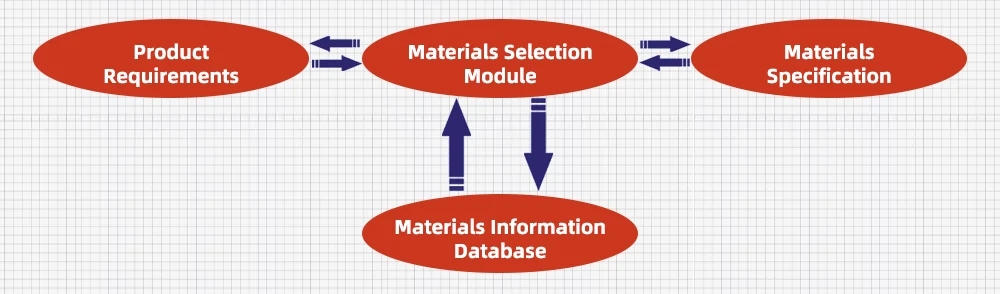
Material Selection and Its Impact on Manufacturability
The selection of material is a critical factor in manufacturability that impacts many aspects of manufacture, such as cost, ease of manufacture, and the strength of the product.
Choosing suitable materials is crucial to a product as it should be possible to produce it with little wastage and cost to meet quality while meeting budget requirements.
Accessibility is one of the critical factors we consider when choosing materials. Using locally available material reigns supreme as it tackles the risks of supply chain interferences, which in most cases results in time wastage and associated high costs.
Whenever finding the materials is not a problem, the flow of materials is easy, and chances of production interruptions due to inadequate materials are minimized. Also, any cheap raw material is usually likely to have an existing supply chain, which can help determine the possible changes in supply and price, thus allowing an organization to better plan for it in terms of budgeting.
Processing Properties and Their Influence on Manufacturing Efficiency
Another important aspect related to the Manufacturability of a Product or component is the so-called Processing Properties of the materials.
Some materials are more ductile than others, and depending on how malleable they are, they can have a comparative effect on the manufacturing and quality of products.
For instance, aluminum plays a significant role in manufacturing due to its ease of use compared to other metals like titanium, making this information vital.
Doing so can lead to increased production throughput times, improved durability of the machinery, and, thereby, lower operational costs.
Cost issues are always an essential factor one must consider when choosing a material. Costs may often fluctuate, and selecting suitable materials that are competent in performance and cost-effective is central to it.
Cost vs. Performance: The Trade-offs in Material Selection
High-performance composite materials might have better properties but may be more expensive. On the other hand, opting for cheaper materials could reduce performance or even the product’s lifespan.
Hence, evaluating the overall quantifiable cost consequences of implementing such changes is vital to achieving targeted expense optimization in materials and manufacturing processes.
Material Compatibility with Manufacturing Processes
Another important factor to consider is how well the material aligns with the manufacturing processes.
Materials must align with the selected manufacturing technologies to enable efficient product manufacturing.
For example, there may be types of plastics unsuitable for processes such as injection molding because of their chemical or physical characteristics, which may cause some problems in manufacturing.
Understanding how particular materials perform under specific manufacturing processes is vital. This knowledge helps prevent problems related to material efficacy or cost. It also plays a crucial role in producing the highest quality end product.
Design Complexity Modern Manufacturing
Design Complexity and Its Influence on Efficiency and Cost
It is evident that design aspects significantly impact manufacturability in modern engineering since they determine production efficiency and cost.
It covers whether the design process is complex or easy, and reducing designs can dramatically improve the manufacturing process and reduce expenses.
The Role of Component Count in Manufacturing
Based on the research, it is clear that the Number of Components is a significant determinant of design factors.
If a product has fewer components, there would be fewer assembly operations, which would help reduce costs.
Reducing the number of parts also contributes to shaving time and ensures that mistakes are eliminated due to multiple assembly of parts.
Reductions in the number of components also mean that production processes are less complex, and there are lower costs involved in handling and transporting components and stored spare parts.
Geometric Complexity and Its Challenges
Geometric Complexity relates to the level of detail of the shapes and parts included within a specific design.
Complex shapes can be a problem from the manufacturability in modern engineering perspective within automotive designs, as they call for complex tools and machining times.
Their choice may also lead to manufacturing errors and defective products being developed.
By eliminating complex shapes and other designs like fillets and R radii, designers can shave off time and space while ensuring that the machinery is safe and efficient.
This approach can contribute to reduced production costs and improved product quality since it involves the creation of simpler geometries, which are easier to manufacture and test.
Tolerance, Precision, and Their Cost Implications
Other aspects of design complexity include Tolerance and Precision.
When the parts must fit closely to one another, that is, there are minimal limits to the deviation in dimensions of the parts, then the manufacturing process may get all the more expensive.
Accuracy might call for even more complex equipment, extra steps in the control process, and longer working hours.
Thus, manufacturers can eliminate high-precision methods by designing within allowable deviations, lowering manufacturing costs and the probability of flawed products.
This means that while the tolerance cuts a small margin for error to enhance efficiency in producing the various products, the precision does the same regarding acceptable quality and performance.
The following is a demonstration of the impact of design complexity on manufacturing.
| Design Complexity | Typical Manufacturing Time (Hours) | Cost Implications |
|---|---|---|
| Low | 5 | Low |
| Moderate | 15 | Medium |
| High | 30 | High |
Ease of Assembly In Modern Manufacturing
Importance of Assembly Ability
Another parameter, one of the most important criteria and highly correlated with production efficiency and manufacturing costs, is assembly ability. It covers how quickly and effortlessly a product can be constructed, and streamlining the construction procedure can result in notable firm savings and enhanced product quality. Several key considerations influence the ease of assembly.
Impact of Part Count on Assembly Efficiency
Part Count is one of the simplest elements associated with efficiency in assembly operations.
Cutting down the parts in a product has always been outstanding because it favors speedy assembly and is also relatively cheap. A smaller number of parts requires less complex assembly procedures, which can reduce the duration and minimize mistake risks. Fewer components also entail less handling, storage, and inventory costs, all factors that help make up for the extra costs.
Simplification of Structures and Its Benefits
Also, less complex structures entail minimal assembly personnel training, improving the operations’ effectiveness. According to the case organization, there are two critical factors for reducing the assembly time and incorrect measures: Alignment and Fit.
Importance of Alignment and Fit
Having parts properly fitted and positioned correctly minimizes the fine adjustments that must be made manually after the components have been fitted into position.
When components align correctly, it means that parts fit together as they were probably designed, which aids in creating stable products and reduces the time required to redo them.
Focusing on fit and alignment reduces the chance of defects and enhances the assembled product’s manufacturing reliability.
Role of Assembly Techniques in Process Improvement
Assembly Techniques are critical components in the improvement of the assembly processes.
This produces quality parts that are interchangeable and leverages standardized assembly methods and equipment for cost efficiency.
Standardizing structures by using common parts or implementing assembly line technologies is possible.
Moreover, tools and fixtures that aid in positioning and handling the individual components can help improve the assembly process.
It is evident that best practices of assembly techniques decrease the chances of getting defects and help make the manufacturing process more disciplined.
Production Techniques in Modern Engineering
Matching Product Design with Production Processes
Production processes involve different procedures and technologies in making a product, and it becomes essential to match product design with these processes, mainly to come up with efficient and cheap means of production.
Various important factors influence the effective matching of the selected production methods to the specifications of the product’s design.
Manufacturing Methods and Their Suitability
Manufacturing Methods are the crucial elements of manufacturing and play a vital role in producing goods.
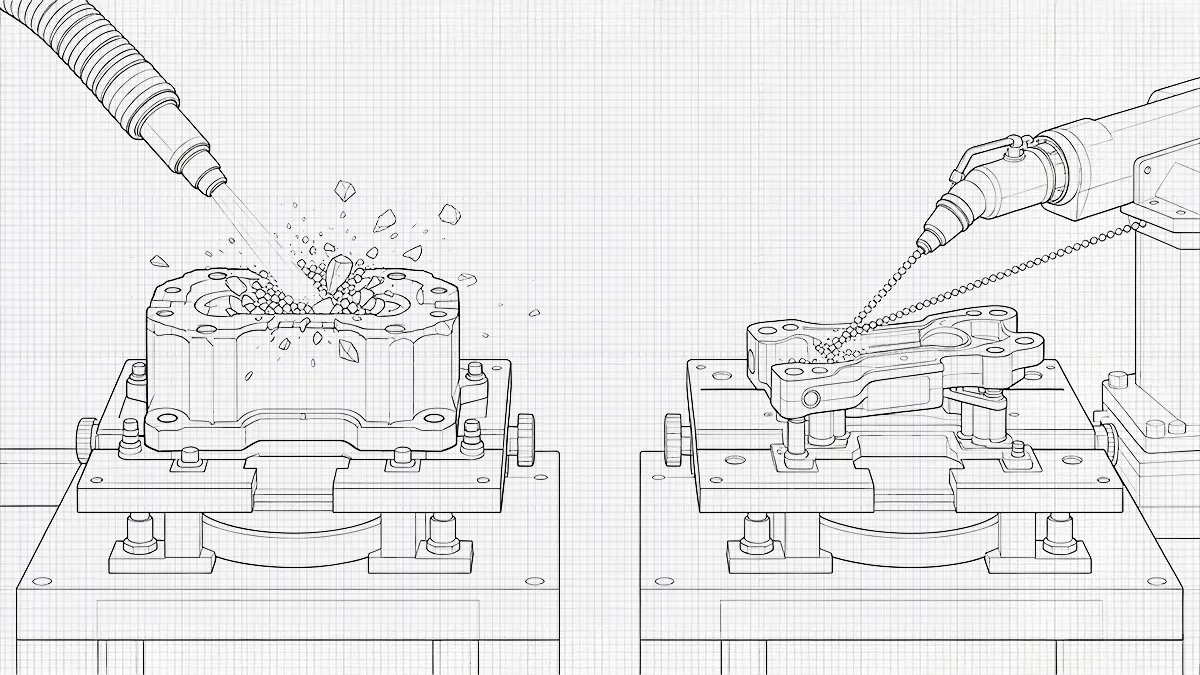
The end product design has to be suitable for the chosen manufacturing processes like injection molding, Computer Numerical Control (CNC) machining, or additive manufacturing.
Both methods have their strengths and weaknesses.
For example, injection molding is suitable in applications where large volume and uniformity of the shape and quality of the produced item, like plastics. CNC machining, on the other hand, is more appropriate in situations where the shape is complex and requires accuracy in the metals.
While flexible for prototyping and designing custom parts, additive manufacturing or 3D printing can be less efficient in terms of cost for high-volume production.
Ensuring that the product design matches the selected manufacturing strategy will make it easier for firms to secure efficiency and reduce costs.
Tooling and Equipment Assessment
Tooling and equipment assessment are also critical in production strategy and techniques.
This means that the proposed design must be achievable given the cutting tool and equipment currently within the possession of a manufacturer. If custom and or complex tooling is needed, this will directly affect the cost and time required to produce the required part.
For instance, designing a part that would entitle using unique molds or tooling in the injection molding process will lead to expensive start-up costs.
On the other hand, designs that use regular tools and equipment help minimize setting costs. They also reduce the time required to manufacture the items.
Process Capabilities and Their Impact on Design
Ensuring the design is within the available tooling and equipment type assists in reducing costs and improving functionality.
Process capabilities here refer to awareness of the strengths and weaknesses of various manufacturing processes. Different manufacturing methods have their strengths and limitations in terms of approaches to product design and production.
For example, the operation of sheet metal work includes sheet metal processes like cutting, bending, and joining of metal sheets. To consider these processes involves understanding the properties of the materials and the mechanical properties of the tools you will use.
These process capabilities are essential for designers because they show what products will be easy to produce and free from manufacturing problems.
The following table summarizes standard production techniques and their applications;
| Production Technique | Typical Applications | Advantages | Limitations |
|---|---|---|---|
| Injection Molding | Plastics, small parts | High efficiency, low cost for large volumes | High initial tooling cost |
| CNC Machining | Metals, complex geometries | High precision, versatile | Higher cost for low volumes |
| Additive Manufacturing | Prototyping, custom parts | Flexibility, no tooling required | Slower and more expensive for large quantities |
Integrating Manufacturability into the Design Process
Importance of Manufacturability in Design
Applying manufacturability features to product design is critical for the effectiveness of the manufacturing process and the possibility of minimizing production costs. This integration uses several activities that assist in preventing problems from occurring in the first place, making the production flow efficient, and enhancing the quality of the final products.
Cross-Functional Collaboration
Cross-functional collaboration is integral to realizing manufacturability integration in the design process. Involving manufacturing engineers, material scientists, and production personnel at the time of the design facilitates showing up bottlenecks that may surface towards the later stages of development. Engaging these specialists also helps the designers understand the possibilities of specific solutions, the availability of certain materials, and the potential of particular manufacturing strategies. This approach of working in teams ensures that the team considers all aspects. It also helps in decision-making by taking into account the production capacity and limitations.
Prototyping and Testing
Prototyping and testing are essential because they help define manufacturability problems, which occur later. Prototyping allows designers and engineers to assess the product’s feasibility as a manufacturing prototype. One can observe material handling, assembly, and production issues using prototypes. These affordances allow the refinement and correction of the design before creating issues for full-scale production. Prototyping also assists in proving design hypotheses by identifying the actual product, quality, and performance.
Design Reviews for Manufacturability
Design Reviews parallel the development process and address manufacturability-related issues at different stages. Manufacturability reviews, as part of the regular design reviews, consist of assessing the design against the capabilities of manufacturing processes, contamination checks, and more. Such reviews should be conducted at specific phases of the design process, for instance, at the conceptual, detailed, and final design phases. By proactively evaluating and modifying a product design with a focus on manufacturability assessments, the team can ensure that manufacturability principles guide the manufacturing process. This approach also keeps the product design aligned with targeted production objectives.
Strategies for Enhancing Manufacturability
Engineers and designers can employ several methodologies to make manufacturing more accessible, cheaper, and efficient. These aim to improve the design layout to enable more accessible and more efficient production processes.
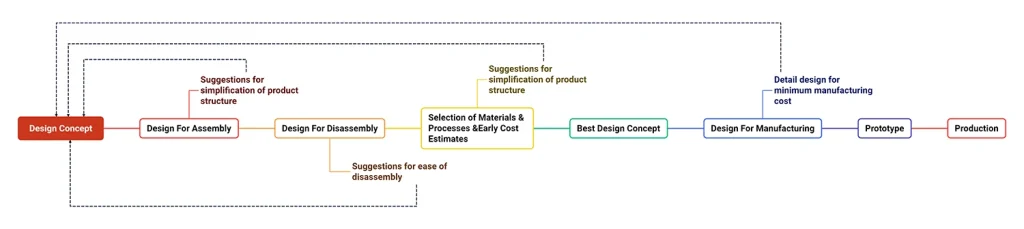
Design for Assembly (DFA)
Design for Assembly (DFA) is an approach that simplifies the assembly process. The aim is to optimize the assembly of designs so that the resultant design may take a very short time and cost less than the time required. DFA’s components include a reduction in the number of parts, which reduces the number of assembly steps and hence reduces errors.
Furthermore, incorporating self-locating and self-fastening components enhances the ease with which the assembly is done since there will be fewer requirements for fixtures and tools. Designing for easy access during assembly ensures that workers can assemble parts effortlessly and efficiently.
Design for Manufacturing (DFM)
Design for Manufacturing (DFM) is a concept whereby the design and the available manufacturing processes will be matched. It also becomes possible to coordinate the design with selected production methods like injection molding, CNC machining, or additive manufacturing. When considering DFM, it’s important to address several factors. These include specifying tolerances that accurately match the manufacturing processes and selecting the appropriate materials for those processes. When funneling design into manufacturing capacities, DFM aids in avoiding production issues, cutting costs, and improving the ecosystem.
Modular design
Modular design employs equipment parts that are easily interchangeable and can be easily installed, removed, or changed. It is convenient for producing and assembling products because it involves using parts of the same kind. The modular design also decreases the requirements for special tools and minimizes the need to change production layouts. This design approach also simplifies maintenance and upgrades. When a change becomes necessary in one part of the system, it won’t affect the other parts because each part functions as a unique module. It can result in various benefits, such as reduced costs, shorter time to produce goods, and increased flexibility in manufacturing.
Simulation and Prototyping
Simulation and prototyping help evaluate how easily a part or design can be manufactured for its actual production. Simulation tools enable the designers to emulate the production process and highlight problems related to material flow, product construction, and production methods. Prototyping is beneficial in that it helps give physical form to the design. This leads to the testing and evaluation of the design. These tools improve manufacturability through early identification and solving of issues that would otherwise cause design modification when in production, making the design process more efficient.
Conclusion
Manufacturability in modern engineering is a critical factor that should be considered in the product design and development process. Manufacturability as a strategic focus allows organizations to reduce costs, enhance product quality, accelerate the rate of product launches, and manage resources efficiently. We mentioned practices such as DFA, DFM, modular design, and simulation tools can significantly improve manufacturability. We must consider manufacturability for efficiency gains, competitive advantage, and future performance in a competitive environment. Integrating manufacturability into design is more than a recommendation; it is necessary for today’s engineering and production. This paper, therefore, holds the view that manufacturability analysis enables engineers to produce goods that meet market needs. This approach ensures that the process operates smoothly without any compromise.
Manufacturability is a fundamental consideration in product design and engineering. Companies can achieve cost savings, improve quality, speed up time-to-market, and optimize resource usage by focusing on manufacturability. Implementing DFA, DFM, modular design, and simulation tools can significantly enhance manufacturability. In a competitive market, prioritizing manufacturability drives efficiency and contributes to long-term success. Incorporating manufacturability into the design process is not just a best practice but a necessity for modern manufacturing and production. By understanding and applying manufacturability principles, engineers can create products that meet market demands while achieving operational excellence.




 EN
EN  ES
ES  FR
FR  DE
DE  IT
IT  PT
PT  NL
NL  PL
PL  AR
AR  JA
JA  KO
KO  ZH
ZH