射出成形によるVR製造

注釈

私たちはすべての顧客と市場参入前の守秘義務契約を結んでいます。ご覧いただいているすべてのケースは、お客様との間で交わされたものです。私たちはいくつかの機密情報をモザイクしています。すべての写真はFirstMoldの内部撮影から撮ったものです。

The first VR headset by Ivan Sutherland, called “Sword of Damocles”, weighed around 10 pounds (approx. 4.5 kg). It was heavy and uncomfortable to wear for a long time. Therefore, it was supported from the ceiling using a mechanical arm. Newer VR manufacturing techniques have doubled down on lightweighting to make the devices more comfortable for long wear.

The average weight of newer VR headsets ranges from 1.1 to 1.5 lbs. (approx. 500 to 800 grams), without the strap and battery pack. For example, Meta Quest 3, which was released in 2023, was approximately 1.14 lbs. (515 grams). Pico 4, which was released in the same year, came in at around 1.3 lbs. (586 grams).

The focus of companies with VR components manufacturing is shifting towards lightweight, ergonomic, and high-precision/high-resolution. The trend is transforming bulky headsets into sleek, all-day wearable devices.

Plastic Parts at Core of Lightweight VR Manufacturing

VR manufacturing plastic parts evolution has been an important strategy used by manufacturers to achieve lightweight. This is particularly important because plastic accounts for roughly 50—70% of VR components. The external casing, head straps, and inner structure are primarily made of durable plastics. Evolving VR components manufacturing strategies include: 

  • Use of advanced materials: VR makers are replacing traditional plastics with advanced engineered alternatives like carbon fiber to reduce weight without compromising on structural integrity.
  • Weight distribution: Many of the designs from 2025 featured the use of a halo-style strap system to move the center of gravity closer to the user’s head.
  • High-density interconnect (HDI) printed circuit boards: The HDI technology is used to pack components closer, using microvias and finer trace widths.
  • Precision manufacturing techniques: The use of precision VR injection molding for the plastic parts and other advanced technologies, e.g., high-temperature molding of glass for lenses, allows manufacturers to meet high precision demands.

The need to address the user’s physical discomfort (neck strains and headaches) and the push towards creating VR headsets that are truly wireless are some of the drivers of the ongoing innovations in the industry.

Structural and Functional Components of VR Headsets

A VR headset is a complex device. The front section, also called the visor, is the most critical area. It houses the lens, the sensors, and the “brains” of the device. The hard outer plastic shell protects the internal electronics while also providing stability and comfort to the wearer.

The VR headset can be divided into three parts, namely the external structural parts, the functional components, and the optical-related parts.

VR external structuresVR functional componentsOptical-related parts
Front cover or faceplateTracking camerasLenses (Fresnel and pancake lenses)
Facial interface (including foam or interface gasket)RGB pass-through camerasDisplay panels
Head strap systemDepth sensorInterpupillary distance adjustment mechanism
Cable managementInertia measurement unitEye-relief adjustment
Vents for ventilationSystem-on-a-Chip 
 Microphones and speakers 
 Physical buttons 

Material Options for VR Manufacturing Components

The materials used in VR manufacturing focus on balancing weight for user comfort and performance. Other factors that VR makers consider during material selection are durability and thermal management. For example, the casing or outer shell is made to tight precision using high-performance plastic to balance lightweight and durability. The tight precision helps to keep optics aligned.

  • VR casing: Plastics such as polycarbonates (PC) and acrylonitrile butadiene styrene (ABS), or PC+ABS blend, are used for the casing because they balance rigidity and lightweight. To further reduce the weight, VR injection mold makers often use thin walls and ribbed designs with lattices.
  • Optical component: Special transparent materials with excellent scratch resistance are used for lenses. A good example of material used for making a VR lens is cyclic olefin copolymer (COC) with light transmittance ≥ 92%.
  • Wearability comfort: Thermoplastic elastomer (TPE), a flexible and soft material, is used for anti-slip components, thereby enhancing wearing comfort, especially for long session users.
VR manufacturing componentsCommon materials used for making VR componentsCriteria for choosing material
Internal frameMagnesium, aluminum, carbon fiber reinforced polymerSpecific stiffness, low density.
Outer shellPC, PC+ABSHigh impact resistance, lightweight, gloss finish.
Face PadTPE, open-cell foamComfort, breathability, lightweight.
HeatsinkAluminum, copper, graphiteHigh thermal conductivity.
LensCOC, polymethyl methacrylate (PMMA)Clarity, scratch resistance, light transmittance, precision.
StrapsPolymer gears, polyesterTensile strength, low weight.

Key Technologies in VR Injection Mold Design

The process of designing a mold for VR headset production involves high-precision, specialized technologies. The focus of the key technologies is delivering lightweight components with complex geometries and superior surface finishes.

The process of creating molds for VR injection molding often starts with the use of advanced CAD, CAM, or CAE software like SolidWorks or ProE in combination with Moldflow analysis to ensure design for manufacturability (DFM). Advanced software is crucial for optimizing wall thickness and cooling. Three key aspects of VR injection mold design include:

  1. Precision control: High-speed, high-precision CNC machining is used to ensure extreme dimensional accuracy of molds. A major injection molding challenge with VR casings is achieving a high-gloss surface devoid of defects. This can be overcome by optimizing injection molding parameters like speed, pressure, and temperature. Common defects like warping and shrinkage in complex shapes can be reduced by optimizing the cooling system.
  2. Structural optimization: Curved housings and complex buckles often face multiple challenges with conventional two-part molds. Common challenges with molding curved VR housings include incomplete detail forming and demolding difficulties. A multi-slide + insert structure is designed to solve these problems. It can be used to create parts with intricate, multi-directional undercuts and complex shapes.
  3. 表面処理: Flow marks and weld lines are cosmetic blemishes that can result from inconsistent molten plastic flow. Reducing the micro-surface roughness of the mold surface or mirror polishing significantly reduces frictional resistance between the molten plastic and the mold cavity. Initial machining marks are removed using oil stones with 180 to 600 grit sizes. Smoothing is done with wet sandpaper of 400 to 1600 grit. Final polishing is achieved using diamond paste (0.25µm or 0.5µm).

クライアント要件

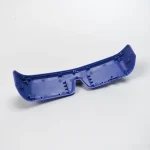
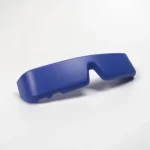
A client specialized in VR wearable devices manufacturing was in need of a custom VR headset front cover. Their previous supplier was unable to overcome the warpage challenge that resulted from the extremely thin walls of the part. Also, there was the issue of substandard assembly precision.

The client was eager to find a VR injection mold maker that could overcome the challenges. The client was reassured of the capability of First Mold to solve the problems after a comprehensive tour of the company’s facility and reviewing albums of previous projects. The client’s detailed requirement included:

  • Part wall thickness 1.0mm,
  • Weight ≤25g,
  • No flow marks on the surface,
  • Assembly tolerance ±0.03mm,
  • Mass production yield rate ≥98%

課題

Achieving a weight ≤25g required more than just swapping materials. First Mold engineers had to rethink the design, in collaboration with the client. It was necessary to identify non-critical areas using Finite Element Analysis (FEA). Ribs were added for rigidity, instead of solid materials.

To further lower the weight of the VR headset, a snap-fit design was favored over screws. However, that required a tight tolerance to ensure the parts snap tightly together during assembly.

ソリューション

First Mold adopted gas-assisted injection molding (GAIM) structure for the VR injection mold design. This method offered significant advantages over traditional molding by using pressurized nitrogen gas to create hollow sections. GAIM reduced resin usage by more than 20%. It also allowed the optimization of material distribution and improved overall surface quality.

Gas-assisted injection molding creates hollow sections with differential cooling. That is, hollow sections cool faster than solid sections. Therefore, it was necessary to introduce precise cooling channels. Optimizing the cooling channels was important to avoid uneven cooling, which can lead to warpage. An optimized cooling channel was also important for maximizing production speed.

The parting was optimized for non-visible areas. This design decision was made during the CAD phase to ensure seam lines remain hidden. Keeping the parting lines hidden allowed First Mold to maintain 100% aesthetic flawlessness on the VR headset casing surface.

Process Adjustment

The selected material for the VR plastic parts manufacturing was a glass fiber-reinforced PC+ABS blend. The combination of this material with nitrogen-assisted injection molding prevents material decomposition. This is because Nitrogen acts as an inert gas that displaces oxygen within the barrel and mold.

The displacement of oxygen prevents the degradation of the polymer at high temperatures. This technique also prevents discoloration and maintains the mechanical strength of the plastic.

Quality Control System

First Mold employed real-time monitoring with in-mold pressure sensors. The sensors measured cavity pressure (up to 2,000 bar) and temperature. It provided instant data on mold filling, packing, and gate freeze-off for immediate detection of defects. This helped to reduce scraps.

First Mold engineers carried out a thorough inspection of the finished part using a coordinate measuring machine (CMM). The scanner measured the outer geometries to spot warpage that the naked eye could easily miss. The measurement was matched to the product blueprint to check for consistency.

Final Results and Customer Testimonial

First Mold did not just deliver a mold. The company delivered a VR injection molding system that helped the client to overcome some of the previous manufacturing challenges they experienced with their former supplier. The solution First Mold delivered helped the client to create lightweight VR components. This ensured their product was lighter than many of the products from competing brands in the market, offering VR enthusiasts comfort for a longer wearing experience.

記事タグ
jaJA