
ホーム / ツーショット射出成形サービス
ツーショット射出成形サービス
- < 0.5% の不良率
- ±0.05mm(±0.002インチ)の回転精度
- 130~280T JSWプレス
2ショット成形は、御社の部品に適していますか?
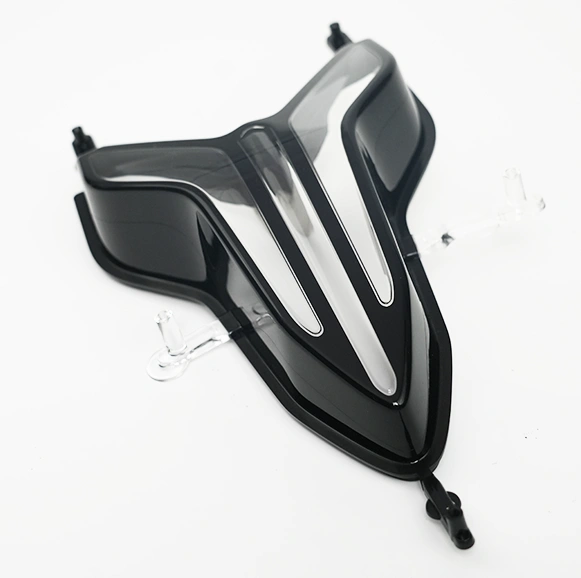
ツーショット成形では、1回の成形サイクルで2種類の材料(または2色)を1つの金型に射出します。その結果、恒久的に結合された単一の部品が得られ、二次組立が不要となります。
Two-shot tooling costs more up front, but it pays back through lower assembly, fewer defectsそして faster production.
マルチカラー
柔らかなハンドルと2色のパーツを1回の成形工程で成形――継ぎ目も接着剤も不要。
防水・気密
IP67/IP68規格に対応するため、プラスチックに直接成形されたゴム製シール—Oリングが外れる心配はありません。
永久債
材料は高温の状態で結合するため、接着剤やスナップフィットのように接合部が剥がれたり破損したりすることはありません。
大量生産
10,000台以上の場合、自動成形により手作業による組み立てが不要となり、単価が低下します。

Process Guide: 2-shot molding is a single-cycle process for high volumes. If you have a limited tooling budget, see “オーバーモールディング”. If you are molding plastic over metal, visit “インサート成形".
ファーストモールド社の2色成形装置および仕様
Two-shot molding requires multi-barrel presses and rotary molds. We run JSW two-shot presses (130T–280T) in automated production. Shut-offs and mold details are machined in-house on Makino EDMs and Haas 5-axis CNCs. The table below lists our two-shot capabilities and key:
| 仕様 | 能力 | 仕様 | 能力 |
|---|---|---|---|
| Primary Machinery | JSW All-Electric 2-Shot Presses (130T – 280T) | Rotary Platen Precision | ±0.05mm(±0.002″) |
| Multi-Material Tech | Rotary Platen, Index Plate, Core-Back (Core Pulling) | Standard Part Tolerance | ±0.05mm (±0.002″) |
| Min. Sealing Gap | ≤ 0.02 mm | 推奨されるドラフト角度 | 1.5° – 3.0° |
| Typical Combinations | Rigid+Soft, Rigid+Rigid, Opaque+Clear |


なぜファースト・モールドと提携すべきなのか?
先進のツーショットマシン
複数の2ショット射出成形機を持つ2ショット射出成形ワークショップ、高効率、低コスト、迅速な大量生産の可能性を提供します。
ツーショット金型開発能力
私たちの金型製造工場は、高精度の2色金型を製造することができます。
製品の魅力向上 | 複雑なデザインの対応 | 滑り止め面でのグリップ力向上 | 追加機能の搭載が可能 | 強度と耐久性の向上 | 幅広い用途
2-Shot Material Compatibility & Selection
With over a decade of practical experience, First Mold has mastered the complex material fusion required for flawless multi-material parts. Because different plastics have distinct physical and chemical properties, maximizing your product’s aesthetics and strength requires careful material pairing. To achieve a permanent bond, we strictly evaluate the chemical compatibility, melting temperatures, and shrinkage rates of your chosen resins.

PC + PMMA or PC + ABS offer the industry gold standard for optical clarity and impact resistance.

Two Color Injection Molding Design Guidelines
Designing a successful 2-shot part requires a clear division of labor between the two materials. To ensure a satisfactory bond, prevent warpage, and avoid costly tooling redesigns, we recommend you follow these core structural principles in your 3D CAD models
- Use a rigid plastic such as ABS or PC as the internal frame so the part can carry loads and hold its shape.
- Limit the soft elastomer such as TPU or TPE to functional areas such as grips, seals, or visual accents.
- Make the rigid base thicker and stiffer than the soft layer so it can withstand the heat and pressure of the second molding step.
- If the two materials do not bond well chemically, add physical features such as undercuts, grooves, or through-holes so the soft rubber is held in place mechanically.
- Make sure the contact area between the two materials is at least 1.5 mm wide, because narrow contact areas peel apart easily.
- For flat surfaces that are hard to bond, add a knurled texture or a diamond grid pattern to the rigid plastic part to greatly improve grip.
- Keep the soft overmold layer even, ideally 0.8 mm to 2.0 mm thick, because too thin can cause incomplete fill and too thick can cause shrinkage and cracking.
- Avoid sharp corners where the two materials meet and use a radius of at least R0.5 mm to reduce stress buildup.
- Do not let the shrinking soft rubber completely wrap a closed hollow space, because the contraction can crush or warp the rigid shell.
- Design all assembly features—such as snap-fits, screw bosses, and alignment pins—on the rigid plastic, never on the soft layer.
- Because soft materials like TPU are sticky, use a larger draft angle of at least 5° on the soft sections so the part releases smoothly from the mold.
Two Shot Molding FAQ

What is the typical lead time for a 2-shot injection mold?
Due to the higher tooling costs and complexity, customers rarely opt for rapid tooling (prototype molds) in 2-shot molding. If rapid tooling is strictly required, the absolute minimum lead time is 15 days.
For mass production molds, the complex rotary mechanisms require more time than standard molds—T1 samples take at least 4 weeks. For ultra-precise projects, such as automotive 2-shot molds, lead times can extend up to 10 weeks.
What is the Minimum Order Quantity (MOQ) for 2-shot molding?
First Mold has no strict MOQ limits. In fact, we have successfully delivered specialized 2-shot projects for runs under 10,000 units. However, looking at it strictly from a cost-saving perspective for your business, we typically recommend this process for volumes of 30,000 units or more.
Because 2-shot tooling requires a higher initial investment, reaching this volume ensures that your savings on manual assembly will quickly pay for the mold, maximizing your true ROI.
Can I supply my own rigid substrates and ship them to First Mold for overmolding only?
Usually no — not as a direct upgrade.
A two-shot mold is not just a single-color mold with one more cavity. It is a different tool designed for a different machine. Here’s why a simple “upgrade” is rarely practical:
- Your old mold was not designed for two-shot movement.
- The moving half normally has to be rebuilt.
- The “upgrade” can cost almost as much as a new mold — with more risk.
Can we use cheap recycled plastic for the hidden inner part and premium plastic for the outside?
Sometimes, but not automatically. “Hidden” does not mean “no risk.”
A hidden inner part can still affect:
- Recycled plastic may vary in impact strength, stiffness, and consistency.
- In 2-shot or overmolding, the inner material can affect adhesion and delamination risk.
- Automotive, medical, electrical, food-contact, and many brand customers have strict rules on recycled content and traceability.
- Cheap recycled material with inconsistent batches can cause short shots, warpage, flash, and higher scrap.
You can send us the inner part’s function, the recycled material type and source, the planned recycled content percentage, and any certification requirements. We can then tell you quickly whether it is workable, what testing is needed, and whether the real cost saving is worth it.
 JA
 EN
 ES
 FR
 DE
 IT
 PT
 NL
 PL
 AR
 KO
 ZH