
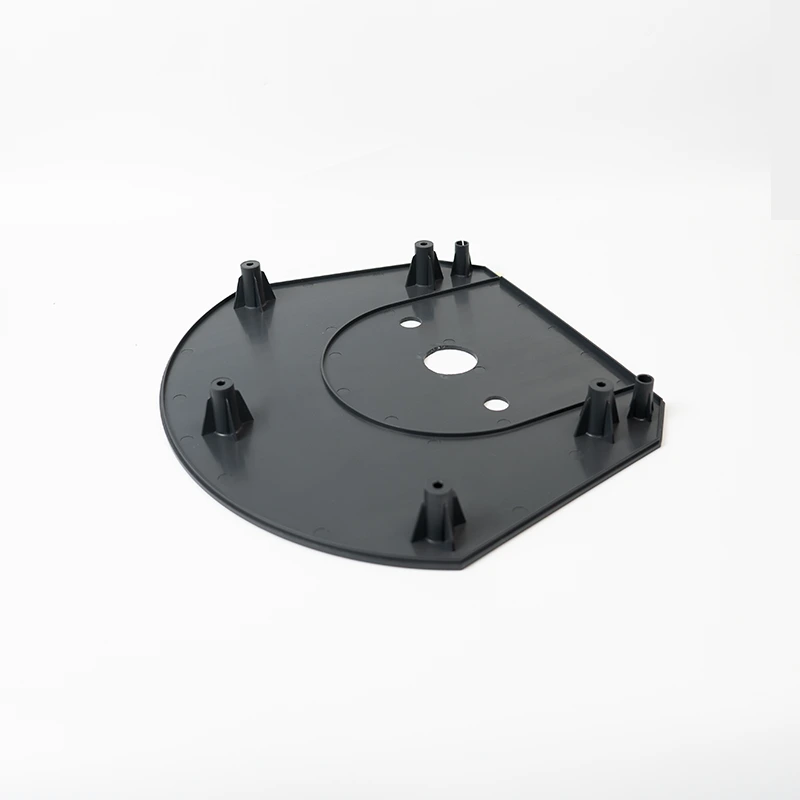
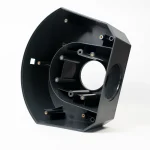
The inspection equipment housing manufacturing project consists of two parts:
- Main Body: This part features intricate internal structures with deep ribs, which are essential for the durability and functionality of the housing.
- Cover: This simpler component is designed to fit seamlessly over the main body, ensuring a secure enclosure.
Both inspection equipment housing parts are produced using rapid tooling and insert molding techniques to facilitate small-batch production.
Mold For Inspection Equipment Housing Design Challenges
The main body of the inspection equipment housing presents significant challenges due to the depth of the internal ribs. These deep ribs are crucial for structural integrity but pose risks of injection molding defects such as sink marks. Additionally, the internal structure requires precise alignment for the embedded brass screw inserts, which are crucial for assembly.

Injection Molding Process
We employ advanced techniques to mitigate potential injection molding defects:
- Material: We use standard PVC material, known for its durability and ease of molding.
- Embedded Insert Molding: The screw inserts are embedded using a well-established insert molding process.
Addressing Injection Molding Defects
To address the potential for sink marks and other defects, we employ several strategies:
- Optimized Mold Design: Our molds are designed with precise cooling channels and balanced gate locations to ensure uniform material flow and cooling.
- Process Control: We maintain strict control over the injection parameters, including pressure, temperature, and cycle time, to minimize defects.
- Quality Inspection: Each component undergoes rigorous inspection to ensure it meets our high standards for dimensional accuracy and surface finish.

 EN
EN  ES
ES  FR
FR  DE
DE  IT
IT  PT
PT  NL
NL  PL
PL  AR
AR  JA
JA  KO
KO  ZH
ZH