
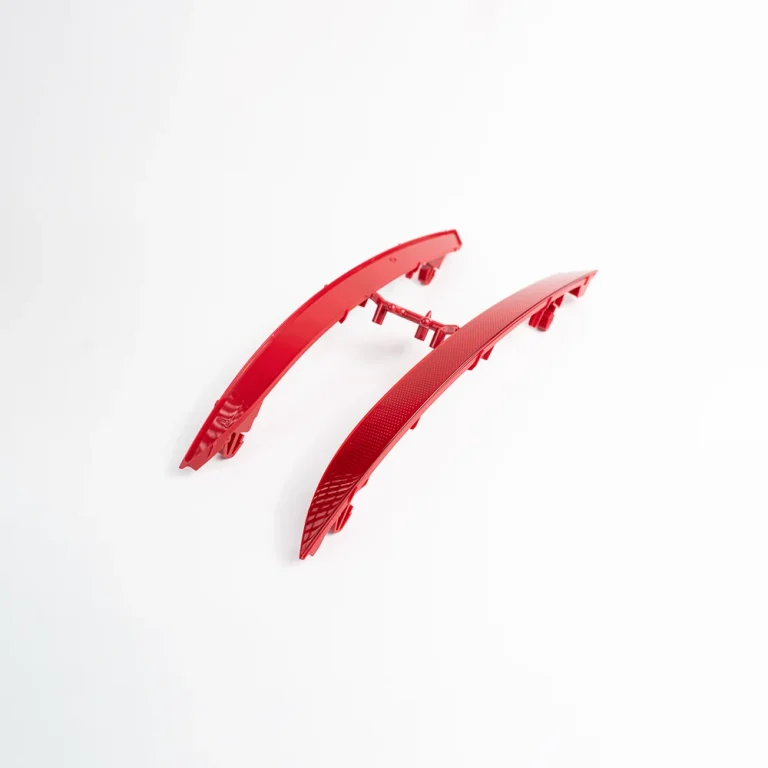

The rear red reflector of cars is a mandatory safety device. They are mostly red plastic lenses with prisms that reflect light coming from the headlights of oncoming vehicles. This makes the car visible at night or during poor visibility, even when the lights are turned off. The car rear red reflector is a safety part that helps to prevent rear collisions.
Automotive rear red reflector works on the principle of the reflective properties of light. When a beam of light hits the internal prisms, the light is sent back, creating the visible glow on the plastic part. To function effectively, red reflectors are expected to meet the following photometric performance criteria and material durability standards.
- Reflective intensity compliance: To ensure sufficient light is returned to the source, the production of rear reflector must meet specific photometric performance standards, including ECE R3, and SAE J594.
- Accurate and stable color: The part must reflect incident white light as red light. The reflected color must remain stable throughout the life span of the part.
- Full angle coverage: Car rear red reflector must be engineered to reflect beams coming from a wide range of typical headlight beam angles and viewing positions. This is to ensure visibility regardless of the direction of approach.
- High and low-temperature resistance: The material and reflective coating used for rear reflector production must endure extreme temperatures without cracking, peeling, or function and appearance degradation.
- UV and aging resistance: Since the part is constantly exposed to UV, it must be made of materials that resist UV degradation. Material breakdown or yellowing is a common sign of aging from UV breakdown.
- Water and chemical corrosion resistance: The material must be resistant to moisture ingress. It should also resist corrosion from common automotive chemicals, including oils, fuels, and cleaning agents, and prevent internal fogging.
- Impact and scratch resistance: The outer shell of the car rear red reflector must be durable enough to resist scratches that may impact the reflective properties. Also, it should withstand minor impacts.
- Sealed waterproofing: During assembly, the reflector must be properly sealed to prevent water and dust from entering the internal reflective optics and compromise performance and durability.
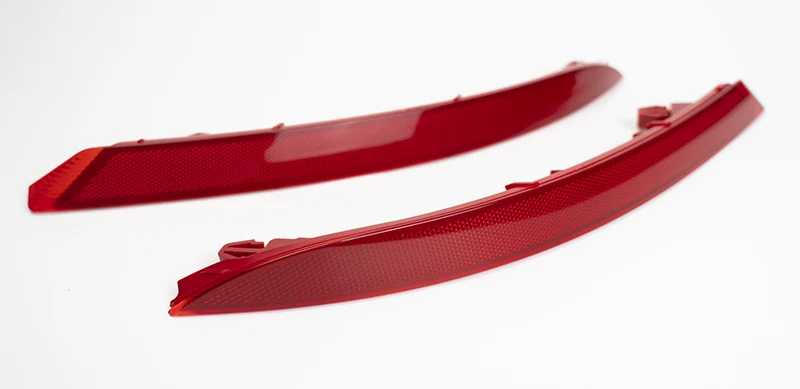
Factors Necessary for Efficient Automotive Rear Red Reflector Functioning
Four principal factors will affect how efficiently a car rear reflector will perform its primary role of providing passive safety. These factors include material selection, structural design, process control, and inspection systems.
Materiaalkeuze
The desired results can only be achieved by choosing the right materials. Transparent and impact-resistant plastic like polymethyl methacrylate (PMMA) is used to mold the outer lens. These materials also offer excellent optical clarity and resistance against impact from road debris, extreme temperatures, and UV exposure.
The reflective internal layer is usually made from a highly polished aluminum coating. Vapor-deposited reflective film can also be applied to a molded plastic base to create a highly reflective surface across a wide range of wavelengths. The reflector housing is usually made of lightweight, weather-resistant ABS plastic.
Structureel ontwerp
The design of a car rear red reflector will affect how it captures light and returns it to the rear driver’s eyes. Retroreflection is usually achieved in these parts using small, cube-corner glass beads or prisms. The angling and positioning of these micro-prisms must be highly precise.
The shape, size, and placement of the reflectors on the vehicle must be governed by regulatory requirements to ensure it meets specific range and angle visibility. Also, the design must be integrated into the vehicle’s aesthetics.
Procesbeheersing
Rigorous manufacturing controls are crucial for maintaining uniformity in the product quality and performance across different product batches. Precision rear reflector mold is used to produce the intricate prism structures with the necessary micron-level accuracy. Process control manages factors like pressure and temperature to prevent material distortion.
The control must be thorough across every production step, from the application of reflective coating via vacuum metallization to the final assembly of the lens to the housing. Any flaw in these steps will affect the reflective property. For example, poor sealing or assembly can lead to dirt and moisture ingress that will compromise the internal reflective surfaces.
- Supplier’s Role in Rear Reflector Production Process Control: Rear reflector injection molding suppliers bear a huge process control responsibility in ensuring the part meets the client’s expectations and regulatory standards. Process control for suppliers includes meeting core mold requirements and optimizing core injection molding parameters.
Inspection Systems
Although human inspection will always come first, car rear red reflectors undergo automated optical inspection to detect surface defects, manufacturing inconsistencies, or scratches that may not be visible to the naked eye. Durability testing under different conditions (temperature shocks, high UV exposure) will help to predict its long-term reliability.
Besides testing for visual defects, the part must undergo rigorous performance testing to ensure it meets the minimum coefficient of luminous intensity and retroreflective efficiency at specific entrance angles and observation. It should be subject to third-party testing to verify compliance with national and international regulatory standards.
Vereisten en zorgen van de klant
The client approached First Mold for rear reflector production. Their main concern was ensuring the reflective performance of the part met automotive industry standards. Since the material of choice was PMMA, which is hygroscopic and has low heat resistance, the client was also worried about achieving a flawless appearance.
The melt viscosity of PMMA changes significantly with temperature. If the temperature is too high, it degrades the material, and if it is too low, it causes short shots or flow lines. The same issue can be recorded if the injection speed/pressure is not set correctly. The temperature and pressure sensitivity, as well as the hygroscopic nature of the material, make it hard to achieve perfect optical clarity.
Since the client was working on a tight deadline (which is usually the case in the automotive industry), they were also worried about the delivery timeline. Failure to meet the timeline can lead to huge financial losses on the part of the client.
Oplossing
After the client had detailed their requirements and concerns, First Mold engineers carefully studied the automotive rear red reflector blueprint and outlined the critical process control requirements for delivering the best rear reflector mold for the project.
Core Mold Requirements
Rear reflector mold is specialized because the core forms the critical, highly-polished retroreflective surface. It usually requires an inverted mold design where the core is in the fixed half to avoid ejection marks on the functional surface. The critical process control points identified by First Mold engineers for the production of the client’s rear reflector mold rapid tooling include:
- Cavity precision: The mold cavity must have a tight tolerance (±0.0254 mm for mold dimension and ±0.05 mm for the finished part).
- Mold material: To achieve the desired surface polish for the automotive rear red reflector, it was important to use high-strength aluminum alloys with a lifespan of up to 100,000 shots.
- Koelsysteem: A conformal cooling channel was implemented to ensure uniform temperature distribution and minimize warpage. Cooling channels were placed around 2 to 2.5 times the diameter from the cavity surface. The recommended diameter was 8 mm.
- Gate and vent design: It was necessary to choose an appropriate gate type with diameters that are suited to the part’s thickness, for example, 0.8 to 2 mm for pin gates. For the vent depth, First Mold engineers settled for 0.04 to 0.06 mm with a width of 3 to 5 mm.
- Ejection mechanism: The size and placement of ejection pins are critical to the safe removal of the molded car rear red reflector to avoid causing damage to the highly finished surfaces.
Core Rear Reflector Injection Molding Requirements Using PMMA
To ensure the rear reflector manufacturing using injection molding met the client’s requirements, First Mold’s process control focused on material pre-treatment and optimization of key molding parameters, including temperature, pressure, speed, and so on.
- Material pre-treatment: PMMA, the material of choice, is hygroscopic. Before processing, drying was vital to prevent bubbling during molding. Bubble formation reduces transparency. First Mold achieved less than 0.04% PMMA moisture content by subjecting it to drying at 80-90°C for 2 to 4 hours.
- Temperature control: To ensure uniform flow, PMMA was maintained at a stable melt temperature of 210-270oC. A stable mold temperature of 40 to 80oC, for PMMA, was essential for surface finish and dimensional stability.
- Pressure and speed control: Variable injection speed is often necessary to fill the mold quickly and prevent premature cooling. The injection pressure for PMMA was maintained at 80 to 120 MPa, while the holding pressure after injection was 40 to 60 MPa.
- Stability control: Statistical Process Control was employed to monitor critical automotive rear red reflector molding parameters in real time. It helped First Mold engineers to identify patterns and trends that will affect part quality. These patterns are easily missed by the naked eye.
- Post-processing: After rear reflector injection molding, the part underwent visual inspection and testing to ensure it meets regulatory standards.
FAQ
An aluminum mold can have a lifespan of between 1,000 and 100,000. Several factors will affect how long a mold will last, including the material used in making the mold and the material used for creating the part. Abrasive materials or glass-filled resins wear molds down faster.
Higher brittleness, hygroscopic nature, and low heat resistance are some of the challenges that must be overcome when PMMA is the material of choice for manufacturing an automotive rear red reflector using injection molding.



 NL
NL  EN
EN  ES
ES  FR
FR  DE
DE  IT
IT  PT
PT  PL
PL  AR
AR  JA
JA  KO
KO  ZH
ZH