

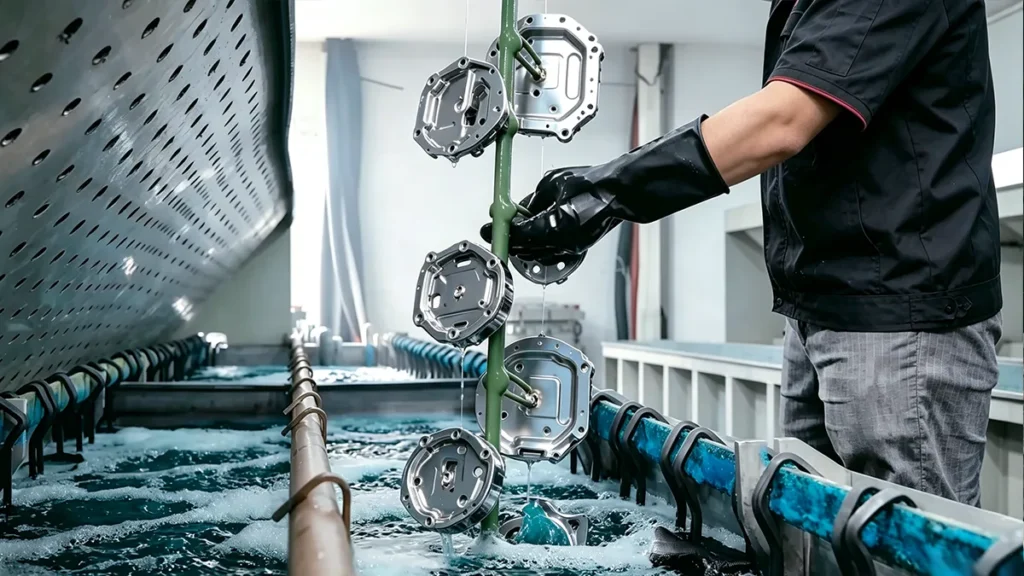
La galvanoplastie est un procédé chimique largement utilisé dans le domaine de l'ingénierie. Elle est parfois considérée comme un procédé de finition visant à traiter une pièce afin qu'elle réponde à des exigences fonctionnelles spécifiques. Prenons, par exemple, un connecteur électrique en acier utilisé dans l'assemblage automobile. Sans galvanoplastie, le connecteur peut facilement se corroder lorsque le véhicule est exposé à l'humidité et à des contaminants. Cependant, une fois galvanisé, le composant peut résister plus longtemps à ces environnements corrosifs, en fonction du matériau de revêtement utilisé. Cette technologie est également très répandue dans l'industrie de la beauté. Grâce à la galvanoplastie, les boucles d'oreilles et les colliers prennent un aspect doré, ce qui les rend plus attrayants.
L'efficacité du dépôt électrolytique ne dépend pas uniquement du choix du matériau approprié, mais également de la manière dont les paramètres du procédé sont gérés. Cette analyse examine divers paramètres du dépôt électrolytique, notamment la densité de courant, la durée de dépôt, la composition chimique du bain, la température, le pH, l'agitation, la disposition des anodes et des cathodes, la préparation de la surface et le rendement courant. Ces paramètres doivent être étroitement surveillés afin d’obtenir l’épaisseur de revêtement, l’adhérence, la résistance à la corrosion et la dureté spécifiées. De plus, en comprenant ces paramètres, les fabricants peuvent obtenir les performances électriques, l’aspect et les tolérances dimensionnelles souhaités tout en maintenant une variation de processus acceptable.
Qu'est-ce que la galvanoplastie ?
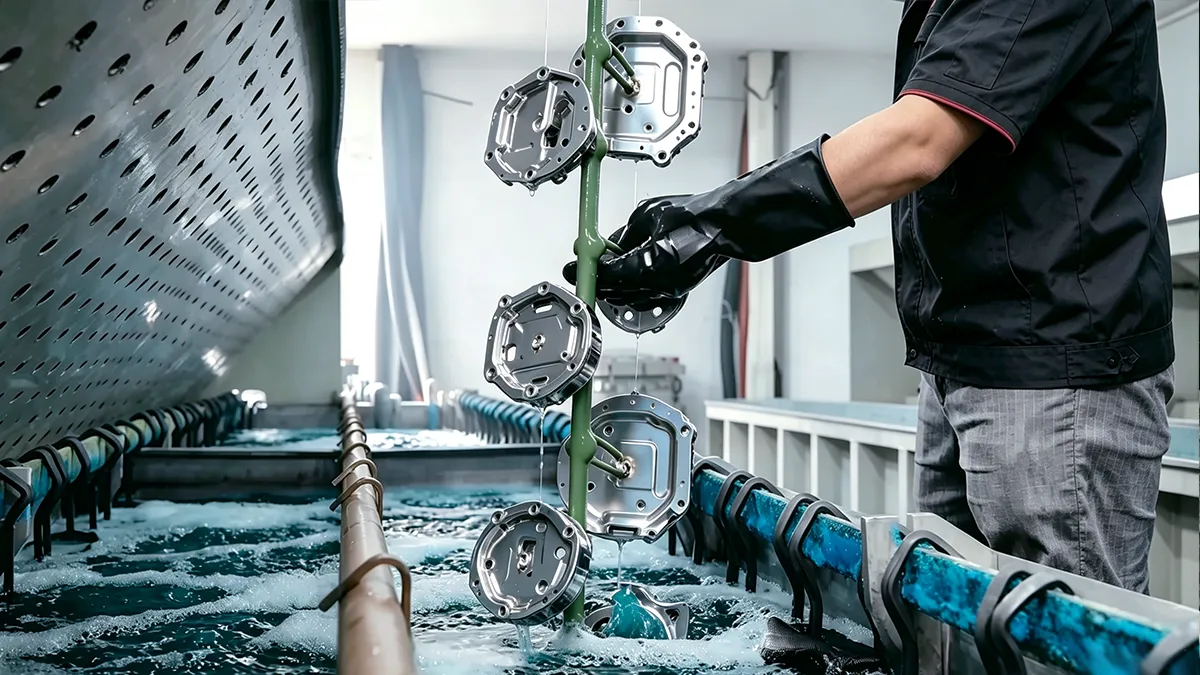
La galvanoplastie est un procédé de fabrication qui consiste à déposer une fine couche d'atomes métalliques sur un autre matériau par électrolyse. Le métal ajouté est appelé « métal de dépôt », tandis que le matériau sous-jacent ou la pièce à traiter est appelé « matériau de support ».
Les principaux composants d'un dispositif de galvanoplastie sont la cathode (l'objet à plaquer), l'anode (un métal fournissant les ions nécessaires au plaquage) et la solution électrolytique contenant les ions dissous ; ensemble, ils forment une cellule électrolytique régie par des paramètres électriques précis. [1]. L'alimentation en courant continu fournit l'énergie électrique nécessaire au dépôt. La galvanoplastie comprend également un système de contrôle des paramètres du procédé.
Comment fonctionne le procédé de galvanoplastie ?
Le processus de galvanoplastie se déroule en plusieurs étapes, commençant par le contrôle des pièces et se terminant par le contrôle final après le dépôt. Dans cette présentation, nous allons illustrer le dépôt de nickel sur une pièce en acier.
1. Contrôle des pièces
Inspection du substrat (dans notre cas, l'acier) avant le placage. Les points clés à observer comprennent la composition du métal de base, la rugosité de surface, les traces d'usinage et les bavures. Il convient également de prêter attention à la porosité, aux défauts de soudure et à la précision dimensionnelle. Il convient de vérifier la présence éventuelle d’oxyde sur le substrat, car celui-ci peut affecter la couche déposée. Ces défauts doivent être corrigés avant la gravure. Le procédé de galvanoplastie ne masque pas ces défauts. Ceux-ci seront toujours visibles par la suite sur la pièce finale.
2. Préparation de la surface
La préparation du substrat est essentielle avant le dépôt, car un haut niveau de propreté est indispensable pour garantir une bonne adhérence du revêtement et éviter les défauts. [3]. Même si l’acier peut paraître propre à l’œil nu, il peut néanmoins présenter des traces de graisse, d’huile, d’empreintes digitales, d’oxydes, de poussière et de résidus issus des étapes de traitement précédentes. Ces contaminants peuvent nuire à l’adhérence de la couche de nickel sur le substrat en acier. La préparation comprend le dégraissage de la pièce en acier dans une solution alcaline pour éliminer les huiles, un rinçage pour éliminer la poussière, ainsi qu’une activation acide pour éliminer les oxydes. Dans certains cas, on applique une couche d’apprêt au nickel. Il s’agit d’une fine couche de nickel appliquée avant le dépôt de la couche principale de nickel. L’apprêt au nickel améliore l’adhérence au substrat et offre une surface de départ efficace.
3. Galvanoplastie générale
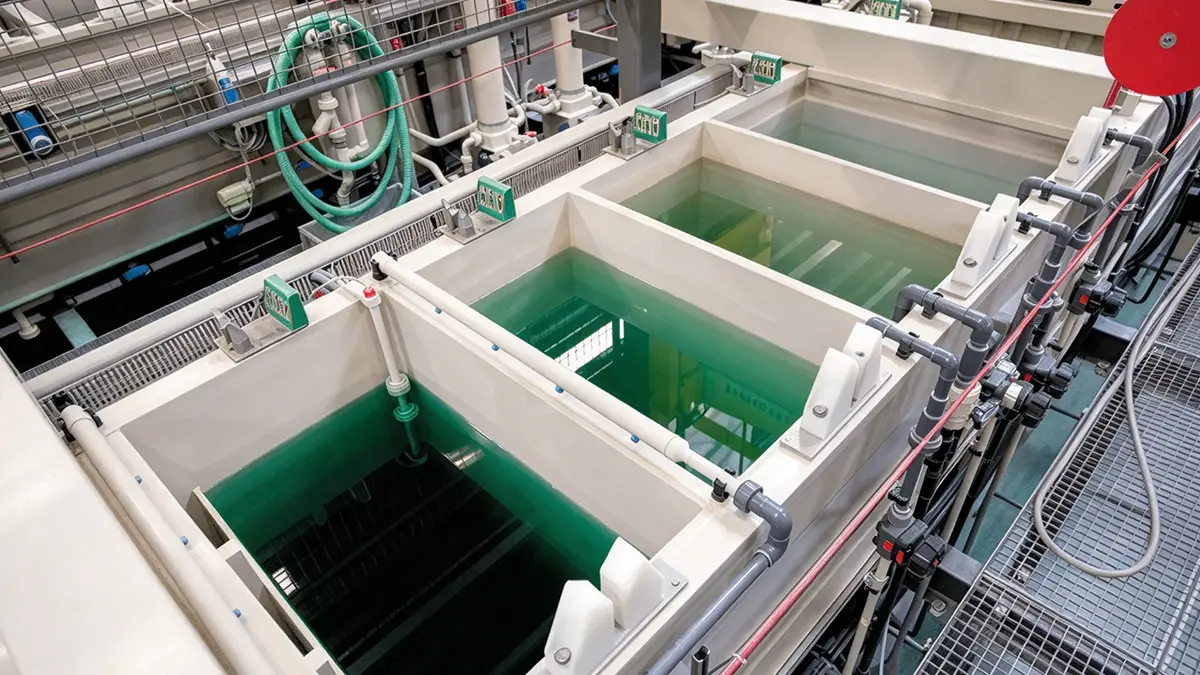
Le procédé de galvanoplastie repose sur le transfert d’électrons. Une anode et une cathode sont mises en place afin de créer une différence de potentiel. Dans notre cas, la plaque de nickel est reliée à la borne positive, formant ainsi une anode. De l’autre côté, la pièce en acier est reliée à la borne négative, formant ainsi une cathode. L’anode et la cathode sont toutes deux immergées dans un électrolyte contenant du nickel. Une fois le courant continu mis sous tension, un courant électrique entraîne les ions nickel vers la pièce en acier. Une fois déposés, les ions nickel se transforment en nickel métallique, formant ainsi une couche. Au niveau de l’anode, le nickel métallique perd des électrons pour se transformer en ion, comme le décrit la réaction suivante :;
Ni → Ni²⁺ + 2e⁻
Au niveau de la cathode, les ions nickel présents autour de l'acier captent des électrons pour former du nickel métallique, comme le montre la réaction suivante :;
Ni²⁺ + 2e⁻ → Ni
4. Rinçage et traitement ultérieur
À chaque étape du processus de galvanoplastie, la pièce est rincée. À l'issue de ce processus d'électrolyse, le rinçage permet d'éliminer l'électrolyte présent à la surface. Le rinçage permet d'éviter toute contamination croisée entre les bains. Après le rinçage, le composant subit un post-traitement, qui peut inclure le scellement, la passivation, un traitement anti-ternissure, la lubrification et le séchage.
Quels sont les paramètres les plus importants dans les procédés de galvanoplastie ?
Le tableau suivant résume les principaux paramètres du procédé de galvanoplastie.
| Paramètres | Poste type dans le domaine de l'ingénierie | Que se passe-t-il si la maladie n'est pas bien contrôlée ? |
|---|---|---|
| Densité de courant | Permet de contrôler le débit de dépôt et les caractéristiques du dépôt | Brûlures, mauvaise couverture, épaisseur excessive |
| Durée de placage | Détermine l'épaisseur du dépôt | Sous-placage ou sur-placage |
| Température du bain | Régule la cinétique des réactions et la conductivité | Dépôt lent, rugosité, instabilité chimique |
| pH | Influence la chimie de la sédimentation et la qualité des sédiments | Rendement insuffisant, dépôts granuleux ou friables |
| Concentration en ions métalliques | Consommables pour le dépôt de métal | Variation d'épaisseur, dépôt instable |
| Agitation | Améliore le transport de masse | Mauvaise homogénéité et appauvrissement local |
| Distance entre l'anode et la cathode | Influence la répartition du courant | Accumulation de matière sur les bords et zones de faible épaisseur |
| Rendement en courant | Détermine la quantité de charge électrique nécessaire pour provoquer un dépôt métallique | Erreurs de prédiction de l'épaisseur |
| Préparation de la surface | Évalue l'adhérence et la propreté | Desquamation, formation de cloques, couverture insuffisante |
| Filtration | Élimine les particules et les impuretés | Pits, nodules et rugosité |
| Contamination de l'eau du bain | A une incidence sur la composition chimique des dépôts | Fragilité, décoloration ou mauvaise adhérence |
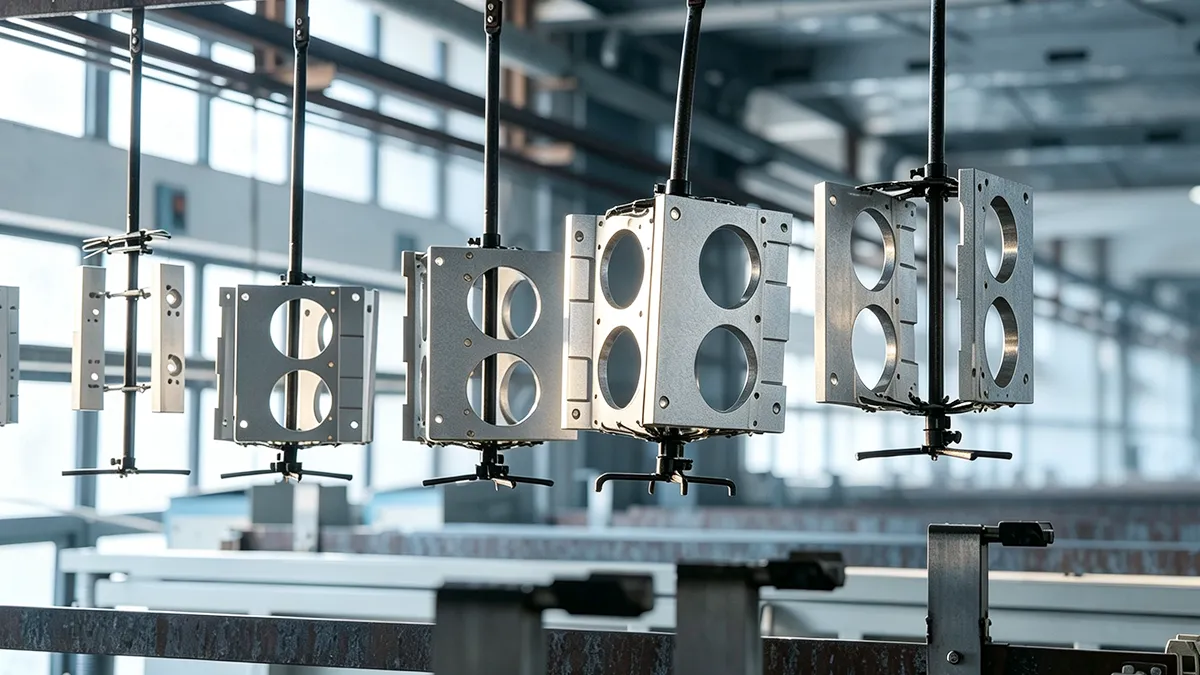
| Orientation des pièces | Influence le débit de la solution et la répartition du courant | Revêtement irrégulier |
Densité de courant
Le procédé de galvanoplastie repose sur la loi de Faraday, selon laquelle :;
m = (M × I × t × η) / (n × F)
Où m est la masse de nickel déposée, M la masse molaire du nickel est d'environ 58,69 g/mol, I est l'intensité du courant en ampères, et t est la durée de dépôt en secondes. Cela fournit un cadre quantitatif permettant de calculer la masse de métal déposée au cours de l'électrolyse [2].
Le processus de placage ne dépend pas uniquement de la quantité fournie. Les concepteurs et les ingénieurs tiennent compte de la densité de courant (J). Il s'agit de la quantité de courant fournie par unité de surface. La densité de courant est donnée par :;
J = I / A
Où A c'est la surface plaquée.
Même si l'augmentation de la densité de courant accroît la vitesse de dépôt, il faut éviter une densité de courant excessive. Celle-ci peut entraîner des brûlures, des dépôts irréguliers, un dégagement excessif d'hydrogène, un aspect médiocre et une augmentation des contraintes internes.
La densité de courant est souvent exprimée en A/dm² (ASD), en A/cm² ou en A/ft².
Durée de placage
D’après la loi de Faraday, la durée de dépôt influe sur la quantité de métal pouvant théoriquement être déposée directement. Cela signifie qu’en maintenant constants d’autres facteurs tels que la densité de courant, la concentration de l’électrolyte et la composition du substrat, l’allongement de la durée de dépôt peut augmenter la quantité de matière déposée (dans notre cas, l’épaisseur du dépôt de nickel).
Supposons que le procédé ait été validé de telle sorte qu'une densité de courant donnée produise approximativement un taux de dépôt connu. Le tableau suivant montre que l'épaisseur du dépôt augmente avec la durée de dépôt.
Cependant, le taux de dépôt ne doit pas être évalué uniquement en fonction de la durée de galvanisation. Tous les autres facteurs décrits dans la loi de Faraday doivent être pris en compte. L’un des principaux défis liés au contrôle du courant réside dans la répartition inégale du courant autour de la pièce. Les reliefs marqués ou saillants du moule ont tendance à recevoir une densité de courant locale plus élevée que les zones en creux. Il en résulte des zones à courant élevé, qui donnent lieu à des revêtements plus épais, et des zones à courant faible, qui donnent lieu à des revêtements plus fins.
Température et pH de l'électrolyte
La température est un facteur d'activation essentiel qui influe sur tous les processus chimiques en galvanoplastie. Elle détermine la stabilité du bain, le comportement des additifs, la cinétique des réactions et la conductivité électrique. Prenons, par exemple, le procédé MacDermid Alpha. Ce procédé fonctionne à une température moyenne recommandée de 55 °C, avec une plage comprise entre 50 et 60 °C. Cette plage de température est inférieure à celle du procédé de nickelage chimique d’Atotech, qui fonctionne entre 74 et 76 °C.
Les relations de température ne constituent pas une contrainte pour un fonctionnement en continu. Elles sont directement liées aux valeurs de pH. Par exemple, dans notre cas, une température de fonctionnement de 55 °C entraînerait un dépôt maximal à un pH compris entre 3,5 et 4,5. Les différences de température entre les différentes technologies d’exploitation montrent que les ingénieurs doivent définir un environnement de fonctionnement spécifique. La température doit être rigoureusement contrôlée afin d'éviter tout écart par rapport aux conditions chimiques de la galvanoplastie.
Effets du pH
Le pH influe sur l'équilibre chimique de l'électrolyte. Il affecte le rendement du courant, la disponibilité des ions métalliques, le dégagement d'hydrogène, le comportement des additifs, la morphologie du dépôt et la contrainte du dépôt. Le pH moyen recommandé pour le système de nickelage électrolytique MacDermid Alpha est de 4,0, avec une plage comprise entre 3,5 et 4,5. Le pH ne doit ni dépasser ni descendre en dessous des niveaux recommandés. Des pH plus élevés peuvent entraîner des dépôts moins ductiles. À l'inverse, des pH plus bas peuvent réduire l'efficacité du dépôt.
Comment contrôler la galvanoplastie en production ?
Le contrôle des procédés de galvanoplastie implique la gestion de paramètres clés tels que la composition chimique du bain (électrolyte), le pH, le courant et la durée de dépôt. Le contrôle du bain consiste à réguler la concentration en métal. Cette surveillance garantit un transfert ionique suffisant de l’anode vers la cathode. Le contrôle du pH porte principalement sur la concentration en additifs et les sous-produits de réaction. Un système de contrôle mesure le pH des réactifs et des produits finaux afin de garantir un équilibre adéquat. Le contrôle électrique enregistre le courant, la tension et la densité de courant. La densité de courant doit se situer dans les plages recommandées. Toutes ces mesures sont programmées par ordinateur, et des signaux rouges ainsi que des sirènes dans l'installation industrielle signalent tout écart.
Références
[1] ASTM International. (2024). Normes relatives à la galvanoplastie : serrer la vis. Actualités et analyses techniques de l'ASTM. https://www.astm.org/news/standards-electroplating-turning-screw-mj24
[2] Institut national des normes et des technologies (NIST). (1997). Programme de technologies de pointe : construction automobile. Archives des rapports techniques du NIST. https://nvlpubs.nist.gov/nistpubs/Legacy/IR/nistir6079.pdf
[3] ASM International. (s.d.). Revêtements par galvanoplastie. Manuels de la bibliothèque numérique de l'ASM. https://dl.asminternational.org/handbooks/edited-volume/46/chapter-abstract/552799/Electroplated-Coatings?redirectedFrom=PDF








 FR
FR  EN
EN  ES
ES  DE
DE  IT
IT  PT
PT  NL
NL  PL
PL  AR
AR  JA
JA  KO
KO  ZH
ZH