

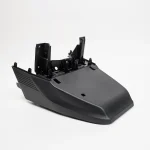
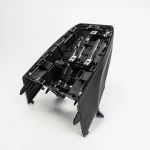
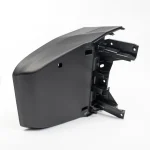
The center console armrest part has both aesthetic and functional roles. The design and material finish contribute to the overall beauty of the cabin. However, it primarily serves the functional roles of providing comfort and improving convenience. For example, it usually features a secret storage for personal items like phones, wallets, and keys.
The center console armrest provides a resting place for the driver and the front passenger’s inner arms. This lowers the risk of muscle stiffness and fatigue, particularly during long drives. With the arms properly rested, the driver can maintain a stable and relaxed posture, which is vital for better vehicle control.

Components of the Center Console Armrest in Modern Vehicles
Manufacturers of most modern vehicles want every feature to either increase comfort or bring new functionalities. The different components integrated into the center console armrest parts manufacturing are designed to deliver on this vision.
| Components of the center console armrest | Function |
|---|---|
| Center console armrest housing | It is a rigid outer casing that protects the internal components of the armrest. It is the part that is physically mounted on the center console or chassis to provide structural stability. It houses features like cup holders and electrical components in modern vehicles. |
| Storage compartment | The armrest usually doubles as the lid of a hidden storage box or console bin. The compartment is useful for keeping personal items hidden from sight. |
| Padding/cushion | The armrest’s top is usually padded or cushioned with a soft material to improve comfort. |
| Hinge mechanism | The center console armrest can securely open and close with the help of a hinge mechanism. In some cases, the hinges allow for vertical as well as forward and backward adjustments for personalized comfort. |
| Integrated electronics | The modern center console armrest part has become a hub for various electronics. Charging ports, control switches, infotainment display, and cable routing are built into the armrest. |
Client Requirements
The client had strict requirements on appearance and functionality. In terms of appearance, the client wanted a center console armrest part that was free of defects commonly occurring on curved surfaces, including sink marks, weld lines, and flow marks. As a premium automaker, the smallest center console armrest injection molding fault can affect the cabin’s appeal.
In terms of functionality, it was expected to have good structural stability and feature snap-fit dimensions for easy assembly. Other features the client was concerned about include perpendicularity of mounting posts, fit clearance, and ±0.1mm part tolerance and ±0.05 mm mold tolerance.
Since the armrest is supposed to withstand the pressure of the arm, as well as survive several opening and closing cycles, the manufacturer was concerned about durability, too. If the armrest fails too early, it can cast a bad image on the automaker.
Challenges and Solutions
Each of the requirements outlined by the manufacturer came with a unique challenge. The manufacturer’s blueprint had several material and dimensional specifications that were more difficult to achieve using a regular molding technique.
Achieving a Flawless Appearance on Thin Center Console Armrest Housing
The first in the series of challenges that First Mold was expected to overcome was creating a stable thin-walled part. Lightweighting is extremely crucial in automobile fuel efficiency. One of the ways of achieving that is through design modifications that promote lower material use.
Thin walls are reinforced with ribs for stability. However, the ribs often introduce weak points in the structure if the material or process is inadequate. This can create issues such as snap-fit breakage or shell warping (leading to the armrest failing to open/close or becoming loose). Any of these issues will shorten the product’s lifecycle, which is typically ≥5 years for most automotive components.
In addition to achieving an appearance free from common center console armrest housing manufacturing faults, the automaker also wanted the center console armrest to have a stylized texture engraving. To achieve this, the engraving had to be carved into the mold, which required detailed CNC machining.
Durability Concerns with Snap-Fit Design
To ensure the center console armrest housing injection molding is durable, First Mold had to overcome the challenges with the snap-fit modules, which must survive thousands of open and close cycles. In snap-fit designs, there is usually stress concentration around the base, necessitating the addition of fillets or radii. Other challenges that First Mold had to overcome include:
- Fatigue failure: This failure results from repeated assembly and disassembly of snap-fits. One way to avoid it is to use Stress-Number of cycles curves, also known as S-N curves, in material selection.
- Creep: Over time, plastic naturally succumbs to deformation under sustained load, which will weaken the snap. Therefore, it is essential to use creep-resistant materials like polybutylene terephthalate, a strong, semi-crystalline engineering plastic, or other reinforced plastics for the production of snap-fits. For this center console armrest housing manufacturing project, First Mold settled for a blend of acrylonitrile Butadiene Styrene (ABS), which has high strength, rigidity, and heat resistance, and polycarbonate (PC). The hybrid material offers a superior balance of durability, toughness, and thermal performance.
Assembly Compatibility Challenges of Center Console Armrest Parts
The ease of assembly of a snap-fit design will depend on the relationship between the mating parts. Design elements like snap-fit dimensions, fit clearance, perpendicularity of mounting posts, and tolerance will determine how properly the parts will function.
- Snap-fit dimensions: The two mating parts must have precise dimensions and be made from flexible materials. This allows the two halves to temporarily deform during assembly and regain their original shape to create a tight connection. The right dimension ensures adequate strength.
- Fit clearance: This is the space between the mating parts. Clearance fit includes a significant space between the two parts, which makes assembly easy. On the other hand, an interference or press fit is used to create a stronger, semi-permanent joint. In a press fit, the parts are larger than the holes they fit into and will require some degree of force to assemble.
- Perpendicularity of mounting posts: To ensure mating parts engage properly, the mounting posts must be at precisely a 90-degree angle to the base surface. This allows them to sit flat on the surface and avoid introducing stress or misalignment.
- Tolerance: This is the allowable variation in the part’s dimensions. No manufacturing process is perfect. Therefore, parts will usually have small (mostly negligible) differences. Tolerance sets the limit for the acceptable variations that parts can have. When parts are within the accepted tolerances, they are expected to assemble and function correctly. For this center console armrest parts manufacturing project, the client had set the limit for parts at ±0.1mm and the limit for mold at ±0.05mm.
What Clients Benefited from Working with First Mold’s Solution
Due to the complex design of the center console armrest housing, First Mold used the Moldflow simulation software to predict the filling/shrinkage of the product in advance. Moldflow simulates how the molten polymer flows into and fills the mold cavity. This simulation helps to identify air traps, short shots, uneven filling, and weld lines.
The outcome allowed First Mold to optimize the slider/lifter structures of the center console armrest housing injection molding tool. For example, to prevent mold flash, which leads to increased material waste and more tedious secondary finishing, First Mold ensured that the clearance between the sliders and lifters is ≤0.02mm.
With the help of virtual simulation, First Mold was able to limit trial molding attempts to 2-3 times. Repeated attempts are time-consuming and costly. With proper planning and leveraging the latest virtual technologies, First Mold was able to offer better value, in terms of faster product-to-market time and money, to the client.
Implementing a 20% Production Capacity Buffer
To help the client meet the center console armrest injection molding capacity, First Mold deployed multiple injection molding machines of the same model. A minimum of 20% production capacity was reserved as a buffer.
In other words, if all the molds for the center console armrest parts manufacturing are working at 80% capacity, they will meet the client’s current demand. If all the molds are working at 100% capacity, the number of parts that will be created will be 20% more than demanded. This 20% excess creates a buffer for shortfalls that may result from maintenance, sudden demand spikes, and unexpected disruptions.
The extra 20% production capacity can also come in handy for the testing of new materials without negatively affecting the production lines.
Production Part Approval Process Documentation
First Mold operates under the IATF 16949 certification system and provides PPAP documentation. This documentation demonstrates that the center console armrest injection molding tools we delivered will consistently meet the technical and quality requirements of the client’s center console armrest parts.

FAQ
First Mold can include textures on the mold cavity using high-precision CNC machining techniques without undermining their dimensional accuracy. The mold undergoes meticulous quality assurance tests and treatment to ensure it meets the client’s functionality requirements.
First Mold relies on advanced simulation software, optimization of molding process parameters, and implementation of robust quality control measures to ensure molds deliver consistent, high-quality parts.

 EN
EN  ES
ES  FR
FR  DE
DE  IT
IT  PT
PT  NL
NL  PL
PL  AR
AR  JA
JA  KO
KO  ZH
ZH