


了解材料在下列情况下的行为 注塑 和 数控加工 是开发优质产品的关键。玻璃转化温度 (Tg) 是注塑成型和数控机床的基本材料属性。这一特性可用于衡量加工条件。它还决定了复合材料和塑料的性能以及结构的完整性。玻璃化转变温度是影响材料性能的关键因素。它用于注塑成型和数控机床的加工及其整个生命周期。.
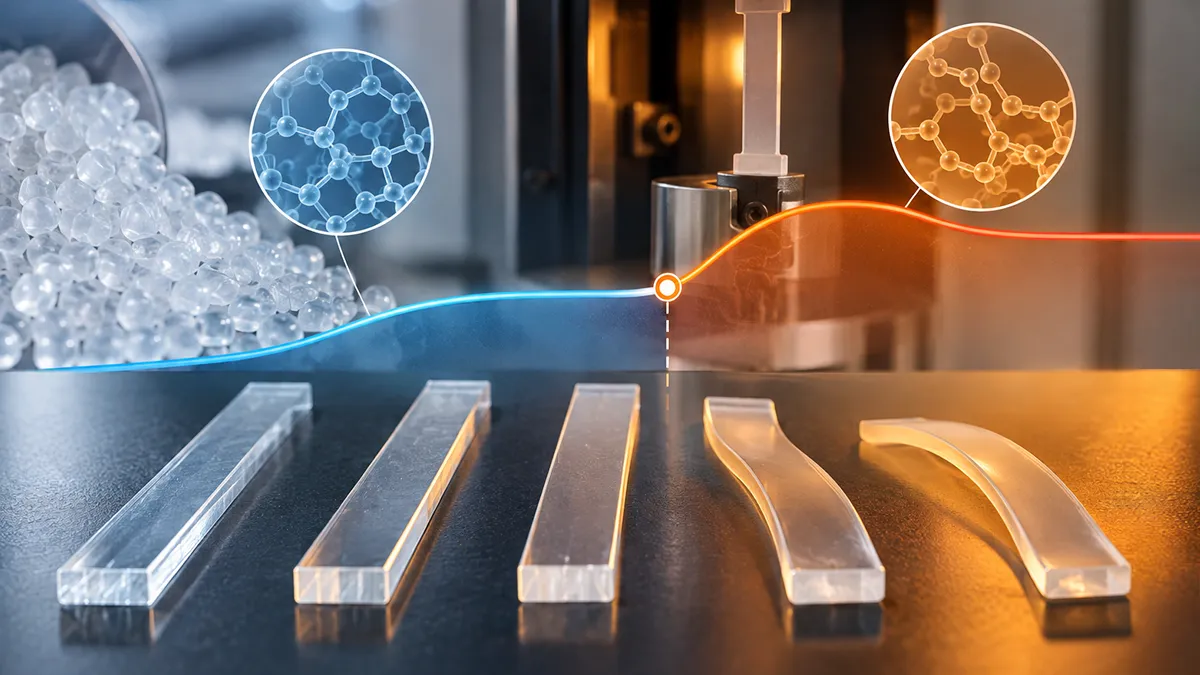
什么是玻璃转化温度(Tg)
玻璃转化温度 (Tg) 是指半结晶和无定形聚合物从玻璃态转变为柔软和皮革态的温度。它是无定形聚合物从坚硬状态转变为光滑状态的温度。
玻璃化转变温度(Tg)是一个非常重要的温度。它决定了聚合物何时从玻璃态(有点硬)转变为柔性态。这种变化会影响聚合物的加工方式和机械性能。这一过程不仅发生在聚合物中,也发生在玻璃和无定形材料中。Tg 标志着这些材料中的分子开始有更多的移动。
玻璃化转变温度(Tg)是指使聚合物从刚性状态转变为玻璃态、橡胶态,最终转变为柔性态的温度。Tg的测定必须严格遵循ASTM D3418等国际标准,使用差示扫描量热仪(DSC)进行。 [1]. 这种高灵敏度的分析设备可测量聚合物从刚性玻璃态向柔韧橡胶态转变过程中比热容的具体变化,从而提供精确的热学临界值,而非近似数值。.
Tg值是在一定温度范围内测得的。在图表上,它不会自动显示为一个精确的数值。低于该温度时,聚合物会变得僵硬且脆性;高于该温度时,则会变得可塑且柔韧。.
温度知识对于优化注塑成型工艺和数控加工非常重要。它的作用是帮助制造商测量合适的加工温度。
将结晶聚合物加热到一定温度后,会出现描述长链结构的有序排列。这种排列的结果是无组织的随机排列。固态聚合物一般会转变并熔化成液体。熔化时的温度称为熔点(Tm)。具有结晶和无定形部分的聚合物具有熔点和玻璃化温度。
Tg 在注塑成型中的作用
制造业正越来越多地采用综合性、多功能的制造技术。这样做的目的是为了满足消费者不断变化的需求。越来越多的工艺侧重于塑料生产。该工艺首先在特定温度下对材料进行加热。然后将其注入模具,再经过冷却以形成其形状。Tg 在生产过程中非常重要,其作用包括
模具设计和材料流动 较低的玻璃化转变温度(Tg)使材料在受热时能够轻松流动。这种出色的流动性使得能够制造出理想且结构极其复杂的薄壁部件,这通常通过 模流分析. 反之,如果将材料注入温度低于所需玻璃化转变温度(Tg)阈值的模具中,材料将无法正常流动。这种过早冷却通常会导致型腔填充不完全,并产生缺陷率极高的零件。.
冷却和凝固 注塑成型后需要进行冷却和凝固。如果未能根据玻璃化转变温度(Tg)对冷却速率进行妥善控制,可能会导致各种 注塑缺陷 例如翘曲、收缩和变形。必须控制模具冷却的时间。目的是消除材料的软化现象。.
机械性能 用于注塑成型的聚合物会改变其机械性能。这些变化取决于部件是高于还是低于 Tg。例如,Tg 值较低时,脆性较低。高于 Tg 时,材料具有柔韧性,可吸收应力而不会断裂。
优化生产效率: 成型商可以对……进行微调 成型周期, ,从而延长了生产时间并降低了效率。玻璃化转变温度(Tg)较高的材料需要更长的冷却时间。而玻璃化转变温度较低的材料在加工过程中所需时间较短。.
玻璃转化温度与数控加工
CNC(计算机数控)是指在切割和塑形材料时结合机器动作的制造精度。不同类型的聚合物、塑料和复合材料都需要经过机械加工。这些类型侧重于数控加工和合金与金属制造。机械加工应用于自动化制造和医疗设备等行业。Tg 在数控加工中的作用取决于加工过程中材料的性质和类型:
加工温度控制: 在数控加工过程中,材料会经历极端升温。 温度超过其玻璃化转变温度(Tg)会导致刚度下降。这种热影响会直接导致表面光洁度下降和严重的形状变形。因此,操作人员必须实施持续的环境监测。这种严格的监控对于防止温度敏感型聚合物在重切削循环中超过其玻璃化转变温度(Tg)至关重要。.
材料的选择: 玻璃化转变温度对于确定合适的材料至关重要。在数控加工过程中,强烈的切削力会在刀具与工件的接触面自然产生大量的摩擦热。如果该局部切削温度超过特定聚合物的玻璃化转变温度(Tg),该材料将立即失去结构刚性,并转变为橡胶状状态。 [2]. 这种热转变会导致严重的尺寸变形、表面光洁度差以及刀具快速磨损。这种变形是由过压引起的,从而导致不良后果。具有较高玻璃化转变温度(Tg)的材料,在较高温度下处于稳定状态时,适用于高精度数控加工应用。.
刀具和切割参数 数控加工需要改变。进给速率、速度和刀具类型等要素需要根据材料的 Tg 进行调整。Tg 值较低的聚合物需要较慢的进给速度。它们还需要定制的工具来克服热积聚。Tg 较高的聚合物则需要更高的速度和更有效的碰撞方法。
不同材料的玻璃化转变温度
不同的 Tg 值会影响数控加工和注塑成型的行为和加工。这两个行业的一些常用材料包括
热塑性塑料
一种在加热时会软化并成功流动的聚合物被称为热塑性塑料。这种流动通常是在材料超过其特定的玻璃化转变温度时产生的。这一物理过程是完全可逆的。因此,该材料可以被有效地重新加工或回收利用。这些材料的玻璃化转变温度(Tg)决定了其成型和加工性能。.
聚丙烯 (PP):Tg = -10°C 至 -20°C
“使用”一词 聚丙烯 该材料在热塑性注塑成型中应用广泛。其显著特征是固相转变温度(Tg)天然较低。这种较低的热阈值使其在室温下极易成型且柔韧性极佳。较低的Tg不仅使其易于成型,还使其在高温下更具柔韧性。该工艺需要有效的温度控制和加工处理,以避免变形。.
聚碳酸酯 (PC):Tg = 145 度
Tg 在 聚碳酸酯 较高,因此适用于需要高性能的应用场合。由于玻璃化转变温度(Tg)较高,该聚碳酸酯在注塑成型加工过程中存在一定风险。其玻璃化转变温度(Tg)较高,导致注塑时需要较高的温度,且冷却时间较长。.
聚苯乙烯(PS);Tg= 100 度
聚苯乙烯 在包装和一次性餐具的生产过程中,这一点非常重要。该材料的玻璃化转变温度(Tg)适中,在注塑成型过程中易于加工。需要采取预防措施,以避免过度翘曲和冷却。.
聚酰胺(尼龙):Tg = 50 至 70 度
现有的 Tg 在 尼龙 较低。该材料强度极佳,且不易磨损。这些材料具有由高玻璃化转变温度(Tg)值所决定的独特特性。在调节温度管理时,必须充分关注玻璃化转变温度(Tg),以防止变形和软化。.
热固性塑料
热固性塑料会经历一个不可逆的固化过程。热固性塑料中的化合物需在特定温度下进行测试。用于制造热固性塑料的起始材料在固化前呈液态。此外,该液体可能具有粘合性。由于其玻璃化转变温度(Tg)较高,这些材料在性能表现上具有独特性。.
环氧树脂:Tg= 100 度至 250 度,视配方而定
环氧树脂适用于汽车和航空航天元件等高强度应用领域。Tg 会根据添加剂和固化剂的不同而发生变化。高 Tg 使其具有完美的热稳定性。环氧功能树脂可与阳离子和阴离子催化剂或听剂发生均聚反应。当反应继续进行时,较大的分子会出现并分裂成不同的结构。
酚醛:Tg= 140 度和 200 度
酚醛树脂在高热环境下工作性能最佳。高 Tg 要求在加工过程中采用定制的工具和热量管理。
复合材料
复合材料的 Tg 值范围很广,这取决于不同的成分。根据现有结构,复合材料包括具有不同 Tg 值的纤维。
碳纤维增强聚合物 (CFRP):Tg= 150 度至 300 度
现有的 CFRPS 具有较高的 Tg 值,在极端温度下不易变形。这些材料需要用于数控加工的高性能切削工具。我们的目标是防止热降解。
常见材料的玻璃化温度图表
| 材料 | 玻璃转化温度 (Tg) |
|---|---|
| 聚丙烯(PP) | -10°C至0°C |
| 聚碳酸酯(PC) | 145°C |
| 聚苯乙烯(PS) | 100°C |
| 聚酰胺(尼龙) | 50°C 至 70°C |
| 环氧树脂 | 100°C 至 250°C |
| 酚类 | 140°C 至 200°C |
| 碳纤维增强聚合物(CFRP) | 150°C 至 300°C |
管理玻璃转化温度的最佳实践
专业人员需要掌握数控加工和注塑成型技术。目标是在 Tg 上实现最佳加工和质量。
了解材料的 Tg: 有必要了解使用中的 Tg 材料。这些信息对于提高工具选择、温度和冷却速率的参数处理至关重要。
在加工过程中控制温度: 数控加工和注塑成型的温度管理需要有效的温度管理。温度水平需要保持在 Tg 左右。这可确保所有材料保持在最佳状态下进行加工和注塑。
优化模具设计和冷却速率: 防止翘曲等因素需要 成型设计 和冷却速度。其结果是防止不适当的凝固和翘曲。.
为数控加工选择合适的工具: 使用适当的切割参数和所需的工具,以减少撕裂和磨损。必须选择具有高 Tg 的材料。
固化和监测冷却: 对温度的实时监控将有助于指导 Tg 值。加工过程中不会出现超速,导致缺陷和变形。
Tg 管理的未来趋势与发展
机器人与自动化: 制造业实现了大规模自动化。更容易控制影响 Tg 的过程,包括冷却和温度。机器人技术也为控制过程提供了一条途径。其结果是持久而精确的材料处理。这种方法也适用于加工和成型过程。
用于实时监控的先进传感器: 物联网和智能传感器设备在数控加工和注塑成型中更为常见。传感器可提供有关压力、温度和材料特性的实时数据。这将对更好地控制 Tg 产生影响。此外,利益相关者还能从产品质量的提高中获益。
可持续材料: 回收材料和生物基部件在数控加工和注塑成型中的应用不断增加。制造业对可持续发展的要求表明,必须使用此类材料。这不仅能带来利润,还能产生社会影响。这些材料通常具有不同的 Tg 特性,需要改变参数才能达到最佳效果。
结论
玻璃化转变温度是决定材料性能的关键物理性质。其影响涉及加工过程、数控加工各环节的性能以及产品质量。专业人士需要有效采用优化工艺,以确保产品品质和耐用性。玻璃化转变温度适用于 热塑性塑料和热固性塑料. 此外,数控加工和注塑成型对产品制造过程产生积极影响也至关重要。.
传感器变革的新趋势带来了实时监控。此外,影响机器人技术和自动化的变化也使这一过程变得更加容易。
最后,对可持续性的关注将适当增加再生材料和生物基注塑成型,这将有效增加材料。最后一个组成部分是 Tg 特性,它要求改变参数并达到最佳效果。
参考资料
[1] 美国材料与试验协会(ASTM International)。(2021年)。. ASTM D3418-21 差示扫描量热法测定聚合物相变温度及熔融和结晶焓的标准试验方法. https://doi.org/10.1520/D3418-21
[2] Kalpakjian, S., & Schmid, S. R. (2014). 制造工程与技术 (第7版)。皮尔森出版社。. https://books.google.com/books?id=frF9MgEACAAJ




 ZH
ZH  EN
EN  ES
ES  FR
FR  DE
DE  IT
IT  PT
PT  NL
NL  PL
PL  AR
AR  JA
JA  KO
KO