
首页 / 嵌件成型服务
嵌件成型服务
The perfect match of metal and plastic. No plastic cracking, no hardware misalignment, and zero flash.
- ±0.02mm Alignment Accuracy
- 100+ Tested Metal-Resin Pairings
- 15-Day T1 Sampling
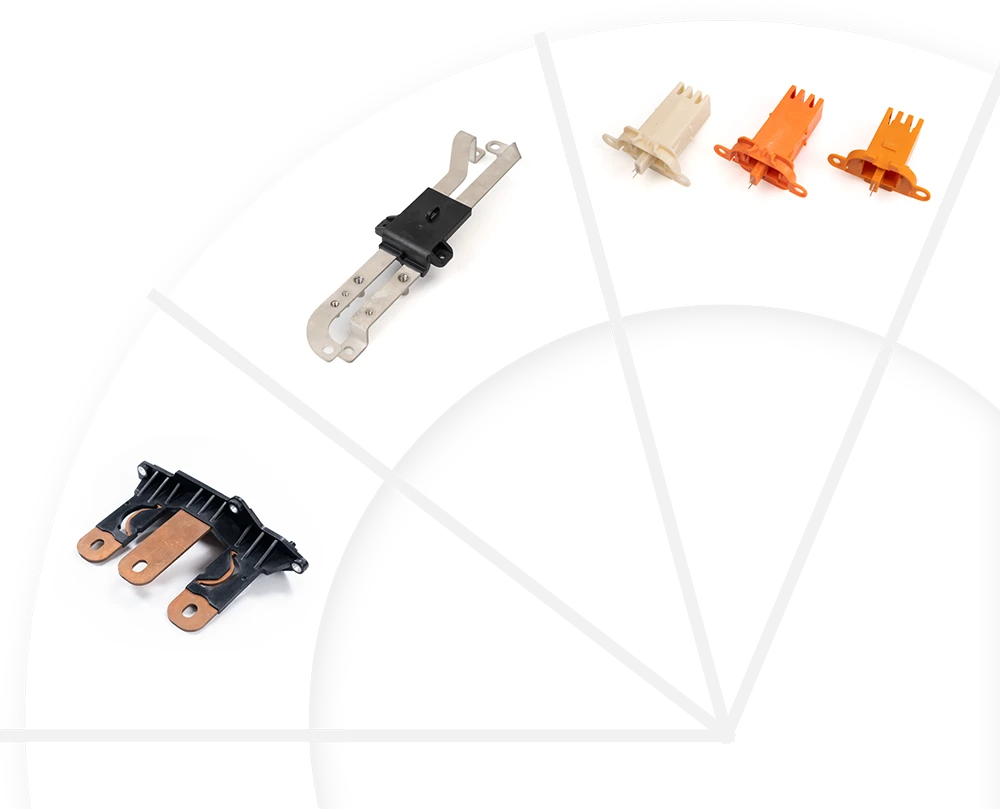
Insert Molding Equipment & Specifications At First Mold
Insert molding is the process of injecting molten plastic around a pre-placed non-plastic component. For your projects, this means permanently integrating fastening, conductivity, or structural strength directly into the plastic part—completely eliminating post-molding assembly steps.
We use both horizontal and vertical injection molding machines to make insert-molded parts. Which machine we use depends on the mold design, and we choose the setup that keeps production costs low.
| 规格 | 能力 | 规格 | 能力 |
|---|---|---|---|
| Machine Types | Horizontal & Vertical Presses | Insert Loading | Robotic Automation |
| 机器吨位 | 50 – 1,000+ Tons | Insert Pre-Heating Temp | 80°C – 150°C (CTE matched) |
| 标准公差 | ±0.1毫米(±0.004英寸) | 精度公差 | ±0.05毫米(±0.002英寸) |
| Tooling Life (Shots) | 50,000 – 1,000,000+ | T1 Lead Time | From 7 Days (Only rapid tool + standard insert) |


Compatible Hardware & Insert Types


Threaded Fasteners (Nuts & Studs)
Brass or stainless steel threads inside and studs outside. Needed for repeated high-force tightening and strong case/cover closure.
Electrical Contacts & Pins
Stamped Metal & Lead Frames
Clips, Meshes & Magnets
嵌入成型零件的材料选择
Insert molding relies on balanced pairing of plastic resin and internal hardware. We work out the right material match using mechanical requirements and thermal expansion coefficient CTE to deliver a permanent bond free of cracks.
主要材料
While we work with hundreds of commercial plastics, insert molding requires resins with consistent shrinkage behavior. We regularly use rigid thermoplastics such as PC and ABS, plus glass-fiber reinforced engineering plastics like PA66-GF and PBT. These materials closely match the thermal expansion rate of metal inserts and help stop stress cracks from forming after molding.
此外,由于我们供应链系统的优势,我们可以及时、稳定地获得这些原材料,而不会对您的产品交付造成任何影响。


插入式材料
嵌件注塑一般最常用于插入螺钉或螺柱,黄铜不会生锈,具有耐腐蚀的特点。黄铜价格低廉,易于加工,因此是嵌件注塑中最常用的材料。
此外,铜、铝、钢、硬质异种塑料件、陶瓷、玻璃和塑料也可用作插入材料。在产品应用中,我们会根据不同材料的热膨胀系数设计塑料零件的形状和结构。

黄铜

铝质

钢

塑料

陶瓷

玻璃
行业应用
Insert molding is used when standard assembly cannot meet strict pull-out strength waterproofing or miniaturization requirements. First Mold supplies high-reliability insert components for industries where part failure cannot be tolerated.

Vehicles face heavy vibration and wide temperature changes. We mold sturdy metal hardware into high-temperature plastics to maintain lasting pull-out resistance.

Medical tools require strict hygiene. Our process forms a watertight bond between metal and plastic with no tiny gaps where bacteria can grow.

Aerospace projects demand effective weight savings. We replace heavy metal assemblies with high-performance polymers molded around critical fasteners.

As electronics get smaller, manual assembly can damage fragile pins. We use precise vertical molding to encapsulate electrical contacts and achieve IP68 waterproof seals in one step.
| Part Category | Typical Inserted Components | Our Engineering Focus |
|---|---|---|
| Threaded Fastening | Brass nuts, threaded studs, standoffs | Zero hardware shifting in mold, pull-out strength, zero thread flash |
| Structural Reinforcement | Stamped metal brackets, steel plates, shafts | CTE matching, load-bearing integrity, warp control |
| Mechanical Hybrids | Metal shafts with plastic gears, bearings | Strict concentricity, wear resistance, dimensional stability |
| Sensors & Terminals | Standard pins, terminal blocks, sensor housings | Secure mold retention, flash-free sealing, insulation |
| Custom Heavy Inserts | Large metal fittings, heat sinks, thick plates | Optimizing high-tonnage horizontal presses for large hybrid parts |
Case Study: Preventing Insert Shift
See our mold design expertise in action. In this breakdown of a complex HVAC harness connector, we reveal how we engineer custom positioning cores to completely eliminate insert shift caused by melt flow.
How It Works From CAD Upload To Insert Molded Parts
We make the insert molding process transparent and hassle-free. Once you submit your design, our engineering team handles everything from mold design to final quality control.
01
CAD Upload & Technical Review
You upload your 3D CAD models and 2D drawings specifying the hardware inserts. Our engineers will quickly review the files for manufacturability and provide a quote with DFM feedback.
02
DFM Approval & Tooling
Once you approve the design and quote, we begin machining the mold steel. We engineer precise internal retention mechanisms to ensure your metal inserts will never shift during injection.
03
T1 Sampling & Fit Testing
We produce the first batch of insert molded prototypes and ship them to you for real-world testing. You can assemble them to verify the pull-out strength, sealing, and dimensional accuracy.
04
Mass Production & Delivery
After you approve the T1 samples, we lock in the molding parameters and start mass production. We perform strict quality inspections before shipping the finished parts globally to your facility.
Tip: Prefer a visual walkthrough? See how our platform works in this 3-minute video: How to Get a Part Production Quote from First Mold.
Recommended Product Design Guidelines for Insert Molded Parts
Proper design of both your plastic parts and metal inserts is key to preventing stress, flash, and part failure. Please note that the following design tips are based on general manufacturing standards and serve as a helpful reference. For a custom analysis of your specific project, we recommend consulting directly with our engineering team.
- Specify diamond or straight knurls on the outside of your insert. This increases friction and helps the plastic grip the metal tightly.
- If designing a custom rod-shaped insert, make the embedded portion square, flat, or bent so it won't spin inside the plastic.
- If designing a custom rod-shaped insert, make the embedded portion square, flat, or bent so it won't spin inside the plastic.
- Design your plastic wall thickness to be at least 0.8 to 0.9 times the insert’s outer diameter to safely absorb shrinkage.
- If you are placing two inserts on opposite facing walls, make sure the plastic layer between them is at least 3.5mm thick.
- Keep the metal insert at least 0.6mm away from the outer side wall of the plastic part to prevent weak spots.
- For accurate placement in the mold, design the exposed part of the insert that sits inside the mold tooling as a simple cylinder.
- Design custom inserts with a small stepped shoulder or ring. The mold will press against this step to create a tight, leak-proof seal.
- Keep metal inserts ≥5mm from the cavity wall. Preheat them to 80–120°C before molding to prevent thermal stress cracking during shrinkage.
Plastic Injection Molding FAQ

Is insert molding tooling more expensive than standard molds
Yes, typically by about 10% to 15%. Insert molds require specialized retention features (like custom pins, magnets, or mechanical sliders) to hold the hardware securely, as well as harder tool steel to withstand metal friction.
However, this slight tooling premium eliminates your downstream assembly processes. The traditional route is buying a cheaper mold and paying for manual assembly; insert molding is a one-step process that offers much better positional consistency and yield rates. Tooling is a one-time investment, whereas assembly labor and rework are recurring costs on every single part. If your project has stable volume, we can calculate the total ROI to show you exactly how fast the assembly savings will pay off the initial mold premium.
Will the plating on the metal insert peel or discolor during the molding process?
是的、 plating peeling or discoloration is a known industry risk in insert molding, not a random anomaly. However, its occurrence has specific triggers, and the risk is entirely controllable as long as boundaries are locked in across three levels: material matching, mold design, and process parameters. We don’t wait until the mold trial to discover these issues.
During our initial DFM review, our engineers will strictly verify whether your specific plating type is fully compatible with the melt temperature of your chosen resin.
Does the high hardness of metal inserts accelerate mold wear, and how do you maintain tooling life?
Yes, metal inserts add an extra wear burden to the mold. But the primary risk isn’t the “hardness of the metal”—it’s whether the insert is strictly secured. If an insert shifts during mold closing, the hard edge gouging the cavity causes catastrophic damage.
We manage this through three lines of defense:
- 1st Defense (Locating Design): We use angle pins, poka-yoke (error-proofing) geometry, and elastic constraints to ensure the insert sits in the exact same micro-position every shot, eliminating source friction.
- 2nd Defense (Materials): The direct contact areas use hardened steel or carbide inserts. The base mold steel is selected from P20 to H13 based on your life requirements, with nitriding or coating on critical surfaces.
- 3rd Defense (Maintainability): High-wear zones are designed as quick-change modular inserts. If wear occurs, we replace the insert without tearing down the entire mold. For long-term production, we can even outline a spare parts plan during the quoting stage, making mold life management a predictable budget rather than a line-down emergency.
How do you decide whether to use a horizontal or vertical injection molding machine for my project?
We don’t default to a specific machine type; we let the insert’s positioning requirements dictate the choice.
For slender terminals, micro-hardware, thin sheets, or parts needing strict concentricity, we prioritize Vertical Presses. The top-down clamping and gravity-assisted loading keep the inserts stable, and the top-down melt flow causes less disturbance. If the insert can sit stably horizontally, or if the project uses fully automated loading, Horizontal Presses are viable, though the mold requires side-clamping mechanisms to compensate for gravity.
We also factor in volume, part size, and tonnage. Vertical rotary tables offer flexible efficiency for mid-volumes, while horizontal presses are better for massive parts, high tonnage, or complex side actions.
Ultimately, we calculate the total unit cost—factoring in tooling differences, automation, and yield rates. Send us your insert features and estimated volume, and we will clearly outline our machine selection logic in the DFM report.
 ZH
 EN
 ES
 FR
 DE
 IT
 PT
 NL
 PL
 AR
 JA
 KO