Overmolding Service

A two-step injection molding technique to combine rigid plastics with soft, durable overlays. First Mold’s precision mold manufacturing and high-quality overmolding production are highly recognized worldwide.

ISO 9001:2015 | ISO 13485:2016 | NDA Available
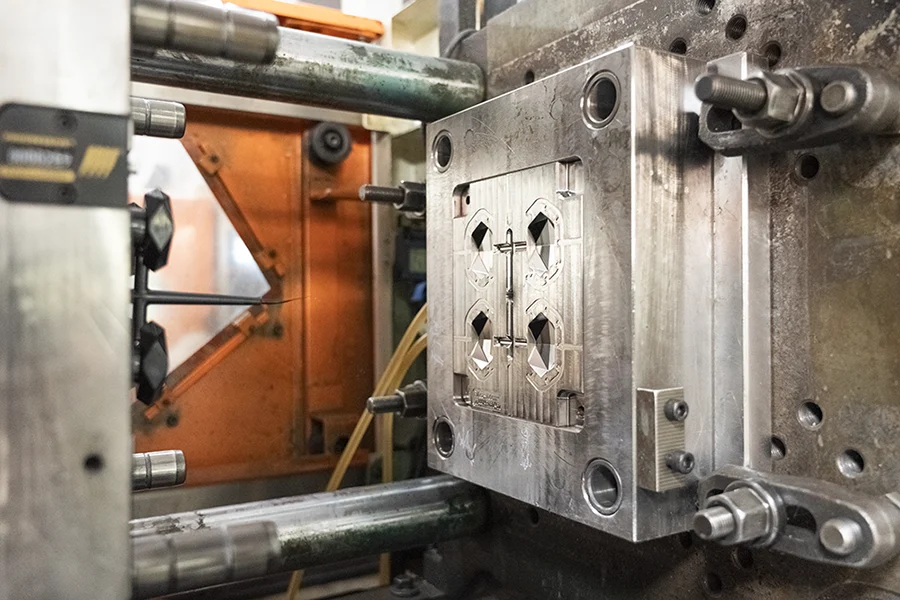
Cosmetic caps with a 2×2 layout are produced on injection molding machines through the overmolding process

What is Overmolding?

In product design, some of your products may have a soft material (such as TPE, silicone, or rubber) wrapped around a base material (hard plastic or metal). This is done to improve grip, prevent slipping, or enhance appearance. Such products are quite common, like tool handles, toothbrush grips, and phone cases. Their production usually requires a overmolding process.

Overmolding involves using two different plastic materials, injected separately in one injection molding machine. After the first molded in one set of molds, the product is taken out and placed into another set of molds for the second injection molding. Therefore, overmolding typically requires two sets of molds.

No More Slippery Handles — Bond, Seal, Protect with Overmolding

First Mold leads the injection molding industry with comprehensive capabilities. Overmolding stands as one of our proven specialties. We solve tough overmolding problems like:

Fixing Production Defects

Addressing Design Pitfalls

overmolding services process at FirstMold
Precision ejection of overmolded PA66-TPV housing from mold cavity

Overmolding Applications

As an injection molding factory, First Mold uses overmolding in a wide range of industries. 

Industry Representative Products Key Advantages
Medical Devices Surgical instrument grips, Prosthetic components, Catheter connectors, Syringe plungers Biocompatibility (ISO 10993), Chemical resistance, Enhanced sterilization compliance (FDA/CE)
Automotive Steering wheel grips, Airbag modules, Lightweight seat shells, Battery pack housings 40-50% weight reduction, Vibration damping (SAE J1475), Flame retardancy (UL94 V-0)
Consumer Electronics Phone cases, Earbud charging cases, Game controller grips, Smartwatch bands Anti-slip & shock absorption, IP68 waterproofing, Seamless multi-color aesthetics
Industrial & Tools Power tool handles, Wrench anti-slip sleeves, Precision instrument housings 300% impact resistance improvement, MIL-STD-810G compliance, Ergonomic fatigue reduction

Challenge

Frequent drops cause TWS earbud cases to crack. This leads to a 23% user complaint rate.

Solution

Hard PC inner shell and TPU shock-absorbing overmold

Surface Treatment

Skin-like matte texture, fingerprint-resistant finish

Results

A Top 3 global smartphone brand reduced after-sales repair costs by 41%

Watch a Video of Overmolding In Injection Molding Factory

Material combinations for overmolding technology

Overmolding technology is a paradigm of multi-material integrated manufacturing in industrial production, with diverse material pairing options. First Mold summarizes the material combination strategies for Overmolding as follows:

​Functional Synergy

i.e.: Combining polypropylene (PP) with SEBS elastomers leverages molecular chain entanglement to eliminate adhesives, while achieving gamma sterilization resistance (25kGy dose) for medical-grade handles

Performance Enhancement

i.e.: Nylon (PA66)-TPV elastomer composites exhibit exceptional resistance to oil/acid corrosion and ultra-low friction (μ=1.2). It’s ideal for high-voltage battery housings in electric vehicles.

Sustainable Innovation

i.e.: Bio-based TPE fused with PLA substrates delivers fully biodegradable solutions. By cutting carbon emissions by 50% means it meets EN 13432 industrial compostability requirements—revolutionizing eco-packaging systems.

Two distinct material groups for Overmolding process: engineered polymers (left) and thermoplastic elastomers (right) arranged on production workstation
Substrate Overmold Typical Applications Certification Standards
PP TPE/SEBS Medical handles, tool grips ISO 10993, FDA 21 CFR
ABS TPU Phone cases, smartwatch bands IEC 60529, RoHS
PC Liquid Silicone Rubber (LSR) Automotive transparent buttons, baby pacifiers IATF 16949, LFGB
Nylon (PA6/PA66) TPV Automotive battery housings, industrial gears UL94 V-0, MIL-STD-810G
PBT Glass-fiber reinforced TPE Power tool handles, connectors EN 61340, IEC 60695
PEEK Fluorocarbon Rubber (FKM) Aerospace sensors, medical implants ISO 13485, AS9100
Metal Inserts TPE/TPU Power tool handles, medical devices ISO 2768, ASTM D638
POM Thermoplastic Elastomer (TPE) Gear damping sleeves, precision instrument housings DIN 54800
PPS Silicone Rubber (VMQ) High-temperature sensors, engine components SAE J2460, AMS 3217
PLA Bio-based TPE Eco-friendly packaging, biodegradable products EN 13432, ASTM D6400

Overmolding Vs. Insert Molding Vs. Two-color molding

Overmolding involves injecting one material onto an existing substrate (such as hard plastic or metal). This process is completed in separate steps to form a protective or functional layer. In insert molding, the inserts such as metal or electronic components are placed into the injection mold first. Then, plastic is injected to secure and integrate the inserts. In two-shot molding, a rotating mold is used to inject two different materials in the same cycle.

Dimension Overmolding Insert Molding Two-Color Molding
Process Steps Two-step injection: Hard core → Soft overmold Pre-insert placement → Single-shot encapsulation Dual-shot injection (rotating/sliding mold)
Material Combination Soft-hard bonding (e.g., PP+TPE) Plastic + metal/insert (e.g., PA66+copper) Dual-color plastics (e.g., ABS+PC)
Equipment Requirements Standard machine + compatible mold Standard machine + robot/manual insert placement Dedicated two-color machine + rotating mold (±0.02mm)
Material Interaction Chemical bonding (thermodynamic compatibility) Mechanical locking (no chemical bonding) Physical layering (melting point synchronization)
Structural Difference Layered encapsulation (functional integration) Insert core (composite reinforcement) Seamless layering (aesthetic fusion)
Mold Cost $$ $ $$$
Production Cycle 30-60 sec (requires cooling between layers) 45-90 sec (manual insert placement) 20-40 sec (automated dual-shot)
Typical Products Tool handles, medical instruments Automotive connectors, medical electrodes Dual-color taillights, translucent keyboard keys
Mass Plastic Parts with a Click
en_USEN