
Início / Serviço de sobremoldagem
Serviço de sobremoldagem
Bond soft rubber directly onto hard plastic parts. We deliver comfortable grips and waterproof seals that never peel off, crack, or leak.
- 50+ Validated Rigid-Soft Pairings
- Zero Delamination & Flash-Free Edges
- Shore A 30 to D 80 Custom Grips
Compatible Overmolding Applications
In product design, you often need to improve grip, add waterproofing, or enhance appearance by wrapping a soft material (like TPE, TPU, or silicone) around a rigid plastic base. This is exactly what overmolding achieves. You see this everyday in tool handles, toothbrush grips, and rugged phone cases.
Unlike manual assembly or gluing, overmolding is a multi-step injection process that permanently bonds the second material directly onto the hard plastic substrate. For your projects, this means instantly adding ergonomic or protective features with no assembly gaps and zero peeling.
Ergonomic Grips & Tactile Surfaces
Adds soft, non-slip TPE or TPU to hard plastic parts. Commonly used for power tool handles, wearables, and control knobs.
Integrated Seals & Gaskets
Bonds rubber directly to housings to replace separate O-rings. Creates reliable IP67/IP68 waterproof and dustproof seals.
Impact Protection & Insulation
Uses thick rubber layers to absorb shock or provide electrical insulation. Ideal for rugged device corners and cable strain reliefs.(
Two-Tone Aesthetics & Structure
Combines different colors or materials in one part to reduce assembly. Used for brand logos, cosmetic finishes, and soft hinges.


Case Study: Resolving Shrinkage in Thick-Walled Parts
Thick plastic components, such as cosmetic caps, often develop sink marks due to uneven cooling. In this video, our Engineering Director explains how splitting a thick section into a two-step overmolding process eliminates surface distortion while maintaining the required structural thickness.
Overmolding Equipment & Specifications At First Mold
Two-step overmolding runs on standard injection molding machines, meaning the true quality of the part is determined by the mold tooling. To machine exact shut-off surfaces and prevent liquid rubber from flashing, we build our molds using industry-leading equipment, including Haas 5-axis CNCs, GF+ high-precision CNCs, and Makino EDMs. The specifications below outline our production capabilities and key design parameters.
| Especificações | Capacidade | Especificações | Capacidade |
|---|---|---|---|
| Elastomer Hardness | Shore A 30 – Shore D 80 | Optimal Overmold Thickness | 1.5 – 2.5 mm (for ideal tactile feel); feasible down to 1.0 mm |
| Min. Substrate Thickness | ≥ 1.5 mm (general guide to withstand injection pressure) | Recommended Draft Angle | 1.0° – 2.0° standard; add 0.5° – 1.0° for textured surfaces |
| Métodos de ligação | Chemical Adhesion & Mechanical Interlocking | Adhesion Testing Standard | ASTM D903 (Peel) / ASTM D3359 (Cross-Hatch) |
| Parts Standard Tolerance | ±0,1 mm (±0,004″) | Shut-off Precision (No Flash) | ±0,05 mm (±0,002″) |
| Custom Color Matching | Pantone, RAL, Masterbatch Compounding | Conformidade dos materiais | RoHS, REACH, FDA Class VI, Biocompatible |


Combinações de materiais para a tecnologia de sobremoldagem
Handling 2+ new overmolding production commissions every month, First Mold’s engineering team has mastered the practical application of diverse resins and elastomers. We know exactly how to achieve a permanent, glue-free bond and prevent delamination.
| Soft Overmold | Excellent Bond | Good Bond | Poor Bond | Exemplos de aplicação |
|---|---|---|---|---|
| TPE | PP | ABS, PC, PS | POM, Nylon | Automotive anti-rattle overmolds; strain-relief boots; diagnostic equipment grips |
| TPU | ABS, PC, PC/ABS | Nylon (PA) | PP, PE | Valve spool encapsulation; robotic cable joints; rugged sensor housings |
| TPV | PP | Nylon (special grade) | ABS, PC | Under-hood duct seals; EV charging weatherseals; outdoor equipment gaskets |
| TPR | PS, HIPS | PP | PC, Nylon | Precision instrument isolation pads; soft/soft suction cups; anti-vibration mounts |
| TPE de base biológica | PLA, PBAT | PP | – | Diagnostic device housings; personal-care grips; compostable closures |
Why Partner with First Mold for Overmolding?
Ask yourself about your current supplier: Are their molds built in-house or outsourced? What is their aging degradation data for peel strength? When production defects arise, do they solve the root cause, or just point fingers?
Overmolding is an unforgiving process. Here is how First Mold ensures absolute accountability, verifiable quality, and the lowest total cost of ownership.
Unified Tooling & Molding Team
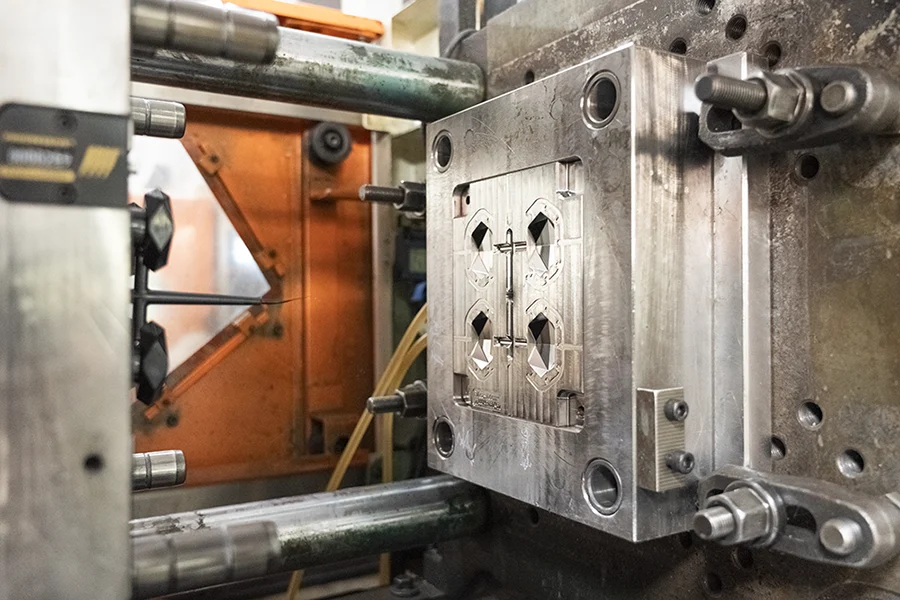
Whether an overmolded bond holds and whether the shut-off stays clean are about 80% decided during mold design. Because our tooling makers and molding engineers work together under one roof, no one points fingers. You never have to act as the go-between for different vendors—if a problem comes up, we find the root cause and fix it ourselves.
Data-Backed Precision & Bonding
We measure adhesion and precision—and prove the numbers. Our parts consistently achieve 180° peel strengths of 1.5–3.0 N/mm (and 4.5 N/mm or higher with plasma activation). We hold flash at critical shut-offs to ≤0.05 mm, with parting line clearances under 0.01 mm, so we can guarantee zero delamination in 72-hour salt spray tests.
Deep DFM Intervention
Lorem ipsum dolor sit amet, consectetur adipiscing elit. Ut elit tellus, luctus nec ullamcorper mattis, pulvinar dapibus leo.
Predictive Warpage Compensation
Sobremoldagem Vs. Moldagem de inserção Vs. Moldagem de duas cores
A sobremoldagem envolve a injeção de um material sobre um substrato existente (como plástico duro ou metal). Este processo é completado em etapas separadas para formar uma camada protetora ou funcional. Na moldagem por inserção, as inserções, tais como componentes metálicos ou electrónicos, são colocadas primeiro no molde de injeção. Em seguida, é injetado plástico para fixar e integrar as inserções. Na moldagem de dois disparos, é utilizado um molde rotativo para injetar dois materiais diferentes no mesmo ciclo.
| Dimensão | Sobremoldagem | Moldagem por inserção | Moldagem a duas cores |
|---|---|---|---|
| Etapas do processo | Injeção em duas fases: Núcleo duro → Sobremolde macio | Colocação de pré-inserção → Encapsulamento de uma só vez | Injeção de injeção dupla (molde rotativo/deslizante) |
| Combinação de materiais | Ligação macio-dura (por exemplo, PP+TPE) | Plástico + metal/inserção (por exemplo, PA66+cobre) | Plásticos de duas cores (por exemplo, ABS+PC) |
| Requisitos de equipamento | Máquina standard + molde compatível | Máquina standard + robot/colocação manual de pastilhas | Máquina de duas cores dedicada + molde rotativo (±0,02mm) |
| Interação de materiais | Ligação química (compatibilidade termodinâmica) | Bloqueio mecânico (sem ligação química) | Camadas físicas (sincronização do ponto de fusão) |
| Diferença estrutural | Encapsulamento em camadas (integração funcional) | Núcleo de inserção (reforço compósito) | Camadas sem costuras (fusão estética) |
| Custo do molde | $$ | $ | $$$ |
| Ciclo de produção | 30-60 seg. (requer arrefecimento entre camadas) | 45-90 seg. (colocação manual do inserto) | 20-40 seg. (disparo duplo automático) |
| Produtos típicos | Cabos de ferramentas, instrumentos médicos | Conectores para automóveis, eléctrodos médicos | Luzes traseiras de duas cores, teclas do teclado translúcidas |
 PT
 EN
 ES
 FR
 DE
 IT
 NL
 PL
 AR
 JA
 KO
 ZH