
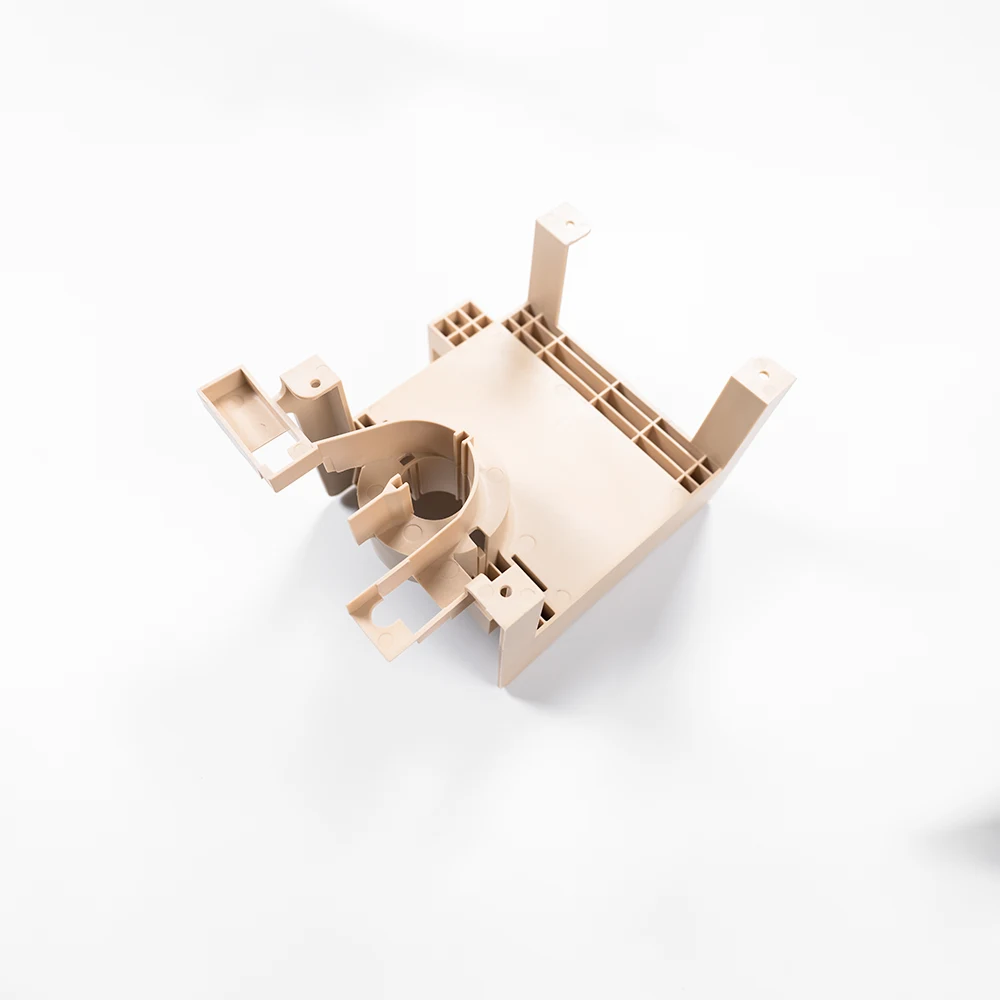

A fuse bracket, also called a fuse holder or fuse block, is a safe, secure housing for a fuse within an electrical circuit. The main consideration for fuse bracket manufacturing is to securely hold the fuse in place. This provides necessary electrical insulation to protect both personnel and equipment from electrical faults like short circuits, overheating, or overcurrent.
There are different types of fuse brackets, including panel-mounted, printed circuit board (PCB) mounted, leaded fuse bracket, rail-type fuse bracket, and automotive fuse bracket. The type of bracket is usually determined by the intended application. Key functions of a plastic fuse bracket include:
- Providing secure mounting and connection: It provides a stable base that keeps the fuse firmly linked to the electrical pathway and prevents it from coming loose due to external factors or vibrations.
- Serves as an electrical insulator for safety: Fuse parts manufacturing (mass production) is usually done using non-conductive, heat-resistant plastic that insulates live electrical components to prevent short circuits and accidental electric shocks.
- Makes maintenance and replacement easier: Technicians can easily access a blown fuse through the bracket for replacement. This minimizes downtime from circuit repair.
- Protection from environmental elements: Fuse bracket manufacturing is mostly designed to seal the fuse from moisture, dust, and corrosion. This allows them to be used in harsh conditions.
- Better organization for multiple fuses: In applications like the automobile industry, where multiple fuses are required, a fuse bracket helps to centralize the different fuses for better management of multiple circuits.
There are lots of applications that require the production of fuse bracket, including automotive, industrial machinery, household appliances, and renewable energy systems. They provide cost-effective and durable solutions to short circuits and other electrical faults.
متطلبات العميل
After touring through First Mold’s production facility and technology, a fuse bracket manufacturer was convinced they had found the right partner and sat down to discuss the details of their project. The client wanted a mass production tooling for fuse parts manufacturing. The steel tool is expected to be used for molding polybutylene terephthalate (PBT) into fuse brackets.
The client specifically wanted insert molding for the manufacturing process. In this molding technique, metal components, such as stainless steel terminals, threaded inserts, or bus bars, are placed into a mold cavity before the injection of the molten PBT. After injection, the plastic encapsulates the inserts to create a single, double part that combines conductive metal with an insulating plastic housing.
Other critical requirements mentioned by the fuse bracket manufacturer include a mass production yield rate ≥90%, standard glossy surface treatment, and a part tolerance of ±0.05mm. Meeting the dimensional accuracy was critical to seamless assembly, a constant challenge they had with their previous partner.
التحديات والحلول
First Mold’s Production Manager, Bowen Huang, assembled a team of tooling professionals to brainstorm the possible challenges with the project and come up with suitable solutions for each one of them. There were peculiar challenges associated with the client’s request. For example, the creation of a fuse bracket mold for insert molding requires more attention compared to regular molds.
Also, while PBT is a high-performance engineering thermoplastic with high strength, stiffness, and heat resistance, it is known to have high water absorption capability. This can lead to the production of defective products if the production process is not properly optimized.
Insert Displacement During Fuse Parts Manufacturing (Mass Production)
One of the biggest challenges with fuse bracket manufacturing via insert molding is the skewing or displacement of the insert by the injected molten plastic. The smallest of displacements can lead to assembly jamming or functional failures. When there is no way to correct the displacement, the entire batch will be scrapped.
Unlike other fuse parts mold makers, First Mold’s team of engineers solved the insert displacement problem at the mold design stage. The innovative design, facilitated with cutting-edge software, led to zero insert position drift in the fuse parts mass production, eliminating scrappage at the source.
Challenge with Molding PBT Material
While PBT has several desirable benefits over regular plastics, it faces different molding setbacks, including rapid crystallization, which can lead to high, non-uniform warpage and shrinkage, especially when reinforced with glass fiber.
PBT material has high water absorption and difficult‑to‑control shrinkage. Also, moisture can break down the molecular chain of PBT at high temperatures. This will make it brittle, lower its strength, and create surface defects like spots or splay. Product warping, out‑of‑tolerance dimensions, and failure to fit into the customer’s equipment are some of the challenges that can result from excessive moisture in PBT.
The team of engineers at First Mold utilized a specialized injection molding parameter library for PBT. This includes drying at 110oC to 130oC for 3 – 4 hours to lower the moisture content below 0.02%. The mold temperature for fuse bracket manufacturing was properly managed around 70oمن C إلى 90oC to control crystallization.
Both mold and product design were carefully considered to prevent thick sections that could lead to sink marks. A combination of optimization steps helped First Mold to completely eliminate shrinkage, deformation, and bubbles, with 100% stable dimensions.
Tooling Challenge for Single Cavity Mold for Insert Molding
Many mold makers are not experienced in creating single cavity molds for insert molding. Although the fuse bracket manufacturer initially suggested a multi-cavity mold, the team of First Mold engineers advised against it because of the higher chance of defects.
However, a lack of experience in single‑cavity mold debugging for fuse bracket manufacturing can lead to frequent production shutdowns, mold adjustments, and material changes occurring during mass production, causing delayed delivery and uncontrolled costs.
First Mold used single‑cavity molds for ultimate precision instead of multi‑cavity molds. The team focused exclusively on high‑end electronic control safety components, with precision far beyond multi‑cavity molds used by competitors.
Insufficient Bonding Strength Between the Plastic and Metal Insert
Incorrect molding parameters, surface contamination, and lack of mechanical interlocking are some of the factors that can lead to insufficient bonding between plastic and metal in insert molding. When inserts become loose, rotate, or fall off, it creates safety hazards. This can lead to direct customer returns.
The team of First Mold engineers created a mature mass production process for fuse parts manufacturing via insert molding that ensured 72 hours of continuous stable production, with a yield rate of 93.2%+, which is far above the industry average. This feat was achieved using a combination of processes, including:
- Proper cleaning or degreasing of the insert using a chemical bath
- Preheat the insert from 80oC إلى 120 درجة مئويةoC to reduce thermal shock.
- Sandblasting the surface of the insert to roughen it and increase interlocking
- Optimizing the injection parameters, including injection speed, holding pressure, and shrinkage control
Poor Dimensional Consistency
Another concern of the fuse bracket manufacturer was ensuring the product had the right dimensional accuracy. Poor dimensional accuracy will create a situation where parts cannot meet the requirements of automated assembly lines and are only suitable for low‑end manual assembly.
First Mold implemented full-process dimensional control to achieve Process Compatibility Index (CPK) ≥ 1.325. The resulting product was perfectly compatible with automated assembly lines for high‑end customers.
ما الذي اكتسبه العميل من حلول شركة فيرست مولدز
We did not just ship a single-cavity mold to the client. First Mold delivered a complete tool with documentation for process optimization that ensures consistently high-quality fuse bracket production. Leveraging our facility’s hardware and software capabilities, as well as a team of engineers with advanced knowledge in mold tooling, First Mold delivered the client’s fuse parts manufacturing mass production mold in under three weeks.
In line with the client’s request for a standard glossy surface finish, we started with initial grinding using coarser oilstones before progressing to polishing the mold surface with finer grits of abrasive paper. Achieving the standard gloss surface finish was important to the fuse parts manufacturer because it saved them post-production costs. In other words, the fuse brackets were ready to ship after assembly.
By working with our team of experienced mold makers, the client received free guidance on redesigning the single-cavity mold for insert molding to prevent displacement during the injection of the molten plastic. Solving this most-reported insert molding issue ensures the client achieves a better yield rate and consistency, far more than their previous contacts proposed.
Just like every other client that First Mold has worked with, the fuse bracket manufacturer enjoyed after-sales support and expedited part replacement, which can save more costs in the long run through shorter operational downtimes.
الأسئلة الشائعة
Insert misalignment and shifting under high-pressure injection of molten plastic, warping or stress cracking due to the difference in coefficients of thermal expansion between the plastic and metals, and poor bonding between the insert and plastic are the major challenges that the mold maker must overcome.
Selecting compatible plastic polymer and metal material: Ensure they have similar thermal expansion coefficients and use materials with excellent adhesive properties.
Proper preparation of insert: Clean and degrease the inserts with alcohol or ultrasonic cleaners and roughen the insert surface to create a micro-porous structure that improves mechanical interlocking.

 AR
AR  EN
EN  ES
ES  FR
FR  DE
DE  IT
IT  PT
PT  NL
NL  PL
PL  JA
JA  KO
KO  ZH
ZH