
Hair dryer manufacturers are innovating with new designs and features that offer better value to customers, including the addition of AI-powered thermal sensors, ionic, high-speed, brushless motors, and lightweight designs.
Manufacturers must also find a balance between airflow volume and speed, while maintaining low noise decibels. There is also an increasing pressure for manufacturers to create eco-friendly models that comply with more stringent environmental regulations. These innovations require design modifications and the creation of new molds.
Any manufacturer of hair dryers that wants to stay in the competitive market must find a way to evolve with user needs, or they will be phased out of the market. One of the challenges of innovating with hair dryer designs and upgrades is the high cost and lengthy tooling process.
متطلبات العميل
A manufacturer approached First Mold for a foldable, portable hair dryer that they believe will revolutionize personal care. Their new design has an internal compartment for dispensing conditioner or fragrance while drying the hair, a feature that is not widely available.
The client wanted to create 100 units of the product for testing with priority on precision, durability, and aesthetics. They were working on a tight budget and wanted the tooling completed as soon as possible since they wanted to test the product within a small market before committing to large-scale production.
التحديات
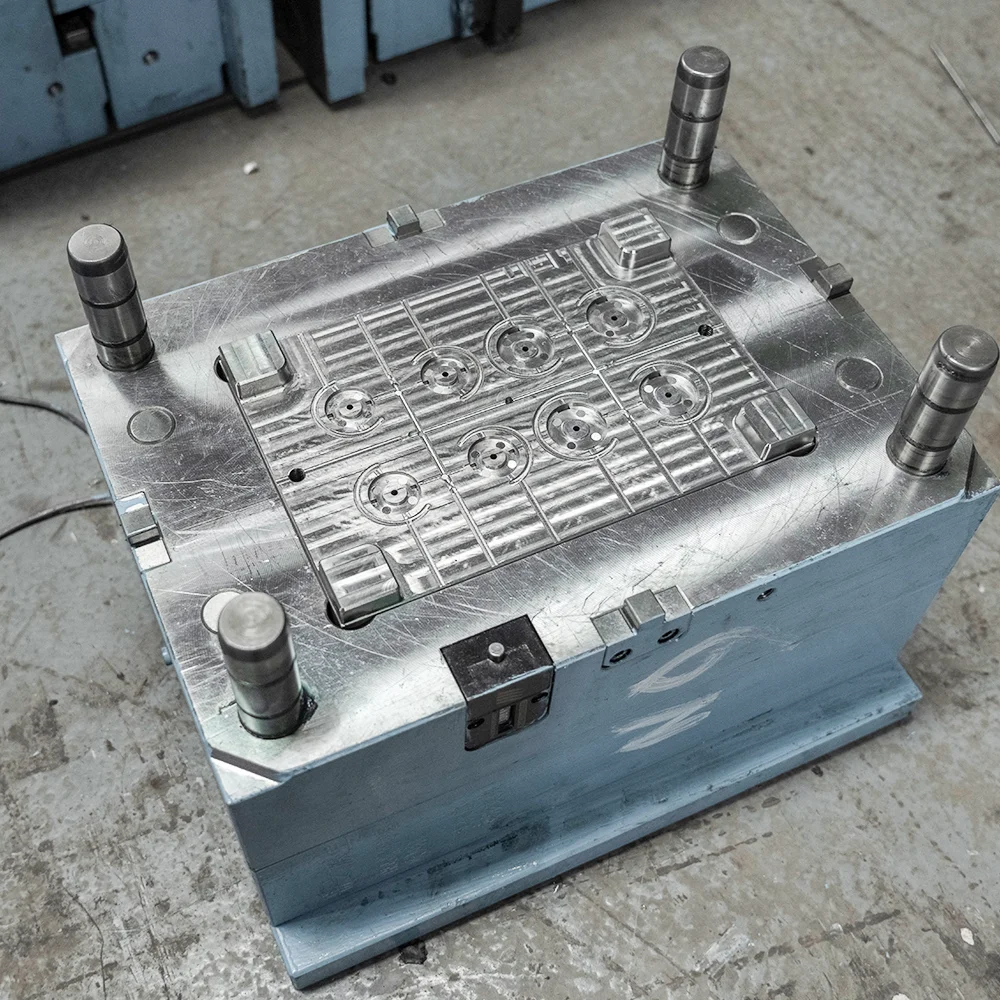
The first challenge that First Mold engineers had to overcome was the fast-turnaround time. Specifically, the hair dryer manufacturer wanted to work with a hair dryer mold maker that could deliver 8 sets of قوالب النماذج الأولية within 30 days.
Liquid Compartment Adds Complexity to Design
Upon further investigation of the product blueprint, First Mold engineers had a better understanding of the complex nature of the hair dryer design. For example, it featured a container compartment that could hold either the fragrance or shampoo that could be simultaneously sprayed on the hair during the drying process. The liquid container must be leak-proof to avoid the spilling of liquid during use.
High Precision Requirement
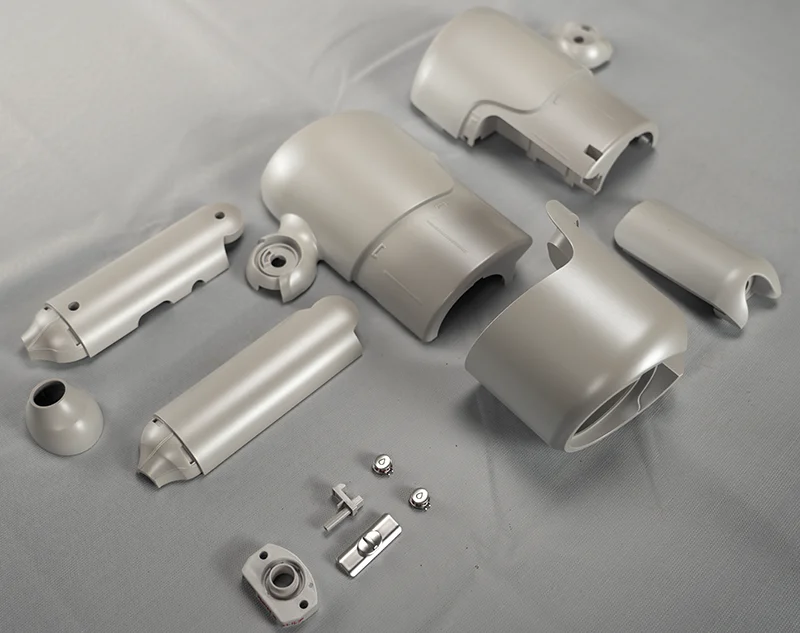
One of the requirements from the hair dryer manufacturer to avoid leaks was to ensure that the parts have uniform thick walls. The main body part features four-panel construction, which will be snapped together during assembly. The more the number of parts that will be snapped together during assembly, the more important it is that the parts have the right precision for easy assembly.
If the precision is too tight, more force will be needed during assembly, which may cause damage to some of the parts. If the precision is too loose, the snap-fit may not function as it should or produce a rattling noise. The snap-fit beam may experience repeated unnecessary flexing that will lead to fatigue failure (the hook breaking off).
اختيار المواد
The major challenge with material selection is that the chosen plastic must have properties identical to or close to the mass production material. However, the material must be safe enough for use on قوالب الألمنيوم without wearing them down. For example, plastics with fiberglass reinforcements wear aluminum molds faster.
Also, resins adhere well to aluminum. Therefore, it is important to make careful preparations when fiberglass-reinforced plastics are used for hair dryer manufacturing with aluminum molds. Some of the critical preparations include:
- Thorough mold surface cleaning: Aluminum oxidizes rapidly. Therefore, it is important to clean the surface of the mold with solvents like acetone to remove contaminants and oils.
- Application of appropriate release agent: To prevent fiberglass materials from bonding permanently to the mold surface, an appropriate, high-quality mold release agent must be applied to the surface. Polyvinyl Alcohol (PVA) is highly recommended.
Tight Timeline
Beating the tight deadline for the hair dryer mold manufacturing required proper planning and execution. The team of engineers at First Mold had to deploy multiple manufacturing technologies to ensure the 8 sets of molds were ready before the due date.
الحل
Upon careful evaluation of the client’s project blueprint and goals, First Mold engineers suggested that rapid tooling was the best bet for the manufacturers. The team arrived at this suggestion based on the number of parts the hair dryer manufacturer wanted to produce (100), the tight timeline, and the limited budget.
Rapid tooling or soft tooling is used to quickly create affordable molds and prototypes for manufacturing. With this technique, working molds can be ready in days, instead of the weeks required for mass production molds. Some of the benefits offered by rapid tooling include:
- Bridge the gap between prototyping and mass production: Manufacturers can easily transition from prototyping to mass production because it allows the use of production-grade materials for producing the prototype parts. This allows the manufacturer to test the real-world performance of the part, quality, and shrinkage.
- Lower upfront costs: Rapid tooling is usually done with aluminum rather than steel, which is significantly cheaper and easier to work with. The price can further be reduced using 3D printing rather than traditional methods.
- Makes design iterations easier: During hair dryer manufacturing, companies can quickly make modifications and adjust designs, minimizing the risk of costly errors in the final, large-scale production.
Soft tooling is great for creating small prototype batches. It is ideal when the number of components required is less than 10,000 units. Given the small number of components that the client wanted to produce, opting for rapid tooling was a no-brainer.
Beating The Tight Timeline
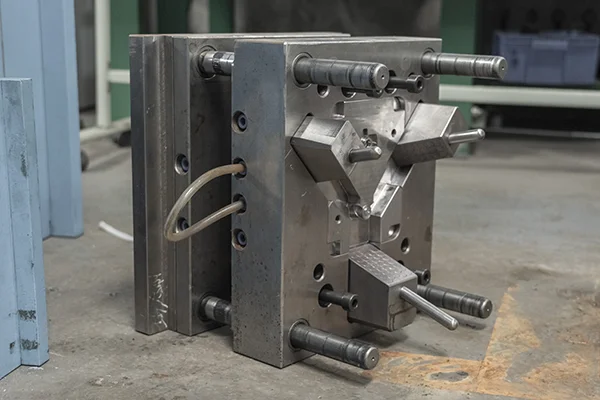
Although the client wanted the finished set of hair dryer molds delivered within 30 days, First Mold engineers completed and delivered a total of 8 sets of molds within 25 calendar days.
To achieve this goal, the team relied heavily on CAD software, التصنيع الآلي باستخدام الحاسب الآلي خماسي المحاور, and their wealth of experience in mold design. The use of CAD software allowed the team to create highly detailed and accurate designs with reduced risk of errors.
The use of CAD software allowed for quick iterations to the mold design. This made it possible for First Mold engineers to collaborate in real-time and unify their ideas before the production of the physical prototype. The ease of collaboration was instrumental in meeting the client’s deadline.
To further streamline any bottleneck that may delay the project, First Mold’s Project Management Team implemented a leaner process and controlled the collaboration between the design and production teams.
Material Selection and Testing
Guided by the material chart, First Mold suggested the use of Polycarbonate + Acrylonitrile Butadiene Styrene (PC+ABS) modified plastic blend with the aluminum mold, because it possessed properties that are closest to the mass-production plastics. Some of the properties of the PC+ABS blend that make it the perfect choice for hair dryer manufacturing include:
- Offer superior toughness and high impact resistance, even at low temperatures. This makes it more durable compared to ABS alone.
- It can withstand higher operating temperatures, making it suitable for functional, heat-exposed components, like the heating elements in hair dryers.
- PC+ABS has high flowability, which makes it easier to process via injection molding. This property also makes it suitable for making complex, thin-walled parts with faster cycle times.
- The modified material blend has high dimensional stability, meaning it retains its shape and size over time, even under environmental stress.
- The use of PC+ABS blend produces a high-quality, gloss surface finish that is easily colored or painted.
- The addition of ABS improves ductility compared to pure polycarbonate. It also lowers the processing costs.
First Mold engineers conducted multiple tests to ensure the material was compatible with the project. The tests were also necessary to validate that the hair dryer parts can be manufactured to the manufacturer’s specifications without faults.
What the Hair Dryer Manufacturer Gained With First Mold’s Solution
By working with First Mold, the hair dryer manufacturer was able to get the exact number of molds they wanted (8) delivered five days before the due date, and within their budget. Additionally, all the molds were delivered with high precision in line with the client’s quality, functionality, and aesthetics requirements.
The on-time delivery gave the manufacturer more time to test the mold and optimize their production parameters ahead of the prototype production. Missing the due date by a few hours would have cost the hair dryer maker their funding partner. They were particularly grateful because several other hair dryer mold makers had turned down the project because of the tight deadline.
Other professional qualities the client enjoyed while working with First Mold engineers include open and transparent communication. Any suggestion or modification the team made to the project was properly communicated, including the reason for the modification. That ensured both teams were always in sync throughout the project.
At the heart of First Mold’s project team was design for manufacturability. Every design was well-thought-out to ensure it brought value to the hair dryer manufacturer. Designs were modified, and where necessary, ribs replaced thick walls. In a nutshell, the First Mold team did not just accept the project; they made it better.
Tips: You may also be interested in the “injection molding of another hair dryer" و "hair dryer design tips“.
الأسئلة الشائعة
Changing consumer demand, volatile material prices, and stringent safety requirements are some of the challenges that manufacturers must overcome to stay competitive in the market.
Some rapid tooling methods cannot be used with materials or injection molding at high temperatures. Also, resins can bond permanently to aluminum surfaces. Therefore, the surface requires treatment.

 AR
AR  EN
EN  ES
ES  FR
FR  DE
DE  IT
IT  PT
PT  NL
NL  PL
PL  JA
JA  KO
KO  ZH
ZH