
Casa / Servizio di stampaggio a iniezione a due riprese
Servizi di stampaggio a iniezione a due riprese
- < 0,5% di tasso di difettosità
- ±0,05 mm (±0,002") Precisione rotativa
- Presse JSW da 130-280T
Lo stampaggio a iniezione a due fasi è la soluzione giusta per i vostri componenti?
Lo stampaggio a due componenti prevede l'iniezione di due materiali — o due colori — in un unico stampo in un unico ciclo. Il risultato è un unico pezzo con un legame permanente, che non richiede alcun assemblaggio secondario.
Two-shot tooling costs more up front, but it pays back through lower assembly, fewer defects, e faster production.
Multicolore
Manici morbidi e componenti bicolori, stampati in un unico ciclo: senza giunture né colla.
Impermeabile e a tenuta d'aria
Guarnizioni in gomma stampate direttamente sulla plastica per garantire la protezione IP67/IP68 — senza O-ring separati.
Obbligazioni a scadenza indefinita
I materiali si legano a caldo, quindi il giunto non si staccherà né si romperà come nel caso della colla o degli incastri a scatto.
Produzione su larga scala
Per oltre 10.000 unità, lo stampaggio automatizzato elimina l'assemblaggio manuale e riduce il costo unitario.
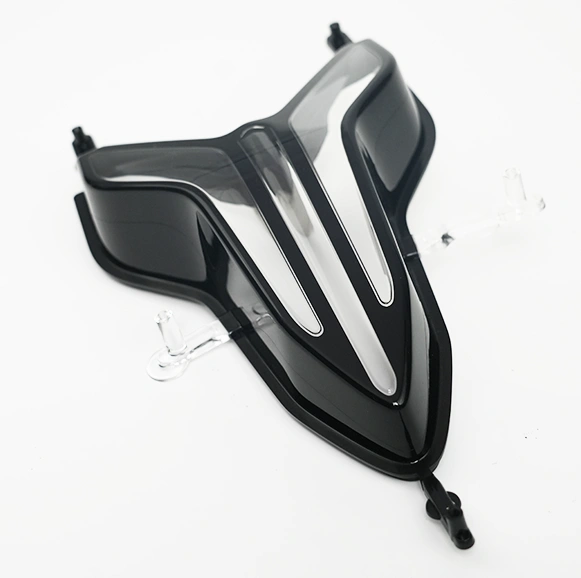

Process Guide: 2-shot molding is a single-cycle process for high volumes. If you have a limited tooling budget, see “Sovrastampaggio”. If you are molding plastic over metal, visit “Stampaggio a inserti".
Attrezzature e specifiche per lo stampaggio a due iniezioni presso First Mold
Two-shot molding requires multi-barrel presses and rotary molds. We run JSW two-shot presses (130T–280T) in automated production. Shut-offs and mold details are machined in-house on Makino EDMs and Haas 5-axis CNCs. The table below lists our two-shot capabilities and key:
| Specifiche tecniche | Capacità | Specifiche tecniche | Capacità |
|---|---|---|---|
| Primary Machinery | JSW All-Electric 2-Shot Presses (130T – 280T) | Rotary Platen Precision | ±0,05 mm (±0,002″) |
| Multi-Material Tech | Rotary Platen, Index Plate, Core-Back (Core Pulling) | Standard Part Tolerance | ±0,05 mm (±0,002″) |
| Min. Sealing Gap | ≤ 0,02 mm | Angolo di lancio consigliato | 1.5° – 3.0° |
| Typical Combinations | Rigid+Soft, Rigid+Rigid, Opaque+Clear |


Perché scegliere First Mold come partner?
Macchine avanzate a due colpi
Officina di stampaggio a iniezione a due colpi con più macchine a iniezione a due colpi, ad alta efficienza e basso costo, che offre la possibilità di una rapida produzione di massa.
Capacità di sviluppo stampi a due riprese
Il nostro laboratorio di fabbricazione di stampi è in grado di produrre stampi bicolore ad alta precisione.
Maggiore attrattiva del prodotto | Realizzazione di progetti complessi | Migliore aderenza su superfici antiscivolo | Funzionalità aggiuntive | Maggiore resistenza e durata | Ampia gamma di applicazioni
2-Shot Material Compatibility & Selection
With over a decade of practical experience, First Mold has mastered the complex material fusion required for flawless multi-material parts. Because different plastics have distinct physical and chemical properties, maximizing your product’s aesthetics and strength requires careful material pairing. To achieve a permanent bond, we strictly evaluate the chemical compatibility, melting temperatures, and shrinkage rates of your chosen resins.

PC + PMMA or PC + ABS offer the industry gold standard for optical clarity and impact resistance.

Two Color Injection Molding Design Guidelines
Designing a successful 2-shot part requires a clear division of labor between the two materials. To ensure a satisfactory bond, prevent warpage, and avoid costly tooling redesigns, we recommend you follow these core structural principles in your 3D CAD models
- Use a rigid plastic such as ABS or PC as the internal frame so the part can carry loads and hold its shape.
- Limit the soft elastomer such as TPU or TPE to functional areas such as grips, seals, or visual accents.
- Make the rigid base thicker and stiffer than the soft layer so it can withstand the heat and pressure of the second molding step.
- If the two materials do not bond well chemically, add physical features such as undercuts, grooves, or through-holes so the soft rubber is held in place mechanically.
- Make sure the contact area between the two materials is at least 1.5 mm wide, because narrow contact areas peel apart easily.
- For flat surfaces that are hard to bond, add a knurled texture or a diamond grid pattern to the rigid plastic part to greatly improve grip.
- Keep the soft overmold layer even, ideally 0.8 mm to 2.0 mm thick, because too thin can cause incomplete fill and too thick can cause shrinkage and cracking.
- Avoid sharp corners where the two materials meet and use a radius of at least R0.5 mm to reduce stress buildup.
- Do not let the shrinking soft rubber completely wrap a closed hollow space, because the contraction can crush or warp the rigid shell.
- Design all assembly features—such as snap-fits, screw bosses, and alignment pins—on the rigid plastic, never on the soft layer.
- Because soft materials like TPU are sticky, use a larger draft angle of at least 5° on the soft sections so the part releases smoothly from the mold.
Two Shot Molding FAQ

What is the typical lead time for a 2-shot injection mold?
Due to the higher tooling costs and complexity, customers rarely opt for rapid tooling (prototype molds) in 2-shot molding. If rapid tooling is strictly required, the absolute minimum lead time is 15 days.
For mass production molds, the complex rotary mechanisms require more time than standard molds—T1 samples take at least 4 weeks. For ultra-precise projects, such as automotive 2-shot molds, lead times can extend up to 10 weeks.
What is the Minimum Order Quantity (MOQ) for 2-shot molding?
First Mold has no strict MOQ limits. In fact, we have successfully delivered specialized 2-shot projects for runs under 10,000 units. However, looking at it strictly from a cost-saving perspective for your business, we typically recommend this process for volumes of 30,000 units or more.
Because 2-shot tooling requires a higher initial investment, reaching this volume ensures that your savings on manual assembly will quickly pay for the mold, maximizing your true ROI.
Can I supply my own rigid substrates and ship them to First Mold for overmolding only?
Usually no — not as a direct upgrade.
A two-shot mold is not just a single-color mold with one more cavity. It is a different tool designed for a different machine. Here’s why a simple “upgrade” is rarely practical:
- Your old mold was not designed for two-shot movement.
- The moving half normally has to be rebuilt.
- The “upgrade” can cost almost as much as a new mold — with more risk.
Can we use cheap recycled plastic for the hidden inner part and premium plastic for the outside?
Sometimes, but not automatically. “Hidden” does not mean “no risk.”
A hidden inner part can still affect:
- Recycled plastic may vary in impact strength, stiffness, and consistency.
- In 2-shot or overmolding, the inner material can affect adhesion and delamination risk.
- Automotive, medical, electrical, food-contact, and many brand customers have strict rules on recycled content and traceability.
- Cheap recycled material with inconsistent batches can cause short shots, warpage, flash, and higher scrap.
You can send us the inner part’s function, the recycled material type and source, the planned recycled content percentage, and any certification requirements. We can then tell you quickly whether it is workable, what testing is needed, and whether the real cost saving is worth it.
 IT
 EN
 ES
 FR
 DE
 PT
 NL
 PL
 AR
 JA
 KO
 ZH